• TalkBass has been independent since 1998. Add your voice.
    Create a free account to reply to discussions, view embedded media, and browse with fewer display ads.
    Join freeLog in
    Want zero display ads or expanded classifieds tools? Compare plans.

300w Cab & a 400w Cab stacked?

Hey all!
I've been searching the threads for a couple of days and haven't found this question yet. So forgive me if it is already posted somewhere. There are lots of discussions about stacking different sized cabs (e.g., a 115 on top of a 410), and questions abound regarding mismatched impedance, ported and sealed together, and so on.

But, would a stack consisting of a 300w 410 cabinet (8ohms) on top of a 400w 410 cabinet (8ohms) be ill-advised? With a 500w (at 4 ohm) amp, they would each be getting 250 watts, yes? The cabinets in question would be a 300w, 8ohm Hartke 410TP, which I already have, on top of a 400w, 8ohm Hartke 410XL, which I've been considering. I realize that the TP has one port and the XL has two, and I'm starting to wonder if that fact alone may prove incompatible. But 300w and 400w?

Any advice is definitely appreciated!
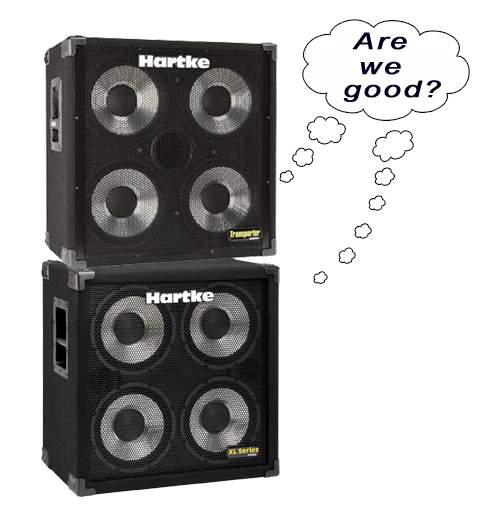
Are we good.jpg
 
Since both cabs are 8 ohms the power will be split evenly between them. The max will be 600W. 600/2=300W which is the power rating of your weakest cab. Keep in mind that cabs often reach their mechanical limits below 100hz with less than their RMS power rating. In other words a cab with a 300WR MS power rating may not handle 300W for all frequencies below 100hz. In fact it's unlikely that a cab will handle its RMS power rating much below the Fb, which is the tuning frequency of the port.

Whether these cabs will pair well together is another factor. Ideally they should have the same sensitivity rating. Since they are not the same design they will also have different phase and group delay characteristics. These come into play around the tuning frequency of the ports. If the difference is significant enough, the cabs will fight each other at certain frequencies instead of working together.

So I suggest you use a bit of caution if you will be pushing anything close to 600W. I suggest putting the 300W cab on top. That way if you push it to over excursion you have a better change of hearing the drivers fart out so you can turn down before you destroy them.

A high pass filter (HPF) can be very helpful as it limits the amount of energy sent to the cab below Fb.

Also the best way to find out of the cabs pair well is to hook them up and play them, IMHO.

Good luck!
 
  • Like
Reactions: BassmanPaul
410 x 2 = 810

You'll find you need less power with 2 cabinets or a 810.
I personally hate the 4x10 form factor and find it easier to not carry cabs. And just roll a slant back 810.

But either way increasing or double the speaker area tends to play out nicely.

Far as the 2 cabs " mixing" well
It's subjective. One guy would say " it's amazing" another guy would say. It sounded funny.
Another guy like me would say. Get a 810 with the same speakers used.

Either way 8 ten inch speakers works well. And actually doesn't require much more than 200 to 330 watts to make sound guys cry like a baby. Meaning loud very easy. And to reach band levels at rehearsal. Very nice and a completely different feel with 8 instead of 4.
Even at lower levels
 
  • Like
Reactions: Wasnex
Thank you, @Wasnex and @BogeyBass , for the insights! I think I am going to go ahead and look for a second matching cab, another Hartke 410TP. If I could afford a newer Hartke 810, or else two Hartke HyDrive 410s I surely would, but they are simply out of the question financially. Thanks again, I appreciate it!
 
  • Like
Reactions: Wasnex
Thank you, @Wasnex and @BogeyBass , for the insights! I think I am going to go ahead and look for a second matching cab, another Hartke 410TP. If I could afford a newer Hartke 810, or else two Hartke HyDrive 410s I surely would, but they are simply out of the question financially. Thanks again, I appreciate it!

If you like your 410TP getting a second mathing cab is a good call. This assures they will work well together. Also I think your 500W amp is a good match, but still use a bit of caution if you are pushing the amp to it's limit. The knobs are not a good indicator of how much power you are pushing. Some amps reach full power with the knobs around 11:00. Of course this also depends on how hot of a signal you send to the amp. If your bass has a hot signal the amp will reach full power sooner. If the signal is weaker you will need to turn the amp up more for full power.

Good luck and Injoy!
 
If you like your 410TP getting a second mathing cab is a good call. This assures they will work well together. Also I think your 500W amp is a good match, but still use a bit of caution if you are pushing the amp to it's limit. The knobs are not a good indicator of how much power you are pushing. Some amps reach full power with the knobs around 11:00. Of course this also depends on how hot of a signal you send to the amp. If your bass has a hot signal the amp will reach full power sooner. If the signal is weaker you will need to turn the amp up more for full power.

Good luck and Injoy!

Thanks! Yes, I think that is the answer. I use a Behringer BDI21 driver pedal. Not in the effects loop, but between the bass and the head. So I'm guessing that is a fairly hot signal to the amp? Should I be putting it in the effects loop instead, do you think?
 
Thanks! Yes, I think that is the answer. I use a Behringer BDI21 driver pedal. Not in the effects loop, but between the bass and the head. So I'm guessing that is a fairly hot signal to the amp? Should I be putting it in the effects loop instead, do you think?

Normally pedals are designed to receive and send an instrument level signals. Effects Loops normally run at line level and are intended for rack gear like EQs or compressors. Running an instrument level pedal in an Effects Loop may result in distortion or a bad Signal to Noise ration.

As long as the BDI21 is not overdriving the front end of the preamp, I would leave it where it is. Also if your amp has an input pad, you can pad the signal down if needed, or turn down the Level control on the BDI21.
 
  • Like
Reactions: Haunted House
Normally pedals are designed to receive and send an instrument level signals. Effects Loops normally run at line level and are intended for rack gear like EQs or compressors. Running an instrument level pedal in an Effects Loop may result in distortion or a bad Signal to Noise ration.

Ah! I never knew that! Makes sense now.


As long as the BDI21 is not overdriving the front end of the preamp, I would leave it where it is. Also if your amp has an input pad, you can pad the signal down if needed, or turn down the Level control on the BDI21.

Yes, it has a -15dB pad. I'm going to try engaging that. Great info for me, thanks again!
 
  • Like
Reactions: Wasnex
All good.

Except - you should know the sensitivity of each cab.. since the drivers have less power handling in one, that means they are electrically and/or mechanically different from the higher power handling one. The sensitivity ( db value measured with 1 watt power @ 1 meter, that sorta test) of each cab should be the same, otherwise you might actually be not getting as much volume increase as you'd expect.

If each cab is for example 95db sensitivity (measured the same as each other), then yes, it'll be much louder with both cabs together. Assuming one is less sensitive, then together it'll possibly be louder than the quieter of the 2 cabinets run on it's own... but quite possibly NOT any louder than the louder of the two cabinets on it's own.

However, the advantage of running 4 ohms, with an amp that presumably delivers more power to 4 ohms than 8 ohms, does give you at least a little more output power with 2 cabs. But the biggest difference in volume is is from speaker sensitivity increases, or increasing the number of speakers (all with similar eq and similar sensitivity). Power must be increased a TON before it makes much of an audible difference.

And sensitivity is the same thing as efficiency, from the point of view of my post.... so whatever term they call it is fine - efficiency, sensitivity, either way it'll probably be 90 something, like 92db, 95db, 98db... somewhere like that, and I expect each cab to be different. a db different, not a huge deal, 3db, could be pretty significant. 4db or 5db difference in cab efficiency? It's likely you'd be better off only using the louder of the two cabs. There's math that can answer for sure if it's worth running both cabs or just one, based on power output at 4 versus 8 ohms from your amp related to efficiency of each cab in db.
 
Last edited:
  • Like
Reactions: Haunted House