• TalkBass has been independent since 1998. Add your voice.
    Create a free account to reply to discussions, view embedded media, and browse with fewer display ads.
    Join freeLog in
    Want zero display ads or expanded classifieds tools? Compare plans.

34" vs 35" scale. Can anyone really tell the difference?

In all my years of selling basses, this happens most consistently:

I post a 35" scale bass. I get a comment saying, "If this bass was 34-inch scale, I'd be all over it." A little while later, I sell a 34" scale bass and get the comment, " Man! If this was 35-inch scale, we'd be talking."

I own both. I play both... in 4-string and 5-string. Scale-length has never crossed my mind when switching from a 34" to a 35". I've never noticed any need to adjust. For me, scale length isn't even in my top-10 of things I look for in a bass.

Can anyone REALLY tell the difference between 34" scale and 35" scale? If so, what's the deal? Does it affect your playing? Is it all about how the low-B sounds?

I don't get it. Enlighten me. :meh:

(don't get me started on multi-scale... lol)

I once owned a Lakland 55-02 for nearly a year before I found out it was a 35" scale. :shrug:
It made no difference to me.
 
  • Like
Reactions: Scarysharkface
Can anyone REALLY tell the difference between 34" scale and 35" scale? If so, what's the deal? Does it affect your playing? Is it all about how the low-B sounds?

I don't get it. Enlighten me. :meh:

(don't get me started on multi-scale... lol)
Yes it makes a difference...
 
This is only an issue if the particular bass has a longer distance from where it hangs on your shoulder to the nut, forcing your arm to reach further. A well-designed 35" scale bass with the nut at the same position as a typical "Fender" will feel almost indistinguishable from a 34" with the nut in the exact same place. That's a design issue, not something inherent to the longer scale. There are 34" basses with the nut pushed out further from the body, resulting in a stretched out arm and a longer reach. They would be just as uncomfortable as any 35" with the nut at the same distance from the body.

^^ This has been my experience also ^^ But it's still noticeable.

To the OP, Yes, genuine and significant difference. I suspect those that cannot tell any difference at all are likley less affected by other specs while they play as well. My own body is less adaptable perhaps, scale length and string spacing are both very significant IMO.
 
  • Like
Reactions: lowfreqgeek
I've owned a couple of 35" scale basses and sold them. For my hands I notice it in first position. Being a fairly active player it is uncomfortable for me to play several songs in a row there. Had a beautiful Cirrus that ultimately had to go. I no longer consider any 35" scale basses.
 
  • Like
Reactions: EagleMoon
Fanned frets for folks fancying fingers funking freely fearing feeling fatigue...
I just said this 10 times in a row and now a genie is the room and won't leave.

As far as B strings go, I thought longer always equaled better until I heard a couple of 33” basses with excellent Bs, so there goes that theory for me!

In theory that is true and those with a particular thought process will cling to and insist (even scorch you :D) that the physics are the proof, not the feel or tone. But in real-life, real-world experience, it is an old bass players tale. All things being equal (string tension, gauge, action, setup etc) the best B's I own and play are well designed 34s. It's a reality shared by many.
 
In all my years of selling basses, this happens most consistently:

I post a 35" scale bass. I get a comment saying, "If this bass was 34-inch scale, I'd be all over it." A little while later, I sell a 34" scale bass and get the comment, " Man! If this was 35-inch scale, we'd be talking."

I own both. I play both... in 4-string and 5-string. Scale-length has never crossed my mind when switching from a 34" to a 35". I've never noticed any need to adjust. For me, scale length isn't even in my top-10 of things I look for in a bass.

Can anyone REALLY tell the difference between 34" scale and 35" scale? If so, what's the deal? Does it affect your playing? Is it all about how the low-B sounds?

I don't get it. Enlighten me. :meh:

(don't get me started on multi-scale... lol)
It's longer
 
I play DB and EUB (41.5”).

My BG’s are 35” and 34”. I definitely feel the difference between them.
The 35” is a boutique bass, the 34” is a Squier P5. The Squier is a great bass, but I wish it were 35”.
I really love the P style and tone.
A fancy P5, 35” I’d a maybe for me, but I don’t gig much these days, so it’s hard to justify.
 
In all my years of selling basses, this happens most consistently:

I post a 35" scale bass. I get a comment saying, "If this bass was 34-inch scale, I'd be all over it." A little while later, I sell a 34" scale bass and get the comment, " Man! If this was 35-inch scale, we'd be talking."

I own both. I play both... in 4-string and 5-string. Scale-length has never crossed my mind when switching from a 34" to a 35". I've never noticed any need to adjust. For me, scale length isn't even in my top-10 of things I look for in a bass.

Can anyone REALLY tell the difference between 34" scale and 35" scale? If so, what's the deal? Does it affect your playing? Is it all about how the low-B sounds?

I don't get it. Enlighten me. :meh:

(don't get me started on multi-scale... lol)

I've owned a number of 34" and 35", but currently only one 35". I honestly don't feel a whole lot of difference between them, but maybe it's bc I switch back and forth so often. I also have fairly monstrous hands and fingers, so there's that too. :)

I also find that when I fool around with a medium or short scale bass I don't have much trouble adapting either.
 
I feel the difference much more since I’ve gotten older. I’ve had several 35” scale basses and sold them all due to the scale length. To me it’s most noticeable on the lower frets.
It's just enough difference to mess with me playing chords in the lower register. Admittedly I've never owned a 35" scale bass, just demoed them in a store. TBH I would probably adapt to it better than I think I would but the time I have spent playing them has caused me to actively avoid buying one.
 
  • Like
Reactions: EagleMoon

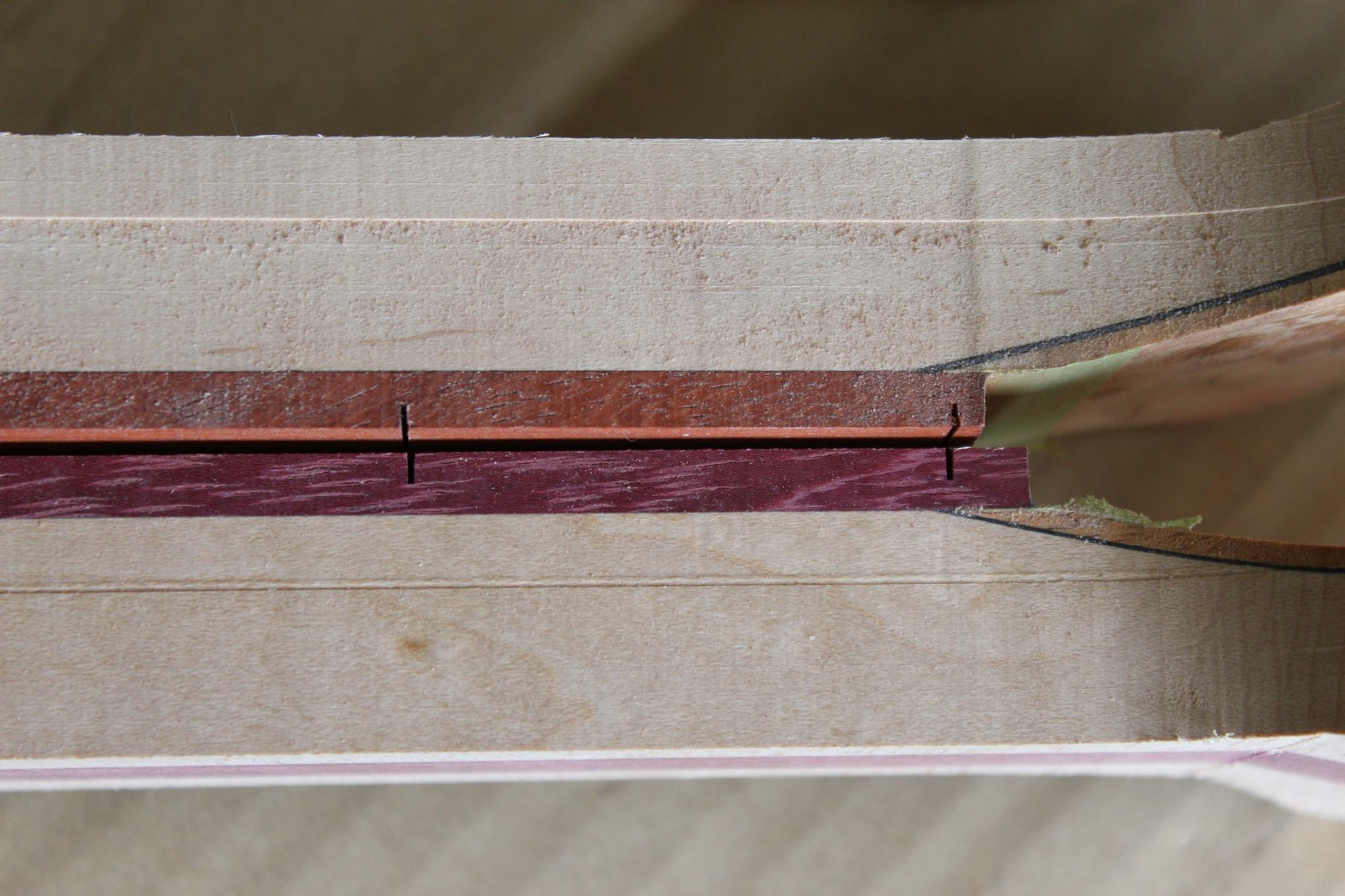
I've posted this before, but seems like a good place to post it again. This is a 34" Roscoe neck side by side with a 35" Roscoe neck. This is the actual difference at the 1st fret. I won't put any judgement either way, just the facts.
 
In all my years of selling basses, this happens most consistently:

I post a 35" scale bass. I get a comment saying, "If this bass was 34-inch scale, I'd be all over it." A little while later, I sell a 34" scale bass and get the comment, " Man! If this was 35-inch scale, we'd be talking."

I own both. I play both... in 4-string and 5-string. Scale-length has never crossed my mind when switching from a 34" to a 35". I've never noticed any need to adjust. For me, scale length isn't even in my top-10 of things I look for in a bass.

Can anyone REALLY tell the difference between 34" scale and 35" scale? If so, what's the deal? Does it affect your playing? Is it all about how the low-B sounds?

I don't get it. Enlighten me. :meh:

(don't get me started on multi-scale... lol)
I can tell the difference. It's slight, but it's more of a stretch for the hand at the end of the neck.

John
 
Well, it's one longer, isn't it? It's not 34. You see, most blokes, you know, will be playing at 34. You're on 34 here, all the way down, all the way down, all the way down, you're on 34 on your bass. Where can you go from there? Where? Nowhere. Exactly. What we do is, if we need that extra push over the cliff, you know what we do? 35. Exactly. One longer.
Thank you Nigel.
 
I play only 5ers and much prefer 34" scale , not because of reach, but because of less finger stretch below the 5th fret. My brother in law is a local, highly regarded luthier who prefers building 5ers in 35" scale. When I asked him why, he busted out a bunch of 34 and 35" 5ers and he explained that the best way to hear the difference is to play double stops down low....that makes it easy to hear the improved clarity 1" can provide. That said, I prefer greater comfort over the small incremental improvement in clarity. YMMV. I can switch to 35", but why bother? There are so many great bass options at 34" that it's easy for me to keep my ergonomics consistent across all my basses (34" scale/19mm spacing), so I do. I get that many have zero issues toggling back & forth between upright, 35", 30", etc. I'm not a member of that club :-)