• TalkBass has been independent since 1998. Add your voice.
    Create a free account to reply to discussions, view embedded media, and browse with fewer display ads.
    Join freeLog in
    Want zero display ads or expanded classifieds tools? Compare plans.

3D printer bass

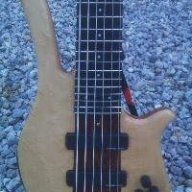
Played the craziest bass tonight. It was developed at Rochester Institute of Technology on a 3D printer. They are unveiling it tomorrow night at an event, and I have to play it for the first two tunes. I have to be honest, it could use a few tweaks, but it actually sounds pretty good. I’m not sure what the material is, but it is hollow like a whiffle ball. The neck dive definitely needs to be addressed since the body is crazy light.
 

Attachments

  • A1C455EB-1238-48EC-A3AB-CD65B6626B34.jpeg
    A1C455EB-1238-48EC-A3AB-CD65B6626B34.jpeg
    800.6 KB · Views: 114
Played the craziest bass tonight. It was developed at Rochester Institute of Technology on a 3D printer. They are unveiling it tomorrow night at an event, and I have to play it for the first two tunes. I have to be honest, it could use a few tweaks, but it actually sounds pretty good. I’m not sure what the material is, but it is hollow like a whiffle ball. The neck dive definitely needs to be addressed since the body is crazy light.
Interesting. Was the neck printed, or just the body?
 
Huh. It only just dawned on me that 3D printing is potentially the least useless application of graphene.

I too am curious about what exactly they used as the print material, although I'm sure RIT might want to hold some of it back.
 
Played the craziest bass tonight. It was developed at Rochester Institute of Technology on a 3D printer. They are unveiling it tomorrow night at an event, and I have to play it for the first two tunes. I have to be honest, it could use a few tweaks, but it actually sounds pretty good. I’m not sure what the material is, but it is hollow like a whiffle ball. The neck dive definitely needs to be addressed since the body is crazy light.

This is the coolest thing I've seen in a long time! I'm hoping it brings possibilities for the future! I hope they get the neck and bridge issues worked out-- but not a bad effort for college kids! Best of luck to them!

That's almost as cool as this.


Both are very cool. I like this idea too. Let's hope we see more of these in the future!
 
I like it! Been following this kind of thing at a distance for a while now, and it's good to see it maturing.
This could be a great way of exploring all sorts of new body-shapes, among other things.
 
  • Like
Reactions: garp
I like it! Been following this kind of thing at a distance for a while now, and it's good to see it maturing.
This could be a great way of exploring all sorts of new body-shapes, among other things.
I'm actually a little surprised that the technology hasn't yet been fully embraced by musical instrument manufacturers. Maybe because it's tough to print in sunburst and tort. ;)
 
I'm actually a little surprised that the technology hasn't yet been fully embraced by musical instrument manufacturers. Maybe because it's tough to print in sunburst and tort. ;)
I'm less surprised. This technology is great for prototyping, and for being able to produce rare parts without having to keep a warehouse's worth of stuff in stock "just in case," but it doesn't scale to mass-production the way CNC does. Yet, anyway.

I'm sure they're also aware of how conservative (and often conformist) their market tends to be - even the model demoed by the OP here is in the classic Precision body-shape. I predict that adoption will be slow, and mostly confined to niche markets for the forseeable future.

On the other hand, I look forward to protracted, hair-splitting arguments over the differences between tone-polymers, the effect on dead-spots of mixing in different dyes or pigments, and the best lattice structure for metal.
 
I agree with warrplayer, headless design would balance better, they should have used a little more thought at the design stage.

<start rant>

Got to say, I'm tired of all these attempts to make 3D printing seem like the second coming. The only places I see it actually being useful is physical shape prototyping (for testing fit and proportion, etc), medical use (one-off custom components designed per patient where the material choices don't suit CNC), and where the material itself cannot be formed by other means. Even then, a lot of these cases will be better served by CNC, depending on cost (for instance, a prosthetic attachment can have a number of prototypes 3D printed to test the fit and then once it is decided, the actual device is CNC machined). All other cases are better served by CNC, since the material strength is not compromised, you have a greater choice of materials and the precision is orders of magnitude better.

Apparently one thing 3D printing is really good for, though, is generating hype. Nobody really cares about a CNC machined bass, but an impractical, unbalanced, instrument made of inappropriate materials is suddenly "cool" because it was 3D printed.

And it's mostly becuase it's become affordable to have your own 3D printer. 3D printing itself is as old as the hills, there were laser-hardened resin printers in the 80's. They didn't make any world-changing items from the technology then and I don't foresee anyone doing it now, either. The only real benefit of a printer at home is printing simple shapes from shared designs for parts that don't need strength. Small convenience gained over having to order online.

</end rant>