
Enjoy the benefits of a premium membership!
Upgrade Account
-
TalkBass has been independent since 1998. Add your voice.
Create a free account to reply to discussions, view embedded media, and browse with fewer display ads.
Join free Log in
Want zero display ads or expanded classifieds tools? Compare plans.
You are using an out of date browser. It may not display this or other websites correctly.
You should upgrade or use an alternative browser.
You should upgrade or use an alternative browser.
4 - 5. - 6. ? Short or Long scale. ?
- Thread starter fastFINGRS
- Start date
More options
Who Replied?



The last 40 odd years has saw me own close to 200 basses and play many more.Do you have a preference.
Had 4, 5 and 6 strings, fretless/fretted, active/passive, long/short/multi scale, solid/semi-hollow/acoustic. For most of the last 10 years I've rarely played anything other than SC passive P-basses with maple/maple necks, strung with flats or tapes. I also tend to avoid solid colours, favouring natural under oil or wax.
p.s.
I no longer buy brand names, preferring my own builds.

For the past several years I've pretty much been playing 23" scale uke basses only. I am very grateful that in the past 1-2 years string manufacturers are starting to make normal steel core strings in uke scale to use in conjunction with magnetic pickups. For a long while it was only the silicon rubber strings and piezos which do sound good but dealing with the idiosyncrasies of the rubber strings was a nightmare that I don't miss.Do you have a preference.


i currently own 28.6", 30" and 34" scale basses and one that's 24.75" scale. i also owned a ubass with i think a 19 inch scale, and i've owned several medium scale basses (32 inch scale). i prefer 4 strings - every couple years, i buy a 5 string, play it a few times, stop playing it, sell it. rinse and repeat.
Violin, 30.7, 34, 35” 4 and 5 including unlined fretlesses and fretted and 24.75, 25.5, 27” guitars. They’re all just instruments. File under play it or weigh it.

My #1 bass guitar since about 1995 has been a Yamaha TRB6P. AFAIK it's 34" scale. I own 4-strings and 5-strings with scale ranging from 33 1/4" to 35" If I play one of them for too long it starts degrading my proficiency and fluency on the 6-string. This is because I use different strategies to navigate the fretboard. With 4-strings it's necessary to shift up and down the neck. With 6-strings it's generally better to play across the neck.
When I was still an active pro, I also played a traditional upright bass and a 6-string electric upright. I find switching to these instruments had little impact on my ability to play bass guitar because I used a totally different fingering system: Simandl [1,2,4] on upright and one finger per fret [1,2,3,4] on bass guitar.
The two uprights did not intonate exactly the same, and this caused problems in situations where I could not hear well enough to adjust on the fly. In particular when playing in a classical style, the upright is usually part of a section. Usually I would store the electric upright in it's case a few days before tour prep. Then I would pull out my old Simandl books to dial in my intonation on the traditional upright. No problem switching between BG and upright.
In big band I played all three instruments. This was possible because the bass stands on it's own in a big band...I was loud enough to hear and correct intonation problems.
When I was still an active pro, I also played a traditional upright bass and a 6-string electric upright. I find switching to these instruments had little impact on my ability to play bass guitar because I used a totally different fingering system: Simandl [1,2,4] on upright and one finger per fret [1,2,3,4] on bass guitar.
The two uprights did not intonate exactly the same, and this caused problems in situations where I could not hear well enough to adjust on the fly. In particular when playing in a classical style, the upright is usually part of a section. Usually I would store the electric upright in it's case a few days before tour prep. Then I would pull out my old Simandl books to dial in my intonation on the traditional upright. No problem switching between BG and upright.
In big band I played all three instruments. This was possible because the bass stands on it's own in a big band...I was loud enough to hear and correct intonation problems.

My #1 bass guitar since about 1995 has been a Yamaha TRB6P. AFAIK it's 34" scale. I own 4-strings and 5-strings with scale ranging from 33 1/4" to 35" If I play one of them for too long it starts degrading my proficiency and fluency on the 6-string. This is because I use different strategies to navigate the fretboard. With 4-strings it's necessary to shift up and down the neck. With 6-strings it's generally better to play across the neck.
When I was still an active pro, I also played a traditional upright bass and a 6-string electric upright. I find switching to these instruments had little impact on my ability to play bass guitar because I used a totally different fingering system: Simandl [1,2,4] on upright and one finger per fret [1,2,3,4] on bass guitar.
The two uprights did not intonate exactly the same, and this caused problems in situations where I could not hear well enough to adjust on the fly. In particular when playing in a classical style, the upright is usually part of a section. Usually I would store the electric upright in it's case a few days before tour prep. Then I would pull out my old Simandl books to dial in my intonation on the traditional upright. No problem switching between BG and upright.
In big band I played all three instruments. This was possible because the bass stands on it's own in a big band...I was loud enough to hear and correct intonation problems.
My TRB5II 5 string is a 35" scale, not sure about the TRB6P. My TRB is a very comfortable 5 string with a great low B. However, I am very much a 34" scale, passive four string guy...most of the time.

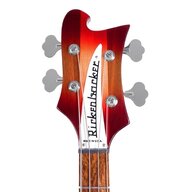
Only 4 strings for me. I own short scale and full scale. After playing 30" for a couple of years, I'm currently back to 34".
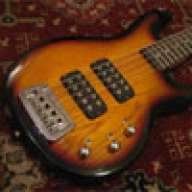
If I could only have one it would be a 34" 5-string, but I do like variety and I prefer 4-strings for many things where I don't need a low B or high C.
I had a 35" scale bass once and really hated it, so it's definitely 34" for me - although I haven't tried short scale. Maybe I should?
I had a 35" scale bass once and really hated it, so it's definitely 34" for me - although I haven't tried short scale. Maybe I should?

Neck length doesn’t really matter for me. If it’s a short scale I like it to be a normal bass body size. If it has 4 stings and no neck dive I’m in.

After close to half a century of playing bass I've figured out my preference: fretted 5 string (BEADG), 34 or 34.5 inch scale (yes, I own both).Do you have a preference.
OR
Would you play a 4. - 5. - 6. - 8. - 12 string and either short and long scale neck
OR
Just stick to one kind. of bass forever ?

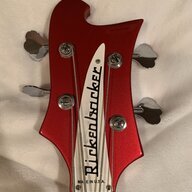
I prefer 4 string basses with 33.25" (Rickenbacker long) or 34" (long) scales. I tune to D Standard (D-G-C-F), so I don't need a fifth string to go any lower.
Short scale basses usually feel like toys to me, so that's why I don't play them.
I never gelled with 6 string basses even though I like the idea of them. The extra muting, extra weight, information overload on the fretboard, and redundant notes make me feel overwhelmed. These issues aren't as bad with 5 string basses, but they're still present. I would only play a 5 string if it were tuned D-G-C-F-A#, so I can have better access to chords and some economy of motion.
Short scale basses usually feel like toys to me, so that's why I don't play them.
I never gelled with 6 string basses even though I like the idea of them. The extra muting, extra weight, information overload on the fretboard, and redundant notes make me feel overwhelmed. These issues aren't as bad with 5 string basses, but they're still present. I would only play a 5 string if it were tuned D-G-C-F-A#, so I can have better access to chords and some economy of motion.

All my builds are now 32" Medium scale. Just fits my hands and reach perfectly.
These days it's short scale five strings. I have a 30" fretless five, two 31" fivers and a 32" scale five. Still own two 34" fours, but the 31" are my go to.

I switch between those three. Guitar, 34" 5-string bass & 30" 4-string semi-hollow bass.
I would like a Ukebass & a fretless in the future.
I guess if U are a fast player with incredible chops, sticking to one type of scale/neck profile/radius makes sense (in order not to be thrown off when playing on another instrument...), but i sadly am not that kind of player & play mostly for myself these days..
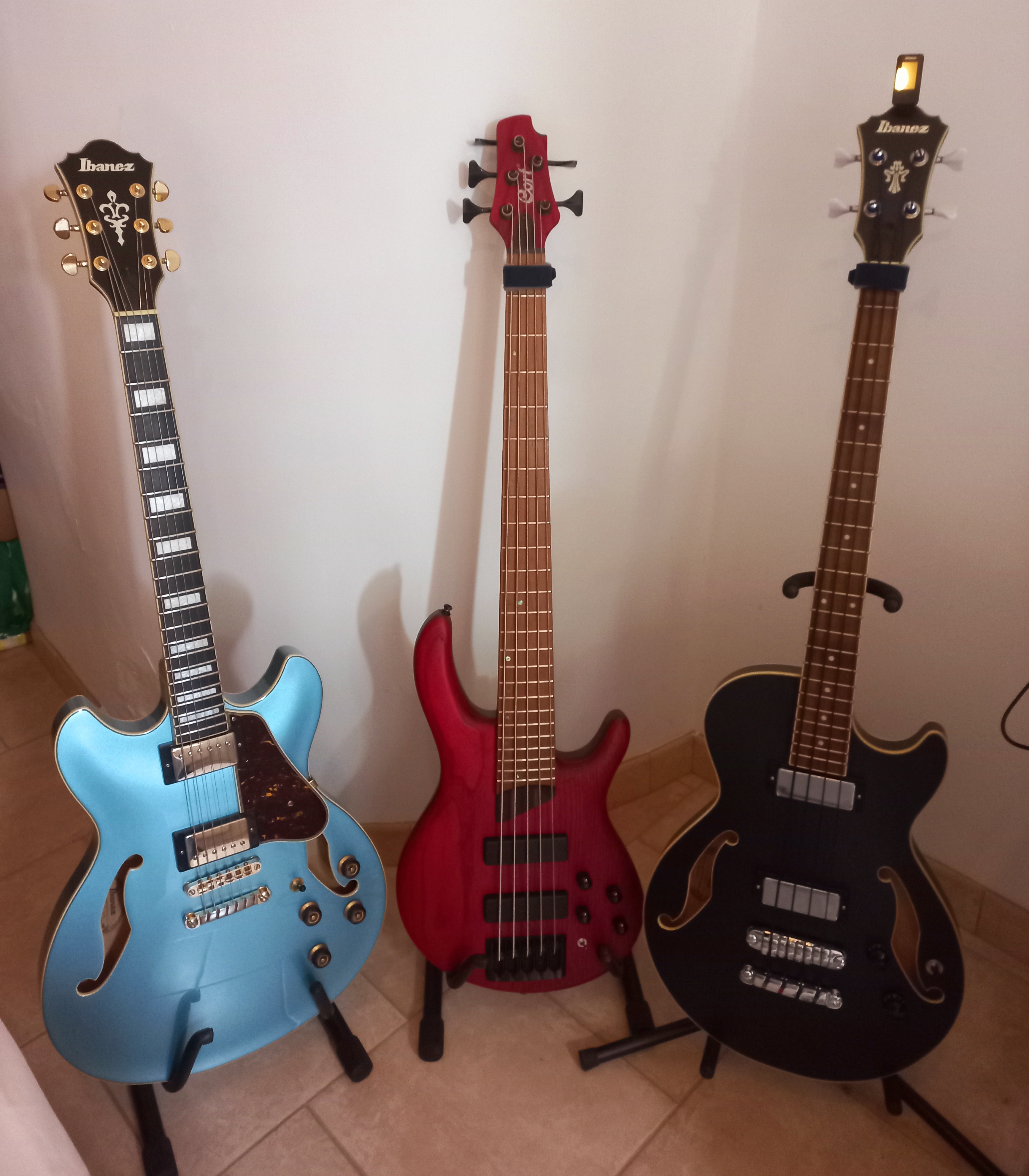
I would like a Ukebass & a fretless in the future.
I guess if U are a fast player with incredible chops, sticking to one type of scale/neck profile/radius makes sense (in order not to be thrown off when playing on another instrument...), but i sadly am not that kind of player & play mostly for myself these days..

As long as it's a full-scale, four-stringed, Jazz-shaped body and neck with two pickups, everything else is negotiable. 

Cool! I'll go back to playing drums. Now...where can we find a bassist?Keyboard


