• TalkBass has been independent since 1998. Add your voice.
    Create a free account to reply to discussions, view embedded media, and browse with fewer display ads.
    Join freeLog in
    Want zero display ads or expanded classifieds tools? Compare plans.
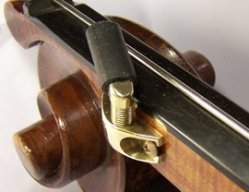
Double Bass 5 string vs C extension.

I studied with both Andy Anderson (5-string guy) and Greg Sarchet (extension guy) and they're both amazing. So, do what works for you! Get the right bass and go from there. I love my 4 string Rogeri by Rumano Solano so I had Bill Merchant make a custom extension for it.

D-A-D-G tuning is very useful - I used it before my extension. Try it on Beethoven 5 excerpt - the fingerings are actually a bit easier.

I love the extension and there's a few times i think the extension wins -

Beethoven 5 when it goes from Bb to low Eb - I set the Eb capo and now can play with part as written.. Yes you can do that with a 5 but you're up higher on the E string.

Bach suites - I'll often open a low C or D to get either a high C harmonic or the resonance of the D depending on key.

Here are some pictures and one of me and Greg doing a duet.

https://www.dropbox.com/sh/91pfkvqr8624wuv/h__gLIWn99
 
  • Like
Reactions: martinez
Feral Feline said:
Where's Warburton? :hiding:

I've had my eye on the Wilfer 5 at David Gage for several years now. Wish I could buy it.

Never played with a 5er, or an extension – maybe because I'm just a newb...

Hipshot FreeRange Extender anyone?

Don't even look at the hipshot, its a situatinal extender that wears bridges. What I mean by situational is if you have 2 songs in cello tuning and don't want to re tune your bass. Its not for everyday use, there was a huge post on it
 
Ok, my turn. I have had a 5er for 10 years now, and I use it for all of the orchestral stuff I need to play. I just recently picked up a 4 with a capoed extension, and use it for all of the commercial stuff I have to play. I have gotten many compliments on the sound of the 5 and lots of people who have played it love how even it plays and sounds, and are surprised how easy it is to get around on. It has taken some study to get used to playing the 4 with this style of extension, and I will agree with the others that the fundamental note is more prominent on the 4 than the 5, but I do like the ease of fingering on the 5 when it comes to the Strauss, Shosta, Stravinsky, Mahler and others. In the end, you'll find that it is much like the French/German debate where it comes down to what you are comfortable with, have access to and study.
 
The five string does, in my opinion, seem better. Faster passages are undoubtedly easier on a 5 string, because of the natural finger patterns, one doesn't have to leap back. It seems as though, having read the thread, people are only thinking about the low notes. It is another string. It offers various different notes in various places. I have a five string electric bass, and I use all of the notes on the string. Playing a G at the neck of the fifth string does seem more comfortable. I also think that the low B probably does make extension players jealous. I understand that the necks can be wide, but my double bass has a very wide neck. I live in Europe, so obtaining a good one could be easy.
 
This discussion comes around regularly. My thoughts haven't changed in years. I wouldn't swap my 4 string with mechanical extension for any 5 I have ever played. I've never found one with a neck I like and a sound I like. I do a fair bit of solo playing, and Bottesini Tarantella doesn't seem feasible on any five! I can't afford 2 quality basses, and I suspect the 5 wouldn't get played anyway. Different strokes for different folks though, some people love them
 
I know of three orchestras with huge instrument budgets that all went looking for fivestrings and gave up. It is not that there are not great fivestrings out there, but as a colleague in one of those grups said they tend to be owned by institutions that will never sell off their good ones.

 
This is really a repeat of previous threads, though they've been more about fielding queries from players considering a conversion of their basses to five strings

My preference has always been for 5 string and I do acknowledge the tradeoffs. But one thing has changed for me since participating in those previous threads. The rotator cuff in my right shoulder is a mess. French bow, which I've played all my life, is ever more painful to use.

The fortunate thing is that German bow is almost pain free. So here I am at 63 switching camps and taking lessons in basic bowing again.

The unfortunate thing is that the biggest problem I'm having with German bow is access to my beloved 5th string. If I used to rotate the bass at all to play on the low B with French bow, the motion was minimal and automatic. With the German bow, any note down there that's either long or loud necessitates a large, deliberate rotation. It's jarring for me. I guess I'll get used to it but right now I'm actually having to mark my parts with a reminder to rotate, ironically the same as 4 string players mark their parts to set their gates.
 
Last edited:
  • Like
Reactions: robobass
Two other considerations to add to the discussion:
On the pro 5-string side - I've hated the aesthetics of extensions. From a design standpoint, they seem like an afterthought. Some makers try to mitigate it, but they still appear to be a highly engineered solution to a range problem.
On the pro gated extension side - There has to be a acoustic benefit to playing a piece in e-flat with your lowest string effectively "tuned" to e-flat rather than e-natural.
 
  • Like
Reactions: robobass
I hate the fingered extension- I've got it on all my basses, even with the gates, and will grab the first opportunity I can get to have them all removed. True, 5 string basses that are good are very rare, especially in the USA, but I'd go that route-

Tough problem....
 
I know of three orchestras with huge instrument budgets that all went looking for fivestrings and gave up. It is not that there are not great fivestrings out there, but as a colleague in one of those grups said they tend to be owned by institutions that will never sell off their good ones.
I know a luthier in the UK who gets regular work from Copenhagen State Opera, converting big old English basses they've bought to 5 strings. He says the same. You can't find good 5 string basses. It doesn't bother me, I don't want one, but it must be frustrating if you do....
 
...biggest problem I'm having with German bow is access to my beloved 5th string.

Same here. Hand pain has me playing German these days. Interestingly, the 5-string makes E-string notes easier to bow, but yes, it takes a big shoulder drop for me to bring the bow into the B string, and the forearm striking the upper bout reduces the usable hair length (right when you need it to move that massive string). Still, the 5-string agrees with me, and I wouldn't trade it.
 
The unfortunate thing is that the biggest problem I'm having with German bow is access to my beloved 5th string. If I used to rotate the bass at all to play on the low B with French bow, the motion was minimal and automatic. With the German bow, any note down there that's either long or loud necessitates a large, deliberate rotation. It's jarring for me. I guess I'll get used to it but right now I'm actually having to mark my parts with a reminder to rotate, ironically the same as 4 string players mark their parts to set their gates.
I watched a guy from the WDR do a chamber piece which had way much sub E work. He played German bow most of the time, but when a lot of 5th string stuff was coming he switched to French a bow.
 
I know of three orchestras with huge instrument budgets that all went looking for fivestrings and gave up. It is not that there are not great fivestrings out there, but as a colleague in one of those grups said they tend to be owned by institutions that will never sell off their good ones.
Good five string basses are being built every day in Europe. Good four string basses are also being built, and not just in Europe. The thing is, with everything equal, a 4-stringer is just bound to have more sound than a 5'er.
 
I use a Hipshot on occasion and find it to be a very useful and fun accessory. Many symphony bass players I work with have them, and there are plenty of opportunities to use a low B if you're looking to do it. It's more about taste and restraint. If it is indeed wearing my bridge, the once-every-other-month or so use I get out of it is probably less harmful than the normal movement of the strings across the bridge. I have in the past used it on other strings than the C string, and the disadvantage that came from removing it was that the wear at the nut moved down into half/first position and I could feel it under my left hand fingers. If you put one on, just commit to it for a while, don't try to add/subtract it frequently.
 
Thinking about getting a C extension. I have two questions though:

1. Can any normal E string be used for it or do you need a special longer string?

2. Is there also such a thing as a B extension? Or would that fingerboard be too long to reach for the left hand? Or too long for the string to fit?
 

Latest posts