• TalkBass has been independent since 1998. Add your voice.
    Create a free account to reply to discussions, view embedded media, and browse with fewer display ads.
    Join freeLog in
    Want zero display ads or expanded classifieds tools? Compare plans.

50s Style Band

Hey y'all,

Gonna be playing some gigs with a cover band, and one of the sets they will be doing is a "Sock Hop" full of 50s songs like Rockin Robin, ShBoom, Good Golly Ms Molly, etc. The chord progressions are all pretty similar and I'm not worried about playing the right notes, however, this is just a style that I've never really played before and want to make sure I can help sell it.

So, what should I be aware of technique wise? I'm guessing a lot of palm muting, probably play on a p bass, but what else am I missing?

Any help appreciated.

Study the genre. Don’t over engineer your parts. More importantly, have fun with it.

I wouldn’t worry about playing it note for note, but stay within the spirit of the song. Most of these songs were recorded by session players pretty much jamming their way through the sessions. JMO, from a guy that grew up playing this stuff.
 
  • Like
Reactions: bigthemat
Color me jealous, OP. My Daphne Blue Jazz and Precision basses scream to play this sort of music live, but alas it's not exactly in the cards right now. I'd totally be down for some cardigan sweaters, matching suits, or maybe even bowling shirts for said gig ;)

ah, that was my next question. Do I go the sweater route, bowling shirt, or something else? someone said to put tape on my glasses haha. I might have to do that
 
  • Like
Reactions: KevInDaBassment
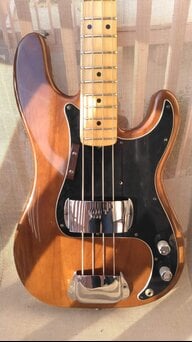
50s style P bass (get the Squier, it's great), flats and pick = rock n roll sonic nirvana.

Oh, and Weezer's look in the Buddy Holly video was great.

14749
 
  • Like
Reactions: bigthemat
Perhaps avoid the lowest notes too. Please do correct me if I'm wrong but many early 50s and 60s basslines were played higher up the neck as not only were most commercial playback devices not capable of reproducing those lower frequencies, but recording them could cause the vinyl cutter to jump out of the groove.

This could of course be nonsense, but I'm sure I heard it somewhere.
 
Perhaps avoid the lowest notes too. Please do correct me if I'm wrong but many early 50s and 60s basslines were played higher up the neck as not only were most commercial playback devices not capable of reproducing those lower frequencies, but recording them could cause the vinyl cutter to jump out of the groove.

This could of course be nonsense, but I'm sure I heard it somewhere.

so what you're saying is I need a 4 string p bass.... great now I got me some GAS lol

50s style P bass (get the Squier, it's great), flats and pick = rock n roll sonic nirvana.

Oh, and Weezer's look in the Buddy Holly video was great.

14749

ooooooh yessss!!
 
ah, that was my next question. Do I go the sweater route, bowling shirt, or something else? someone said to put tape on my glasses haha. I might have to do that

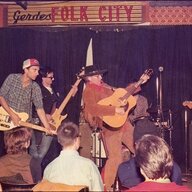
Here's a picture of The Sliders, an eastern-Kansas band from the era (I have the photo because I used to play with Jim Wilson, the saxophonist). The bass player is Buddy Ross, the guy who started Kustom Electronics in Chanute, KS.

upload_2022-9-14_10-51-46.png


For more formal gigs, consider tuxedos:

upload_2022-9-14_11-0-23.png
 
Last edited:
The thumb thing is for tone, and people were still doing it into the 1960s - McCartney made use of his thumb from time to time.

Also, don't play any notes below the A on your E string. 1950s bass amps sucked, and people tended to avoid the really low notes as a result based on what I've read.
Dude…so completely false.
 
  • Like
Reactions: Lobster11
The folks suggesting a P with flats and a mute are steering you right (though you can use the mute to taste). One more thing I’d suggest is if you opt for finger style, play north of the pickup closer to the fretboard, and if you opt for a pick play south of the pickup closer to the bridge. From what I’ve seen, many left the chrome covers on their basses and were sort of forced into these playing positions, but it created very distinct bass tones for the era. Also, utilize the tone knob.
 
  • Like
Reactions: bigthemat
Playing that stuff is a blast. A few thoughts off the top of my head:

1. It's all blues-based -- just (usually) happier and faster -- so whatever you know about playing blues will help.

2. The major pentatonic scale is your best friend: especially 1-3-5-6.

3. A lot of your bass lines will be similar and seemingly repetitive, but this is a feature rather than a bug. Just rock it and the audience will be happy.

I personally disagree with @g-dude about playing with your thumb. I think you should feel free to play fingerstyle or even with a pick if you feel like it. IMO nothing matters other than locking with the drummer (who hopefully can provide a fat back-beat) and making it rock.
All of this. Especially noted is that you do not need to learn new techniques to play it, fingerstyle is fine. Just have a listen to these songs; they are easy, easy, songs. Learn the appropriate scales and just have fun. This is a no-stress assignment so don't add stress to it by piling on unnecessary stuff.
 
I personally disagree with @g-dude about playing with your thumb. I think you should feel free to play fingerstyle or even with a pick if you feel like it. IMO nothing matters other than locking with the drummer (who hopefully can provide a fat back-beat) and making it rock.
Fingers, thumb, or pick would be "accurate" for the genre/era. As long as it's flats with a mute!
 
  • Like
Reactions: Lobster11
Fingers, thumb, or pick would be "accurate" for the genre/era. As long as it's flats with a mute!
Thumb might be most accurate but I am quite sure that nobody in the audience gives a flying rat's patootie how he's going to play it. Why add a lot of unneeded stress to this show? It's the easiest stuff in the world to play. Unless, of course, the OP gets off on the challenge of historical accuracy, in which case, I'd say go for it.

Also, a lot of this was originally played on upright, decidedly NOT with the thumb :)
 
Pretty familiar with the genre - for bass, be advised that the chord changes are not all straight blues progressions. Often times, the band, or sometimes just the bass, will hold a chord longer than expected or play a note that makes the normal chord ambiguous/pivot.

Also timing, timing, timing...most of these songs are dance numbers and the stops and starts for the faster ones are very important. The devil is in the details as they say. Also helps to make the songs sound different if you can sharpen up the rhythmic differences, as otherwise they can all sound the same.
 
Last edited:
Thumb might be most accurate but I am quite sure that nobody in the audience gives a flying rat's patootie how he's going to play it. Why add a lot of unneeded stress to this show? It's the easiest stuff in the world to play. Unless, of course, the OP gets off on the challenge of historical accuracy, in which case, I'd say go for it.

Also, a lot of this was originally played on upright, decidedly NOT with the thumb :)

Do not attempt upright with thumb. You’re better off using a pick, which is also just odd!
 
I play allot of this type of music. I use a fretless with flats. I know an upright would be more appropriate but I get clearer tone and easier transport out of my fretless. I use the same right hand side finger near bass of neck plucking technique. Nobody has ever called me out saying, "hey that's a 60's bass playing a 50's tune"