• TalkBass has been independent since 1998. Add your voice.
    Create a free account to reply to discussions, view embedded media, and browse with fewer display ads.
    Join freeLog in
    Want zero display ads or expanded classifieds tools? Compare plans.

6 String Build Carvin Tribute

Slidlow

The Human CNC
Supporting Member
Apr 15, 2009
2,941
7,702
Oshawa, Canada
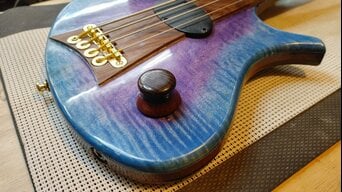
After recently rebuilding a Carvin LB75 Carvin LB75 ressurection I've had thoughts about making a six string based on its design. I like the feel of the Carvin. I have a couple of other projects to finish off so this will be an extended build. I procured some old aged maple and cut out a few pieces and will put two tapered purpleheart stringers in with to create the neck blank. I'll show how I accomplish tapered stringers for this build as I get to it. The center maple piece has already been tapered.
IMG_8237.JPG IMG_8238.JPG
 
Here are some dimensions for a rough neck blank for this design. Carvin fit their neck/body thickness in a 1 3/4" depth. I started with 2" rough boards. So for the neck stringers 2" x 47" will give you the needed size to accomplish this style. You could use a single board or build up layers to get the total width needed. The body thickness of the LB75 I rebuilt is 1 5/8". I use wood from various sources (reclaimed as well) but whenever I am in Home Depot I spend a little time foraging through their maple stock. Sometime I find a nice curly board like this. The good thing for those without big machinery is they are already finished four sides.
IMG_8253.JPG IMG_8254.JPG
 
How did you true up the tapers after the band saw?
With the sled and going slow the cut was pretty clean and just needed light sanding. If I had put it thought the table saw like the Carvin slicing it would have been cleaner and ready to use almost as is but that blade would take out more material.
Another option to true it up after resawing would be a hand plane. ;)
 
  • Like
Reactions: Crawforde
Another way to true up tapered neck lamination strips is with.....a router fixture! But you knew I was going to say that. RichterScale has already been sniffing around in that rabbit hole. Here's a discussion about how to do it:

Router Planing Fixtures
Yeah, but if he's gonna really commit to that, he needs to purchase a really old pin router that weighs more than his car and then build a custom jig for it. Otherwise, he's just goofing off. :roflmao:
 
Yeah, but if he's gonna really commit to that, he needs to purchase a really old pin router that weighs more than his car and then build a custom jig for it. Otherwise, he's just goofing off. :roflmao:

I know that, and deep down he knows that he eventually needs a big old pin router. But we're easing him into the Luthier machines rabbit hole. We don't want him to fall in head first and hurt himself. Basic router fixtures first.
 
  • Like
Reactions: TerribleTim68
A lot of good options. I have gotten pretty handy setting up stuff so little rework is usually required.

Yes, and your process works fine. A sliding taper sled through the bandsaw, cleaned up with a flat sanding block. That works.

I normally cut my lamination strips straight, a little oversize, with the table saw. Then I true up the gluing surfaces in the long fixture with the router. When I need a tapered strip, I just tilt the strip in the long fixture. That's my normal process.

There are many ways to make tapered strips, depending on your tools and patience..
 
  • Like
Reactions: Slidlow
On that same subject of truing up wood strips, I've seen a few cool hand plane fixtures that woodworkers have built. The idea is that you bolt four ball bearings onto the side walls of a hand plane, like precision wheels. And you build a long straight fixture similar to my router fixture. Side clamping, metal bar rails on top. Clamp the strip in the fixture, and run the plane down it until the bearings are rolling on the rails. The rails determine the path of the plane blade, rather than sliding the base on the wood.

I think that would be a great project for Luthiers who really want to stay with hand-powered tools.