• TalkBass has been independent since 1998. Add your voice.
    Create a free account to reply to discussions, view embedded media, and browse with fewer display ads.
    Join freeLog in
    Want zero display ads or expanded classifieds tools? Compare plans.

6 string - EADGBE (or EADGCF) Tuning

When I first bought my Ibanez GSR206, my intention was to string it like a standard guitar (as I also play guitar). I bought a 7 string set and just put the low B string away. I really liked that tuning and prefer the wider string spacing to what a narrow spaced guitar offers.

However I did find that in some playing I did with others having a low B was useful also. When I was in bands I mostly played 5 string basses (BEADG). But now I find myself writing and recording an awful lot more and almost never use the low B any longer. I almost never play chords involving any more than 3 strings (sometimes 4 if fingerpicked), so it's not like I'm playing barre chords or any such thing.

Because I am doing more chordal experimentation, and writing using those chords, I'm thinking of going back to stringing my 6 string EADGBE (or possibly all fourths...EADGCF as I've done both). I'm wanting to do this mostly because the low B gets played far less (if at all) with my more recent work. Not necessarily a common usage of a 6 string bass, but I think it will open more chordal creativity when writing.

I still have my full 7 string set, so I'm going to give it a try again.

I also have a nice Precision strung up EADG, that I may string up BEAD should I really need a low B.
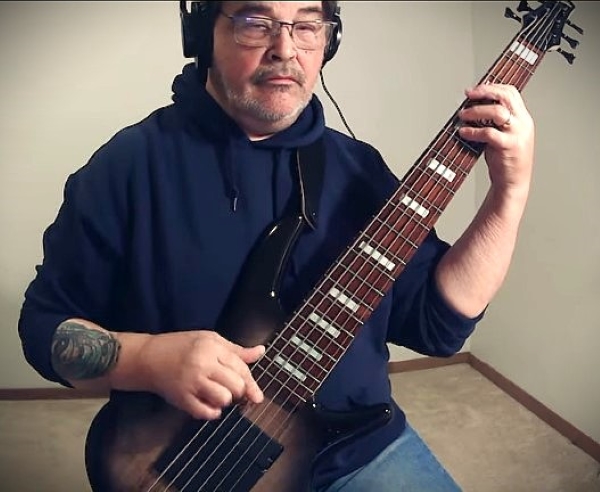

6String-new2.jpg
 
  • Like
Reactions: ambidex
My GVB36 is going to be strung EADGBE.

I think for the lower stuff or transposing, one of the other basses strung with a low B tuning would be played, just not sure which one yet as I have several that could fill that role, both 5 and 6. In fact I was wondering this the other night and had a dream about an older 5 I have, and playing that out, something I've never done with that bass (maybe God is sending a message). My point is that for some work the extended upper range of the E-E six is more useful and for others the B tuning, depending on what I'm playing.

Standard R&R is fine with a B 5 string and the high C (or B) of a 6 usually isn't needed even if it does simplify some hand movements. For solo or melodic accompaniment work, the GVB will be great I think. I briefly looked at the BTB747 to do it all in one, but the neck is almost a full inch wider than the GVB at F24, so pass.

In my own case I've decided to try to pare down my 'playing' instruments to 2 basses and one guitar* to spend more time focussing on playing and writing this year and less futzing with gear and bass-wise it will probably be the GVB and a 5 especially as the neck widths are closer to each other.

* I also have the Hohner / Spirit Steinberger clones as they're too useful for travel or carrying to rehearsal / lessons on my bike. Plus I really like them.

I bought a 7 string set and just put the low B string away
Which set did you get? The Markleys or SIT? I may have asked before but I can't recall if I did or not. I'm thinking of making a custom set, probably Newtones.
I really liked that tuning and prefer the wider string spacing to what a narrow spaced guitar offers.
That's why I got the GVB - a grown up bass VI class instrument. My SRC6 is going to be jealous.
 
  • Like
Reactions: M-Mittlesteadt
My GVB36 is going to be strung EADGBE.

I think for the lower stuff or transposing, one of the other basses strung with a low B tuning would be played, just not sure which one yet as I have several that could fill that role, both 5 and 6. In fact I was wondering this the other night and had a dream about an older 5 I have, and playing that out, something I've never done with that bass (maybe God is sending a message). My point is that for some work the extended upper range of the E-E six is more useful and for others the B tuning, depending on what I'm playing.

Standard R&R is fine with a B 5 string and the high C (or B) of a 6 usually isn't needed even if it does simplify some hand movements. For solo or melodic accompaniment work, the GVB will be great I think. I briefly looked at the BTB747 to do it all in one, but the neck is almost a full inch wider than the GVB at F24, so pass.

In my own case I've decided to try to pare down my 'playing' instruments to 2 basses and one guitar* to spend more time focussing on playing and writing this year and less futzing with gear and bass-wise it will probably be the GVB and a 5 especially as the neck widths are closer to each other.

* I also have the Hohner / Spirit Steinberger clones as they're too useful for travel or carrying to rehearsal / lessons on my bike. Plus I really like them.


Which set did you get? The Markleys or SIT? I may have asked before but I can't recall if I did or not. I'm thinking of making a custom set, probably Newtones.

That's why I got the GVB - a grown up bass VI class instrument. My SRC6 is going to be jealous.
I bought a 7 string set of Dean Markley SR2000's . Beautiful sounding and great feel to them.

I was using my 6 string like most players would... with the low B. But because I like writing and experimentation I thought restringing it and tuning it EADGBE would allow more traditional guitar chording. Even on guitar I seldom play chords using all 6 strings, but more open 3 or 4 string chords and definitely no barre chords.

I played around with it last night after restringing it EADGBE and I really had a lot of fun with it this way. I still have my Precision 4 string bass, but I also used my 6 string's upper 4 strings last night (EADG) and my GSR206 sounded so good even with traditional bass parts.

And because it now lacks the low B, I found it so easy to play those traditional bass lines without complex muting of both the low B and high C being unused that way.

Totally changed my view of playing my 6 string. 3 string chords were super easy to play, finger picked or even "strummed". Very glad I did this.
 
  • Like
Reactions: crazycloud
As I wrote in a previous post, playing a 6 string with a low B and a high C, muting those strings when playing traditional bass lines using the inner 4 strings (EADG) can be problematic as they are each on the outside but on opposite sides of the neck.

With a guitar tuning of EADGBE and the lack of a low B, it is quite natural to keep the high B and E (or C and F depending how one tunes it) from ringing out as the pad of my hand as it comes around the neck makes it quite easy to mute those upper strings with less effort or thought.
 
:laugh: Well, my post was less a request for permission as it was perhaps some insight from others who may use their 6 string as more like a deep guitar without going the Bass VI route.
Sure. If you don't use the low B it makes totally sense to tune from E to E (or F). What I like about the standard 6-string is that you have extra range on both sides (low and high). Plus I like the B string and use it quite a bit. I use all strings equally. Having only extra range at the high side makes it more guitaristic and less applicable in most (common) playing situations. But if you are making your own music you can use it where and how you want.

Tuning E to E (or F) makes it basically a Bass VI with higher tension and thicker strings and a larger scale.
 
  • Like
Reactions: M-Mittlesteadt
Sure. If you don't use the low B it makes totally sense to tune from E to E (or F). What I like about the standard 6-string is that you have extra range on both sides (low and high). Plus I like the B string and use it quite a bit. I use all strings equally. Having only extra range at the high side makes it more guitaristic and less applicable in most (common) playing situations. But if you are making your own music you can use it where and how you want.

Tuning E to E (or F) makes it basically a Bass VI with higher tension and thicker strings and a larger scale.
If I were still in a group/gigging situation, I would keep it BEADGC. That's why I always played 5 string basses and really put the low B to good use. The low B is really not needed now, and the extra higher strings will be used a lot with most everything I write. I also have an acoustic/electric guitar.

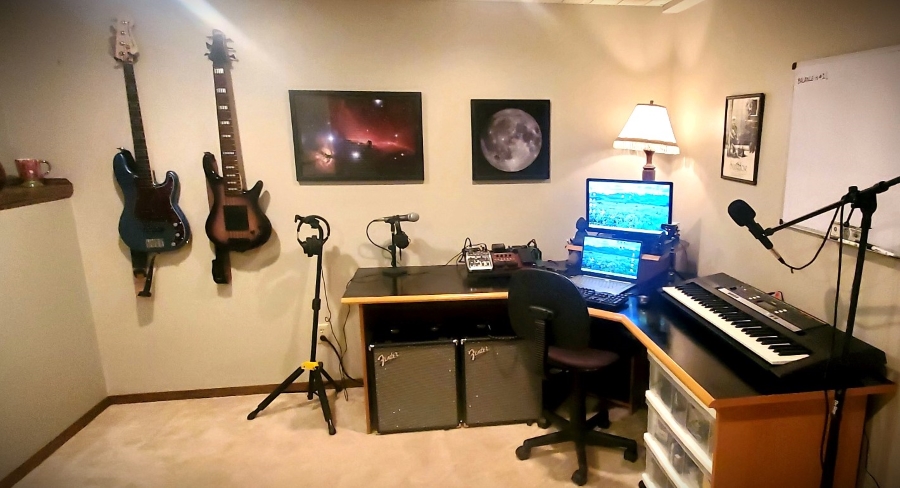
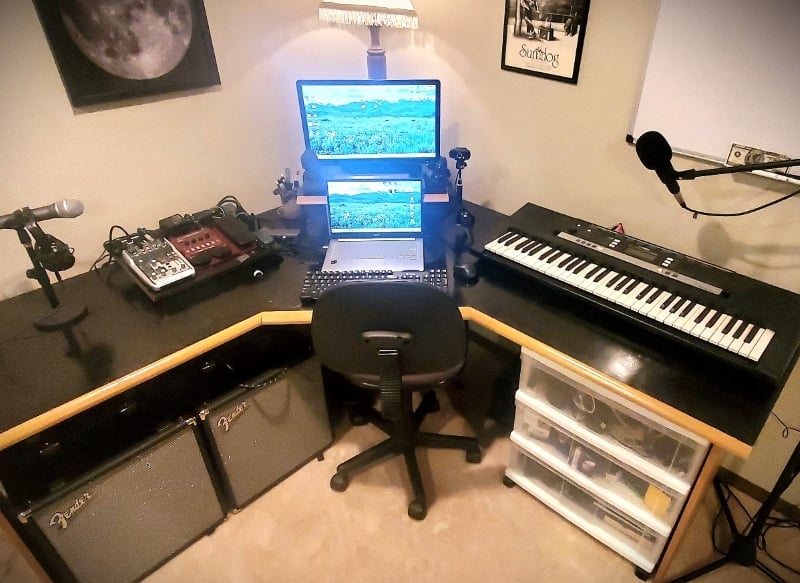
But...this is my current situation (with an electronic drum set soon to be added on the far left).

So I will have a drum set, guitar, 4 and 6 string basses, and a synthesizer... in addition to other musicians and what they can bring to the studio.

Music-Room-1.jpg


Music-Room-2.jpg
 
  • Like
Reactions: Les Fret
Do you need any notes below E1? I often use the D1 and Eb1 so I tune my 4 string basses to D Standard. You could try something similar with your 6 string. In D Standard, it would be D1-G1-C2-F2-A#2-D#3, which is a minor third up from standard 6 string tuning.

If not, E-f tuning would be just fine. I played a piccolo bass for a few years before switching to guitar for solos, leads, rhythms, and melodies.
 
  • Like
Reactions: M-Mittlesteadt
Do you need any notes below E1? I often use the D1 and Eb1 so I tune my 4 string basses to D Standard. You could try something similar with your 6 string. In D Standard, it would be D1-G1-C2-F2-A#2-D#3, which is a minor third up from standard 6 string tuning.

If not, E-f tuning would be just fine. I played a piccolo bass for a few years before switching to guitar for solos, leads, rhythms, and melodies.
I played my bass again last night. After a while, I realized that almost every single chord I played incorporated no more than 3 strings. The main reason for the standard EADGBE guitar tuning was because I also play guitar and that quirky high B string tuning throws off other chord patterns on my bass, and it's not necessary. To be honest I really love the string spacing on my 6'er for chords FAR more than when I play my guitar with those thin strings and very little room in between them. :laugh:

So, I retuned it to all fourths (EADGCF) and it suddenly made all 3 string chord patterns (like major/minor chords especially) identical no matter where they are played (well..."Duh" ;)). I am really digging the all fourths tuning far more this way.
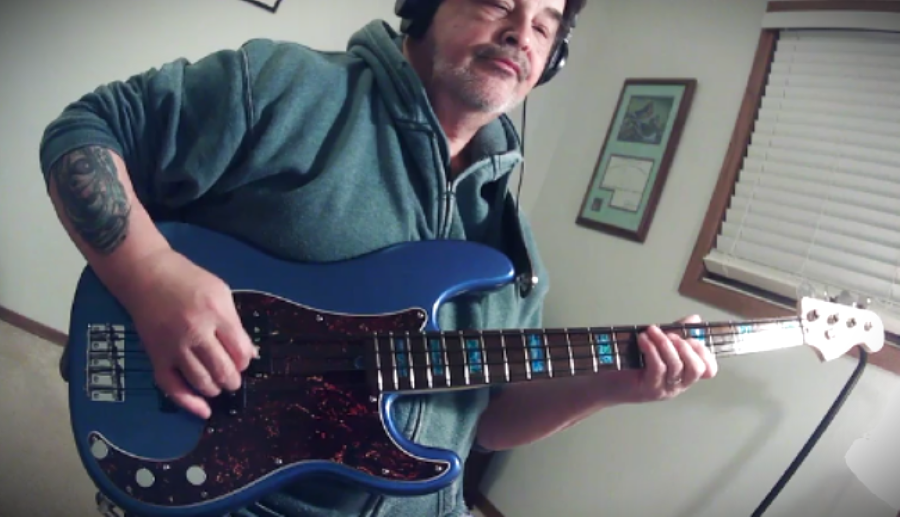
When I am experimenting with chordal work when writing, I NEVER use the low B. And since it's been months since I played with someone else, I have not needed it at all.

And the tone of my GSR206 is absolutely killer (I love the bass's PHAT II EQ in the preamp). So deep, full, rich and bright, and easily sweepable unlike basic treble/bass tone controls.

If I really need a low B I might consider restringing my Precision BEAD, especially because my 6'er has kind of become my main bass now without the low B on it.

Main bass, my 6-er (now strung up and tuned EADGCF)...

mark-gr206.png


4 string Precision (P/J). Restring BEAD? Hmm...

pick-playing.png
 
Last edited:

Latest posts