
Enjoy the benefits of a premium membership!
Upgrade Account
-
TalkBass has been independent since 1998. Add your voice.
Create a free account to reply to discussions, view embedded media, and browse with fewer display ads.
Join free Log in
Want zero display ads or expanded classifieds tools? Compare plans.
You are using an out of date browser. It may not display this or other websites correctly.
You should upgrade or use an alternative browser.
You should upgrade or use an alternative browser.
6-string or 7-string
- Thread starter Maf
- Start date
More options
Who Replied?
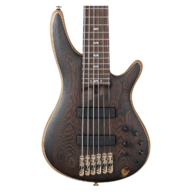
I'm primarily a 6 string player, and have been for going on 20 years. I do like the look of 7 string basses, for whatever reason I think I find that the neck width matches the length and so I tend to find that a lot of basses look best in a 7 string format. I do have the option to get one, but given that I have not found myself wanting to move up higher than the C on my bass, I have never pursued it. If I had the option and was getting a new bass, it would be a 6.I have a 7-string. Probably don't use it as often as I should. The F-string (1st) is used very very little. Got me thinking about getting a 6-string instead. So.... if you had the option, which would it be?

I drew the line at five strings. But right now I’ve got it strung with a high-C set. And I like it. As in really really like it. However, I also seriously miss not having that low B. So now I’m torn between getting another fiver for BEADG or just giving up and getting a 6-string to be done with it.
I guess I’d vote for a 6-string over the 7.
I guess I’d vote for a 6-string over the 7.
Last edited:


Yes, I do believe I'd get a 6 for everyday use. However, I would also keep the 7, tune it in fifths (for a single-scale 35", it would be GDAEBF#C#); then, well, learn to play it, and enjoy the insane range.

Years ago I bought a Conklin GT-7 to flip - while I had it, I really enjoyed playing it. I have one six string that sits in a case now. It's a great playing Douglas and sounds fairly good, even had it refinished. Going to pass that on to my son one day. One of my main basses is a Bill Dickens 7 string now.
Mine is strung with a low F# - so, still basically a six string with an extra low note. I also own a Conklin 9, and a Galveston unpaired 8 string. With 13.5 mm string spacing, the Galveston is a little tight - however, the extra high F comes in handy. The narrow string spacing helps keep the neck from getting too wide, so sliding down on a lower string is still possible.
The 9 string's neck is so wide that sliding down on a lower string from up past the 12th fret is difficult - and I have larger hands. I'm able to do that easily enough on a 7.
So - if you want the extended higher range of a 6, but still go super low, get a 7.
Mine is strung with a low F# - so, still basically a six string with an extra low note. I also own a Conklin 9, and a Galveston unpaired 8 string. With 13.5 mm string spacing, the Galveston is a little tight - however, the extra high F comes in handy. The narrow string spacing helps keep the neck from getting too wide, so sliding down on a lower string is still possible.
The 9 string's neck is so wide that sliding down on a lower string from up past the 12th fret is difficult - and I have larger hands. I'm able to do that easily enough on a 7.
So - if you want the extended higher range of a 6, but still go super low, get a 7.


I play six string basses.
I have had seven stringer and an eight string basses(N/S Stick)
But decided to stick to sixers.
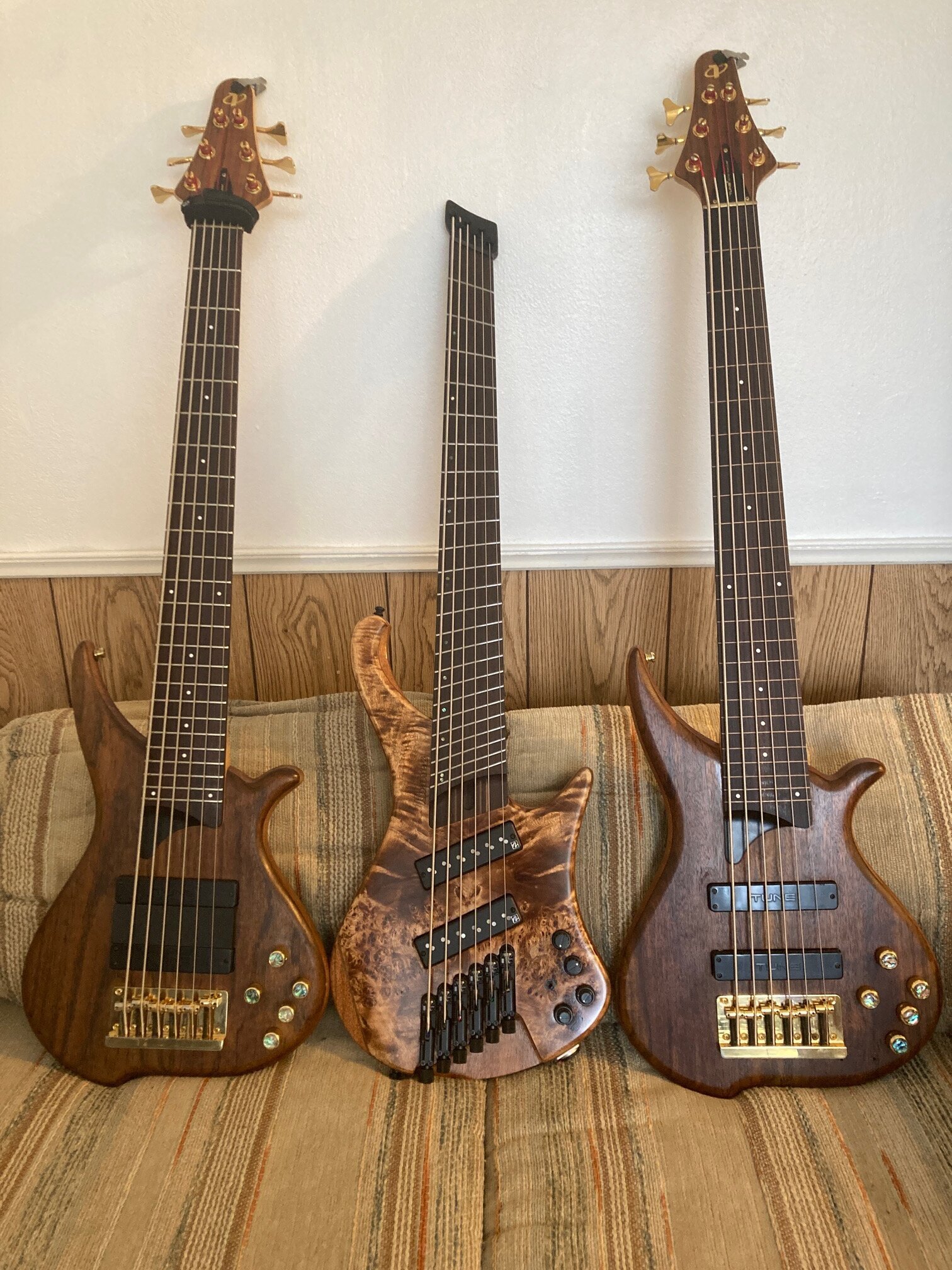
I have had seven stringer and an eight string basses(N/S Stick)
But decided to stick to sixers.
It doesn't matter. Any number of strings is the "right" number if the instrument enables you to express what you want to say musically or to deliver what is required of you in an ensemble setting.
Example: For a time I played in a trio comprised of me, a drummer and a Hammond B3. I found that a Hagstrom 8 string tuned in 4 string octaves worked best in that situation.
Example: For a time I played in a trio comprised of me, a drummer and a Hammond B3. I found that a Hagstrom 8 string tuned in 4 string octaves worked best in that situation.

Six. Thought for about 30 seconds about getting a seven, but what would I need all those strings for?
I'm a big fan of 6 strings, but I would love to try a 7 stringer. Used conklins aren't bad on reverb. One of these days I may pull the trigger.
That being said, if you're only going to have one, 6 is the way to go. I used to play 6 almost exclusively, but now I find I don't bring more strings than I need.
That being said, if you're only going to have one, 6 is the way to go. I used to play 6 almost exclusively, but now I find I don't bring more strings than I need.
I don't really have a need for either, but I voted 7 string. Mostly because I've never played one, and I like lots of strings. I love my 8 string guitar, and have played 7 string guitars for 30 years. So I've kind of always been a fan of extended range instruments.



I'm curious about 7s, but haven't dropped the $ on one, yet. I have a bunch of 6s tuned B-B/C and one, soon two, tuned E-E.
So, I'd probably choose 6, mainly as the necks are (likely*) too wide for my hands. However, I think this comment from @Maf seems to answer his own question.
* I do have a CNC and some NT neck blanks made up though...
So, I'd probably choose 6, mainly as the necks are (likely*) too wide for my hands. However, I think this comment from @Maf seems to answer his own question.
Reading the answers I decided to jam a bit on my 7er... 1,5 hours just flew by. Was awesome. Still didn't touch the F string though...
* I do have a CNC and some NT neck blanks made up though...

I voted 6-string because there are more available options/choices for strings.
And as a string-GASser (string-pokemon- gotta try 'em all), that's important to me.
(I'm currently a 4-stringer, but have spent years on 5 and 6-string basses. 6ers are niiiiiiice!)
And as a string-GASser (string-pokemon- gotta try 'em all), that's important to me.
(I'm currently a 4-stringer, but have spent years on 5 and 6-string basses. 6ers are niiiiiiice!)

I started with 4. About two years after turning pro I transitioned to 5, and then about three years later I transitioned to 6. A Yamaha TRB6P has been my #1 since about 1995.
For my needs, the low B is essential. It makes it possible to transpose down without having to invert the bass line. Also there are quite a few songs where the original bass line drops below the E string.
I find the high C useful, but not strictly required. I am sure I would find the high F would have some utility as well, but IMHO significantly less than the high C. Adding strings has a cost as well. I personally don't think the benefits of having the high F would sufficiently offset these costs (for me). As always, YMMV, so do your own analysis and make your own decision.
When I first started playing the 6, I approached it pretty much like a 4 string with a couple of extra strings. Over the years the logic I use to navigate the fretboard evolved and become optimized for 6 strings. I can still play a 4-string or 5-string, but if the music is technical and challenging, I am more comfortable and at home on the 6. Now when I play 4-string or 5-string it feels like something is missing. Essentially I have become a naturalized 6-string player.
What do I mean by fretboard logic? With a 4 string it's necessary to shift up and down the neck more. With a 6-string, it is often better to play across the strings more and shift less. Ideally fingering should be automatic, meaning it happens without having to think about it. When I play a 4-string or 5-string, I have think about what I am doing. I also have to stop more to figure out how to play lines. Even worse, if I play 4-string or 5-string for an extended time, it starts rewiring my brain. The result is a reduction in my proficiency on the 6-string. So I tend to play 6-string almost exclusively.
For my needs, the low B is essential. It makes it possible to transpose down without having to invert the bass line. Also there are quite a few songs where the original bass line drops below the E string.
I find the high C useful, but not strictly required. I am sure I would find the high F would have some utility as well, but IMHO significantly less than the high C. Adding strings has a cost as well. I personally don't think the benefits of having the high F would sufficiently offset these costs (for me). As always, YMMV, so do your own analysis and make your own decision.
When I first started playing the 6, I approached it pretty much like a 4 string with a couple of extra strings. Over the years the logic I use to navigate the fretboard evolved and become optimized for 6 strings. I can still play a 4-string or 5-string, but if the music is technical and challenging, I am more comfortable and at home on the 6. Now when I play 4-string or 5-string it feels like something is missing. Essentially I have become a naturalized 6-string player.
What do I mean by fretboard logic? With a 4 string it's necessary to shift up and down the neck more. With a 6-string, it is often better to play across the strings more and shift less. Ideally fingering should be automatic, meaning it happens without having to think about it. When I play a 4-string or 5-string, I have think about what I am doing. I also have to stop more to figure out how to play lines. Even worse, if I play 4-string or 5-string for an extended time, it starts rewiring my brain. The result is a reduction in my proficiency on the 6-string. So I tend to play 6-string almost exclusively.
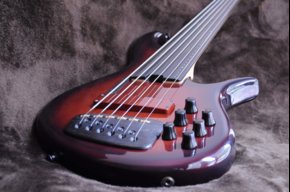
I've played a Conklin GT-7 and a Low End Jazz 7 at two different shops and they both felt great and weren't as intimidating as they looked (I was playing 4s and 5s at the time though I had a few years of playing exclusively 6s). I'd keep the 7 unless you absolutely never have the need for the high F and rarely play that bass.


