• TalkBass has been independent since 1998. Add your voice.
    Create a free account to reply to discussions, view embedded media, and browse with fewer display ads.
    Join freeLog in
    Want zero display ads or expanded classifieds tools? Compare plans.

6 String question - alternate tunings?

I am not a 6 string player but I can't help but wonder if any 6 string players use alternative tuning. It strikes me that one could tune a 6'er to B-E-A-D-F#-B and be able just transfer guitar skills over to it.

Anything like this occur in the 6 string world or any other interesting tuning used?
That is baritone guitar tuning. You play the same chord shapes as standard guitar, but it’s in a different key. So you have to transpose.

I have a baritone acoustic guitar. I enjoy playing it and love the tone, but when I play with standard guitar players, it’s somewhat tedious to have to transpose every song. I could capo, but that defeats the purpose. I might as well just play a standard guitar at that point.
 
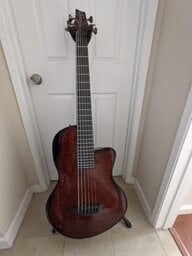
Dang! What strings are those? They look so delicate
I use a set of S.I.T.Powersteel Conklin Signature stainless 7
sit-strings-psr18135-power-steel-conklin-7-string-bass-strings_480x480-1829338753.png
 
Is this the 33” scale model? How do you like it for chords?
It's 35"
Some chords become easier.Some are more difficult.
But one thing,it makes playing a bass version of Michael Hedges' "Aerial Boundaries" very doable!
 
Last edited:
I am not a 6 string player but I can't help but wonder if any 6 string players use alternative tuning. It strikes me that one could tune a 6'er to B-E-A-D-F#-B and be able just transfer guitar skills over to it.
Sure, but that would be a G not an F# unless you're transposing everything I suppose -- neat idea.
I had a 6 I tuned like that -- BEADGB and all the guitar fingerings worked great. made it really easy to play.
I think standard is fourths all the way BEADBC?
 
  • Like
Reactions: thmsjordan
The F# would make it like a guitar in B Standard tuning i.e. everything down a fourth.

Oh, I know, but I don't play guitar in B standard tuning and never have, so that doesn't help me personally. What does help me is to have a G string and a B string, because I have years of practice knowing what the notes are on G and B strings.
 
From what I understand, one of the main reasons for having the major third interval in guitar tuning is for 6 string barre chords: it gives you the 12th and the root 2 octaves above (would that be called the 15th?). On a 6 string bass tuned BEADF#B, those barre chords would likely be voiced too low to be practical. Plus you would be playing single note lines most of the time, and so the logic of keeping it in all fourths wins out, at least for me.

Is this the 33” scale model? How do you like it for chords?

I have tuned my sixer in all fifths before, and I dabble in all fifths tunings on a variety of instruments. You can get easy, strummable 3, 4, and 5 string barre chords in spread voicings. Major and minor triads in all inversions are brain-dead easy, and root position seventh chords fall nicely on 4 adjacent strings. You can even get decent voice leading by just moving the shapes around. Closed voicings and upper extensions are a lot harder, that's where all fourths exceeds in.
 
From what I understand, one of the main reasons for having the major third interval in guitar tuning is for 6 string barre chords

Well, yeah, but not just 6-string barre chords. It also makes certain partial chords easier, or at least no harder, particularly in the higher strings, where you'd be more likely to use them. And in fingerstyle guitar, 3- and 4-note chords are more common than 6-note chords.

But I think there's actually something else that may be as important, for some anyway: the sense that it's somehow more, I dunno, satisfying not to have your outer strings making up such a dissonant interval as B-C. I may be the one of the few who feel this, but it definitely feels more elegant to me in BEADGB; BEADGC feels unnecessarily schematic. Purely a matter of taste, I suppose, but I actually like the slight inconsistency.

Also, when your outer strings are both tuned to the same note name, you only need to know one set of note positions, not two.

But none of this really matters, as long as your tuning allows you to do what you need to do.
 
Last edited:
Well, yeah, but not just 6-string barre chords. It also makes certain partial chords easier, or at least no harder, particularly in the higher strings, where you'd be more likely to use them. And in fingerstyle guitar, 3- and 4-note chords are more common than 6-note chords.

But I think there's actually something else that may be as important, for some anyway: the sense that it's somehow more, I dunno, satisfying not to have your outer strings making up such a dissonant interval as B-C. I may be the one of the few who feel this, but it definitely feels more elegant to me in BEADGB; BEADGC feels unnecessarily schematic. Purely a matter of taste, I suppose, but I actually like the slight inconsistency.

Also, when your outer strings are both tuned to the same note name, you only need to know one set of note positions, not two.

But none of this really matters, as long as your tuning allows you to do what you need to do.

I can understand the argument from aesthetics, having the top and bottom strings be the same note feels just right, even if it's just an artifact of having 6 strings. I do like how BEADGB moves the irregularity to the top two strings instead of near the middle for BEADF#B. I can keep the symmetric patterns for 5 out of the 6 and only have to adjust for the top one.

Part of what inspired me to try fifths tuning was from the consonance of stacked fifths. Of course this is all personal preference, and whatever works for you is good. I'm biased towards symmetry and taking advantage of the circle of fifths, so all fourths and all fifths are what I play (that's also means less work for me figuring out where the notes are! :laugh:)
 
  • Like
Reactions: Riff Ranger

Latest posts