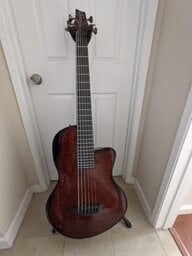
From what I understand, one of the main reasons for having the major third interval in guitar tuning is for 6 string barre chords: it gives you the 12th and the root 2 octaves above (would that be called the 15th?). On a 6 string bass tuned BEADF#B, those barre chords would likely be voiced too low to be practical. Plus you would be playing single note lines most of the time, and so the logic of keeping it in all fourths wins out, at least for me.
I have tuned my sixer in all fifths before, and I dabble in all fifths tunings on a variety of instruments. You can get easy, strummable 3, 4, and 5 string barre chords in spread voicings. Major and minor triads in all inversions are brain-dead easy, and root position seventh chords fall nicely on 4 adjacent strings. You can even get decent voice leading by just moving the shapes around. Closed voicings and upper extensions are a lot harder, that's where all fourths exceeds in.