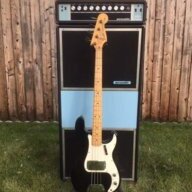
It was the low note growl on track B that grabbed me. My guess was wrong, but that's a good thing. There may be hope for me and my 73.

TalkBass has been independent since 1998. Add your voice.
Create a free account to reply to discussions, view embedded media, and browse with fewer display ads.
Join free Log in
Want zero display ads or expanded classifieds tools? Compare plans.


I still have one that I bought in 1973. It has been recorded many times and gave me a living for decades. I won’t sell it even though I only play 5 strings on gigs now. I had so many good comments from engineers over the years who loved how good it sounded and how easy it was to record.I think this proves that CBS still turned out some really good Fender Precision Basses into the 1970s.
- Steve





Fascinating! I guessed wrong -- boominess of B made me think slab board/ early 60's. Love the study. Thanks for posting!
This also made me wonder what the within group differences would be. So like run the same test with two 62's for example. I have a couple pre-CBS but they're different years so not quite right but they're worlddds apart.
Anyone have two same year slabs/ pre-CBSs that can weigh in?
 .
.
First of all thanks for the compliments on the playing. I was just trying to do justice to James Jamerson’s work as he is my all-time favorite electric bass player whose influence on other bassists and music in general cannot be overstated.
Here's the big reveal: Track A features the 1962 Precision and Track B features the 1972 Precision.
As of right now 96 people guessed correctly, 106 guessed wrong, and carrots receive an honorable mention with 41 votes.
It's hard to describe subtle differences in tone, but to my ears the '62 had a "drier" sound that offered more clarity. By comparison, the '72 was fatter and had a growl on the low notes that's audible on the recording. The differences were more apparent through an amplifier than on the recording. The big difference in playing these basses was the neck. The '62 has a C width neck (1.75" at the nut) that is thinner from front to back. The frets are smaller and most of the lacquer is worn from the back of the neck which gives it that appealing "broken in" feel. The '72 has a round, chunky B width neck (1.625"at the nut) with larger frets and a glossy finish. I'm sure the neck contributes to the sound difference as do numerous other factors including the wood selection, finish type (nitro vs. poly), pickups and other electronic components. The '62 Precision is a great instrument that's really fun to play. It's worth about three times what the '72 Precision is worth, but it's not three times the bass. I think this proves that CBS still turned out some really good Fender Precision Basses into the 1970s.
- Steve



I was under the impression 1960’s Fenders had an Ash body?
Nope. Ash was standard form 51-56, then alder became the standard from 57 til 70 when they started doing natural gloss finish. (save for a couple odd runs like the blonde where the grain needed to show through)
The early 70's sunburst and trans-walnut P's were still lightweight alder, til about 73/74 changeover, then the regular wood became ash.

...what circuitry differences are there?
if you swapped the guts how would each bass respond then?
You should have ignored us and let it run for a week with the reveal

to clarify my question, if you put the '72s pax in the '62 and vice versa do you think there'd be any differences?Both basses used in the recordings have their original pickups and electronics. I don't know enough about aftermarket pickups to answer your second question. All of the Fender basses I currently own and have owned in the past have been stock except for one that had a Nordstrand pickup that I didn't care for.
- Steve