So what I was trying to say was even basses made in the same day or batch, can and will sound dif just because the woods are dif.OK, here's an even more influenced reason the true 62 didn't sound like the 62 I thought it would be in comparison to the 72. Woods! Yes the woods of the body and neck make a HUGE dif. I had been looking for a vintage 62-68 P Bass for 30 years. Oh, I've found them, but prices were absurd. About 8 years ago I took a chance on a bass I saw online. High res pics. It was a 60'th Anniversary of Fender P-Bass. The wood grains (Both neck and Body)were very widely spaced. Less dense.... The bass was incredibly light. 7.3 lbs! After I got it home I played it un-amplified. I could hear it acoustically very easily. After plugging it in it sounded very good. The pickups were a little too fat to my ear, so I had Peter Florence from "VooDoo pickups make me a pair that matched my bass. It took 3 dif pairs and 6 months, but I ended up with a bass that very closely matches a 64 I once heard at Manny's in NYC priced at 7K!

Enjoy the benefits of a premium membership!
Upgrade Account
-
TalkBass has been independent since 1998. Add your voice.
Create a free account to reply to discussions, view embedded media, and browse with fewer display ads.
Join free Log in
Want zero display ads or expanded classifieds tools? Compare plans.
You are using an out of date browser. It may not display this or other websites correctly.
You should upgrade or use an alternative browser.
You should upgrade or use an alternative browser.
'62 Precision vs '72 Precision: can you hear the difference?
- Thread starter bassfiddlesteve
- Start date
More options
Who Replied?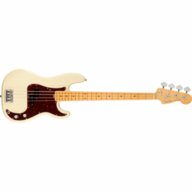
So what I was trying to say was even basses made in the same day or batch, can and will sound dif just because the woods are dif.
Wow. Reading all these posts is giving me a clear picture of all the reasons backing up the statement that no two basses sound alike, even if they're the same make and model. I guess it comes down to the old saying, try it out before you buy it and if you like the way it sounds and plays, it's a keeper.

I think it indicates that the player is the most important variable. Not the bass itself. My understanding is that Jameson’s bass was in pretty rough condition. But it didn’t matter because he was a master.First of all thanks for the compliments on the playing. I was just trying to do justice to James Jamerson’s work as he is my all-time favorite electric bass player whose influence on other bassists and music in general cannot be overstated.
Here's the big reveal: Track A features the 1962 Precision and Track B features the 1972 Precision.
As of right now 96 people guessed correctly, 106 guessed wrong, and carrots receive an honorable mention with 41 votes.
It's hard to describe subtle differences in tone, but to my ears the '62 had a "drier" sound that offered more clarity. By comparison, the '72 was fatter and had a growl on the low notes that's audible on the recording. The differences were more apparent through an amplifier than on the recording. The big difference in playing these basses was the neck. The '62 has a C width neck (1.75" at the nut) that is thinner from front to back. The frets are smaller and most of the lacquer is worn from the back of the neck which gives it that appealing "broken in" feel. The '72 has a round, chunky B width neck (1.625"at the nut) with larger frets and a glossy finish. I'm sure the neck contributes to the sound difference as do numerous other factors including the wood selection, finish type (nitro vs. poly), pickups and other electronic components. The '62 Precision is a great instrument that's really fun to play. It's worth about three times what the '72 Precision is worth, but it's not three times the bass. I think this proves that CBS still turned out some really good Fender Precision Basses into the 1970s.
- Steve
Thanks for the fun comparison and nice playing! I used a pair of Bose NC 700 headphones (not really great but better than earbuds) to listen. Just want to say Track A (62') is much easier to listen to than Track B (72'). Track B brings up a lot of lows that I don't really hear but my ears feel the extra pressure, which is not all that great. Turn up Low or Low-Mid EQ on bass amp to 3 o'clock and you'll get what I mean.

Its funny to see peoples reasons for their guesses.
What I see- which is totally expected out of 2 possible choices is - dang close to a 50/50 split. Just like tossing a coin.
What I see- which is totally expected out of 2 possible choices is - dang close to a 50/50 split. Just like tossing a coin.
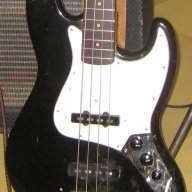
My general impression is that the pre CBS wood quality is better seasoned than the CBS products. The pickups is not rocket science. As I remember CBS paid 13 mio $ for the brand. I have seen an played on CBS guitars, they were of doubtsome quality.My friend Robert Strickland and I decided to conduct an experiment to determine the difference in tone between our Fender Precision Basses, his being a coveted pre-CBS instrument from 1962 and mine being a 1972 model. Both basses have rosewood fingerboards and are completely stock with their original electronics and hardware. They are both strung with La Bella light-gauge flatwounds that have been on their respective instruments for the same length of time, and neither bass has a foam mute. For this experiment, I chose to play a portion of James Jamerson’s classic bass part from Marvin Gaye’s “What’s Going On” along with an instrumental backing track, the bass featured prominently in the mix. Both instruments were recorded directly into Audacity with no compression or effects. The basses were played finger-style and the volume and tone controls were up all the way. We would like the members of this group to listen to both tracks and see if they can determine which bass is being played. We will reveal the answer at a later date.
Track A
Track B
View attachment 3762364
- Steve

I would go with A=62. It laid right in the mix at IMHO, has the Jamerson tonality.
What's interesting about this is that the bass that James Jamerson used to record the original track was not actually a 1962 Precision Bass. I outlined this in an equally nerdy thread, that I started a while back.
- Steve
There are no effects and I was careful to avoid any clipping. I used the level meters to try to match the volume between the two basses. I think what you are hearing as volume differences could be the different character of each bass.
- Steve
It might have been partly headphones as now I've listened on my AKGs there's less difference in general and I perceive less difference between the basses. Interestingly, track B peaks nearly 1dB hotter than A, but based on ABX testing of my ability to distinguish between tones, I wouldn't be able to tell that by ear, but if the bass on B is 1dB hotter that might, paradoxically, stand out more, combined with any frequency differences on headphones that are more compromised in terms of bandwidth than the AKGs.
Now THAT is the land of Bass Nerdom !!I'm getting in this thread late, so apologies if I repeat any observations already made. Track B is what every P bass I've ever owned sounds like. I like Track A much better. To my ear it has a thicker, fatter sound. I understand track A is the '62 and track B is the '73. If I may ask, what's the value of the capacitor in the tone circuit for each bass? As I understand it the older P's had a .1uF cap whereas the newer ones had a .022uF cap. The '73 has a thinner tone to it.

Thanks for the fun comparison and nice playing! I used a pair of Bose NC 700 headphones (not really great but better than earbuds) to listen. Just want to say Track A (62') is much easier to listen to than Track B (72'). Track B brings up a lot of lows that I don't really hear but my ears feel the extra pressure, which is not all that great. Turn up Low or Low-Mid EQ on bass amp to 3 o'clock and you'll get what I mean.
This is probably why I thought it was over driven as I tried it on limited headphones, and with the bass being prominent, it's a lot more low frequency that might usually have been the case.
Listened back to back with only the annoying commercial in between. Not a great sound system but does have a sub so I could hear the bass on both tracks clearly. My ears said A is the 62. Sounded more like an upright. Strings sounded good and dead therefore percussive without ring like aged flats should. B seemed to my ears to have more mids and less thud in the bottom so I chose it to be the 72. Jamerson played HEAVY flats by the way which would thud more than lights and have less prominent mids so that might also lend to my preference for A being the 62. Either way excellent playing. Hats off to anyone who appreciates the subtleties of Jamerson's playing.
If I may ask, what's the value of the capacitor in the tone circuit for each bass? As I understand it the older P's had a .1uF cap whereas the newer ones had a .022uF cap. The '73 has a thinner tone to it.
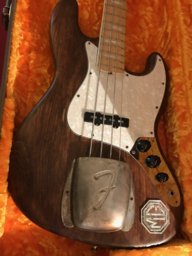
I haven't the slightest idea. Below is a picture of the one in the '72 Precision if that's helpful. My understanding is that capacitor would not have much of an influence here since both basses were recorded with the tone control wide open.
- Steve
62- B 72 -AMy friend Robert Strickland and I decided to conduct an experiment to determine the difference in tone between our Fender Precision Basses, his being a coveted pre-CBS instrument from 1962 and mine being a 1972 model. Both basses have rosewood fingerboards and are completely stock with their original electronics and hardware. They are both strung with La Bella light-gauge flatwounds that have been on their respective instruments for the same length of time, and neither bass has a foam mute. For this experiment, I chose to play a portion of James Jamerson’s classic bass part from Marvin Gaye’s “What’s Going On” along with an instrumental backing track, the bass featured prominently in the mix. Both instruments were recorded directly into Audacity with no compression or effects. The basses were played finger-style and the volume and tone controls were up all the way. We would like the members of this group to listen to both tracks and see if they can determine which bass is being played. We will reveal the answer at a later date.
Track A
Track B
View attachment 3762364
- Steve

I really couldn't say which is which.Both sound great but track B has a slightly deeper more buttery tone imo.I would be happy with either.My friend Robert Strickland and I decided to conduct an experiment to determine the difference in tone between our Fender Precision Basses, his being a coveted pre-CBS instrument from 1962 and mine being a 1972 model. Both basses have rosewood fingerboards and are completely stock with their original electronics and hardware. They are both strung with La Bella light-gauge flatwounds that have been on their respective instruments for the same length of time, and neither bass has a foam mute. For this experiment, I chose to play a portion of James Jamerson’s classic bass part from Marvin Gaye’s “What’s Going On” along with an instrumental backing track, the bass featured prominently in the mix. Both instruments were recorded directly into Audacity with no compression or effects. The basses were played finger-style and the volume and tone controls were up all the way. We would like the members of this group to listen to both tracks and see if they can determine which bass is being played. We will reveal the answer at a later date.
Track A
Track B
View attachment 3762364
- Steve
I listened with studio quality cans, and the difference is very noticeable - mostly what I would call more texture to the sound of B. I have not listened closely to that many Basses, neither of these in particular, so I am defaulting to the conventional thinking that the earlier vintage would have more of that characteristic. I would not bet on it. Very interested in the reveal.
But the point is which one is the '62- not which one sounds better.The playing is terrific, both sounds are high quality, but I'm afraid I'm getting a little thrown by volume differences. A sounds louder to me. And while I like hearing good strong bass, both seem too hot to me in the mix to be able to give you a solid opinion of which I like better.
Thanks! Interesting test.It's been revealed several pages back:
A='62


