• TalkBass has been independent since 1998. Add your voice.
    Create a free account to reply to discussions, view embedded media, and browse with fewer display ads.
    Join freeLog in
    Want zero display ads or expanded classifieds tools? Compare plans.

7.25" Fretboard Radius

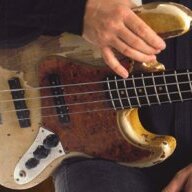
Thanks! Very interesting. I have a Squier Classic Vibe '60s Jazz, but alas the neck radius is 9.5". I'd like to replace it .... I see that Fender's Flea Jazz Bass has the following specs:
  • Maple neck with “C”-shaped profile and 1.5” nut width; Road Worn nitrocellulose lacquer finish on back of the neck
  • 7.25”-radius rosewood fingerboard with 20 vintage-style frets
Try the Fender Flea Jazz if you get a chance. I have large hands and it is the most comfortable to me. Slim neck, 7.25" radius, and skinny frets.
You could also just buy the neck on eBay and bolt it to any standard Jazz or P body. They pop up every once in a while. Easy to resell if you don't like it.
 
  • Like
Reactions: douglasbass
I play 6's often, Radius between 26"- 40" is preferred. With 4 strings, 9.5-12" preferred, no question. 7.25" is often laborious to play in the upper register for my style. I have one Fender J bass with low tension Thomastik flats that has a 7.25". It works well enough to keep.
 
  • Like
Reactions: ctmullins
Don't forget that a player's preference in fingerboard radius also has a lot to do with the right hand. Maybe even more than the left hand. Back toward the bridge, a rounder (smaller radius) fingerboard raises up the middle strings and makes it easier to do more aggressive plucking. Back in the old days (like, the '60's) bass players plucked harder and didn't play as many notes. A 7 1/4" radius over the body felt more comfortable to pluck, if you are used to playing upright bass, and trying out this new-fangled electric Fender thing.

But bass playing technique has evolved over the decades. Modern players play with super low action and pluck with a light touch, using almost acoustic guitar finger-style right hand technique. Lots of fast notes. And then there's slap and pop technique. These players usually like flatter radius under the plucking hand, often even completely flat.

The manufacturers like Fender eventually started making their necks flatter, 9" and 12", because customers wanted them. It was more for right hand plucking technique than for left hand comfort. In the last 30 years, 12" radius seems to have become the standard for 4-string electric basses. It's a comfortable compromise between round and flat; both style players can be happy with it.

Left hand comfort plays a part too. And it depends on your playing technique. Players who use a lot of muscle will usually like a smaller, rounder neck. Light and fast, with lots of chordal work, you may prefer a wider, flatter neck.

The basses I build are mostly 7 1/4" radius, and I offer some models in 4" radius. They are designed for a specific market of players who do upright-style plucking.

These days, there is a lot of choice out there. Think about your right hand technique as you are trying out different basses.
Nailed it
 
Don't forget that a player's preference in fingerboard radius also has a lot to do with the right hand. Maybe even more than the left hand. Back toward the bridge, a rounder (smaller radius) fingerboard raises up the middle strings and makes it easier to do more aggressive plucking. Back in the old days (like, the '60's) bass players plucked harder and didn't play as many notes. A 7 1/4" radius over the body felt more comfortable to pluck, if you are used to playing upright bass, and trying out this new-fangled electric Fender thing.

But bass playing technique has evolved over the decades. Modern players play with super low action and pluck with a light touch, using almost acoustic guitar finger-style right hand technique. Lots of fast notes. And then there's slap and pop technique. These players usually like flatter radius under the plucking hand, often even completely flat.

The manufacturers like Fender eventually started making their necks flatter, 9" and 12", because customers wanted them. It was more for right hand plucking technique than for left hand comfort. In the last 30 years, 12" radius seems to have become the standard for 4-string electric basses. It's a comfortable compromise between round and flat; both style players can be happy with it.

Left hand comfort plays a part too. And it depends on your playing technique. Players who use a lot of muscle will usually like a smaller, rounder neck. Light and fast, with lots of chordal work, you may prefer a wider, flatter neck.

The basses I build are mostly 7 1/4" radius, and I offer some models in 4" radius. They are designed for a specific market of players who do upright-style plucking.

These days, there is a lot of choice out there. Think about your right hand technique as you are trying out different basses.

Very good points here, thank you. I hadn't considered my right hand technique. I favor a "softer" (not aggressive) finger style for reggae, so not a lot of notes compared to other styles.
 
Fender also started out making their guitar fretboards with a 7.25 radius, perhaps in part because chording can be easier (at least for some, including me) with that radius than with a flatter one. The compromise is that bending strings can become an issue with the steeper radius, as strings can "fret out" when bent far enough toward the fretboard center to run into the arch - which was less of a problem at a time when strings were heavier and less bending was done. So that's one reason that for guitar a lot of people nowadays prefer a flatter board. I play with somewhat higher action and heavier strings, on guitar, so the steeper radius is a win/win for me there.

I like the 7.25 radius on bass because it just feels easier to me. I'm used to it, and I like it. I also have some with flatter boards, and I'm ok with that too ... but all things being equal, I'd choose 7.25. Seems to be a very individual thing with no one right answer. Vive la difference!
 
For those of you who play and prefer a bass with a 7.25" fretboard radius, is it due to a greater ease with reaching notes? I have smaller hands and it *seems* like this radius would be better for single note runs, arpeggios, but maybe not.
I can understand how a narrower fretboard would make it easier to reach notes, but why would a smaller fretboard radius do so?
 
don't forget that the rest of the neck shape and depth plays a large role as well. skillet mentioned the aerodyne having a 7.25 radius. i thought it was 9.5 as i switch back and forth with a CIJ geddy lee which feels like a 7.25 to me. well i just went and grabbed my gauges and i am a bit embarrassed to admit i had it backwards. the aerodyne is indeed 7.25 and the geddy is 9.5. so play whatever feels good as there is more to the feel of a neck than just the radius specification-although that is certainly an important part. it is great to have choices!
 
  • Like
Reactions: douglasbass
I can understand how a narrower fretboard would make it easier to reach notes, but why would a smaller fretboard radius do so?
For me,7.25 just seems to fit the natural curve of the fingers. Things just fall right into place. A flatter fretboard is certainly playable for me, and ok, but the steeper one just feels easier. One of number of neck factors, of course.
 
I can understand how a narrower fretboard would make it easier to reach notes, but why would a smaller fretboard radius do so?

Possibly because it seems easier to have a 'rolling' left hand technique, which I'd like to improve. That is, 'rolling down' a finger from, say, the A to the D string, so the second note is played with the first knuckle. But I have yet to try out any basses with a smaller radius, so this is just a guess really.
 
My 3 main basses I play are jazz basses:

Fender Flea 7.25”
Fender Elite 9.5-14” compound radius
Fender All-parts 10”

I have smaller hands and when playing bass lines down low like Paradise by Sade or Midnights Train to Georgia the Elite and Allparts basses feel best. Love the feel of the Flea but for me it’s harder to press down those notes to the frets on the D and G strings (feels longer distance no matter how I setup of the bass) especially at higher speed. But that’s me..
 
  • Like
Reactions: douglasbass
For me I absolutely prefer the rounder 7.25 Radius....I also like the 9.5 as the flattest radius that I can bond with.
I sold all of my beautiful G&L'S because most of them had the 12" Radius.
I also sold all of my Fender 9.5 's for the same reason.
Now all of my basses are 7.25 again...the way it was back in the day.
Sure I can play them no problem but why bother when you know that you prefer 7.25.
 
26098669[/URL], member: 118242"]Off topic, but it is important.

7.25 radius fretboard always has weak A and D output on flush jazz bass pickups magnet .

Flat radius are great for 5 string and 6 string bass which has better output balance on each string from flat soapar pickups.

I would caution making blanket statements like this because it is flat out untrue in the way that you state it. Some jazz bass pickups compensate for this by voicing for a mid bump either passively or with a preamp.
 
For those of you who play and prefer a bass with a 7.25" fretboard radius, is it due to a greater ease with reaching notes? I have smaller hands and it *seems* like this radius would be better for single note runs, arpeggios, but maybe not. I play with my fingers (no pick). My current basses (2) have a 9.5" radius each. Fine to learn with (I'm new to bass), but I'm curious about the differences. From what I've learned so far, the old, early '60s Fender Jazz basses (and maybe Precisions?) had this radius. Closer to the radius of an upright bass? Thanks.

I wouldn’t know what radius my basses have, never occurred to me that something like that is real important, but after reading these post I guess it is. For the most part I just pick ‘em up and play them.

I do recall way back in the very early 70’s, one of my classmates had a early 60’s PB that I played in the school band that gave me fits switching back to my Hagstrom I. Not so much fingering the neck, but dealing with that radius where you pluck.
 
My main bass is a '75 Precision with a 7.25 neck, and I've had plenty of basses with 9.5 or flatter. I prefer the flatter radius but quite honestly, I don't think it matters a massive amount and my hand just sort of adapts to whatever is there. Maybe I don't care that much since I also play guitar, Gibsons and Fenders with their different scales, and short scale basses. Necks, radius and scale are always a moving target in my world.
 
Good point. For example, I use a floating-thumb" technique in which the side of my thumb lies across the (lower) strings to mute them, which works best with the strings all being at the (almost) same height.

I've been adjusting to learning a new bass over the last month, a Yamaha BB735. The 4 string versions of their new BB line have a 10" radius, which is pretty close to the 9.5" I'm used to on my Fender. The 5 string version though has a 23.625" radius, which is much flatter than what I'm used to. I had a hard time with this at first but I've noticed it's way easier to get the floating thumb thing down on the new bass, which affects my angle of attack - I play a lot softer now than I used to. Tighter string spacing may help a bit with that too but I think it's the position of my hand that has the most impact on it.

I'd never really given much thought to radius before now but I am coming to realize it actually makes a significant difference.
 
  • Like
Reactions: Sands and Lobster11
I would caution making blanket statements like this because it is flat out untrue in the way that you state it. Some jazz bass pickups compensate for this by voicing for a mid bump either passively or with a preamp.

I agree though it isn't 'untrue' so much as it is just incomplete. Plenty of non soapbar pickups have excellent string to string balance. As for vintage radius it's not a 'problem' for everyone, but flat pole pieces have caused string volume imbalance issues for years. It is always more prevalent on tight radius. Staggered poles were created to compensate for this. Preamps don't help with this as preamps affect the signal as a whole, nor can you create a mid bump on the middle strings only using a preamp. It is possible to use a stronger magnet type for those strings. Multiple magnet types have been experimented with commercially with pickups for years.
 
  • Like
Reactions: Sands
I’m in the camp of “Flatter radius is easier to play”. I didn’t realize this till I played my old Gen1 Sire and a TMB100 back to back (7.25” vs 12”). Even though the TMB neck is wider, it was and is much easier to play. On 7.25” I struggle with string jumping and fretting clean notes; if I play an A on the E string and jump to a G on the D that note feels like it is way harder to press down for some odd reason.

It might be how I fret, I don’t really hug the neck and keep my fingers flat and my thumb in the middle of the neck. It will be different for everyone obviously.