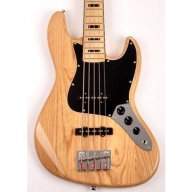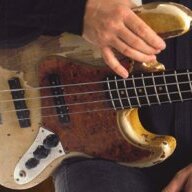
There is no best. Everyone has different hands and flexibility and different preferences. The real win here is that you have found what works best for you. Some people never figure it out.
Man you nailed it I was thinking the exact same thing!!

TalkBass has been independent since 1998. Add your voice.
Create a free account to reply to discussions, view embedded media, and browse with fewer display ads.
Join free Log in
Want zero display ads or expanded classifieds tools? Compare plans.
There is no best. Everyone has different hands and flexibility and different preferences. The real win here is that you have found what works best for you. Some people never figure it out.

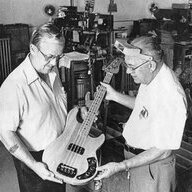
I wouldn't want a 7.25" fretboard. I feel like that radius is best for the ergonomics of barre chords. Flatter is better for single notes (hence the flat Jackson shredding geetars).


I wouldn't want a 7.25" fretboard. I feel like that radius is best for the ergonomics of barre chords. Flatter is better for single notes (hence the flat Jackson shredding geetars).

For those of you who play and prefer a bass with a 7.25" fretboard radius, is it due to a greater ease with reaching notes? I have smaller hands and it *seems* like this radius would be better for single note runs, arpeggios, but maybe not. I play with my fingers (no pick). My current basses (2) have a 9.5" radius each. Fine to learn with (I'm new to bass), but I'm curious about the differences. From what I've learned so far, the old, early '60s Fender Jazz basses (and maybe Precisions?) had this radius. Closer to the radius of an upright bass? Thanks.

A lower radius always made barre chording more comfortable for me.....less of a stress position. Again, that might be just me.Wouldn't a flatter board be easier for playing Barre chords? Please correct me if I'm wrong, I am very much not a guitarist but it seems like a flat radius would make strumming chords easier, not harder.

Bollocks yourself @Flaked Beans!


Bollocks yourself @Flaked Beans!
I will happily concede that it may be easier for you to play, but not for me, not by a long shot. My Jazz is 7.25" radius and my 5-string is 12" radius, which I consider pretty darn flat. Good news is that it has a slim neck and I can make it work, but it's nowhere near as nice to play as as my Jazz. It's a wider neck of course at 1.78" since it's a 5-string, but that's barely wider than most Precision bass necks.
So, for me, the 7.25" radius on my 60's slim C-shape neck is the best. Bear in mind, I have played a bass with that radius, shape and profile since 1965. And, since I toured for 3-years with it in the early 70's, I have played thousands of performances with that neck. Pretty much anything else is going to feel weird to me and does.


Wouldn't a flatter board be easier for playing Barre chords? Please correct me if I'm wrong, I am very much not a guitarist but it seems like a flat radius would make strumming chords easier, not harder.
That's interesting, I have small hands and short fingers and I always hated flat necks, just felt weird and unnatural. My first bass was an entry-level Charvel, I started to hate it as soon as I grabbed my first Fender neck, it felt way more comfortable.

Roger Sadowsky himself has some really nice insight on fingerboard radii. This entire vid is outstanding, but i've posted the timestamp link to pick up right where he speaks to radius:

Idk, my impression was that Roger was talking more about guitars, with the fretting out issue. He knows an awful lot about frets and fretboards, anyway, that's his wheelhouse. I like a 7.25 radius myself, both for guitar and bass, don't have any issues the way I set up. I'm glad there are options, we're not all built the same, so it's all good.Roger is an outstanding luthier. But, his primary reasoning is that there are intonation issues (actually fretting out) when string bending happens on a curved board.
The fallacy in this reasoning is that not all bassists do much string bending. The bass simply is NOT like guitar. Admittedly SOME bassists do use string bending; but, I suspect that tends to happen more in the upper register where the board is flatter.
So, while I have great respect for Roger on many points, I disagree with him on this one; even though I do own and treasure one of his NYC 4 string instruments.
BTW, the Fender Marcus Miller V has absolutely the most comfortable to my hands lower register board of any 5 string bass guitar I have yet to play. Not sure whether it is 7.25” or 9.5”.
Roger Sadowsky himself has some really nice insight on fingerboard radii. This entire vid is outstanding, but i've posted the timestamp link to pick up right where he speaks to radius:
Thank you for this post! I have a 66 PBass (7.25 radius) which i love. I'm attempting to make a project P Bass with the same vibe, but with PJ pickups. Fender doesn't make anything like that. Have been looking all over the internet to see if 7.25 vs 9.5 makes any real difference and this is the only post i found that made sense to me. "When i played it, it felt like home" was the exactly the feeling i got when i playing the 66 PBass for the first time. Even Fender's $700 replacement neck has the right nut width but 9.5 radius.When I played it, it felt like coming home. so I bought it and have played it for the last 36-years. I didn't buy it because it had the 70's-era pickup spacing (4" center to center), or because it was Olympic white, or because it had a white bound maple neck. I bought it because the neck shape, profile AND radius was the same as my 1965 Jazz.
After reading this i checked the MIM Precisions and they're Pau Ferro with 9.5 radius. The Professional and Vintage II series do have 7.5 radiuses (!) but no PJ configuration. The Performer Precision is PJ but 9.5 radius. Will have to find a custom neck i guess. Thanks again for posting!You can't get one from Fender USA now unless you have it custom built. However there were a number of MIM Jazz basses that were made with that neck and their re-issues of the 62 and 60's basses do have that neck. The re-issues from Fender US do not have that neck on them, which is really a sad state of affairs.