• TalkBass has been independent since 1998. Add your voice.
    Create a free account to reply to discussions, view embedded media, and browse with fewer display ads.
    Join freeLog in
    Want zero display ads or expanded classifieds tools? Compare plans.

70s SVT Bench Test Results

I totally agree that a tube amplifier shall be well adjusted to get best performance possible as intended by the manufacturer.
The big benefit with matched tubes is an evenly balanced strain to the tubes thus even balanced wear over time.

Unfortunatelly brand new tubes tend to differ their electrical characteristic during the "burn in" process and thus settle characteristics only after several hours of playing.
After around 50 hours hours of playing it may be useful to (re)match the tubes again which means the matching of triples for bank A and B and also (re)adjust bias for bank A and B.
I don't think there was a noticeable tonal difference but it helps to get best performance as possible and also balances wear over time.

It just reminds me on a funny story with the svt a couple of years before. On stage while playing the svt did a short nasty noise but after that happend still worked fine during the whole show. After that happened I played the svt for a couple of rehearsals till I serviced the svt just to figure out if something might happened to the svt.
To my big amazeing one of the pentodes was totally gone (out of working) but, it was very astonishing that I didn't notice the "missing" of one of the pentodes by ears.
Probably the smallish lack of power was to small to be instantly noticed and, very likely the generated THD sounded to harmonical to be noticed as nasty THD. The generated THD spectrum emphasised the even order Harmonics so (may be) the svt was actually a bit more "musical" sounding just this moment.
It's sometimes very impressing to notice that ears may interpret obvious deviations in a totally different way than measurement results might lead to expect
 
Last edited:
Yes the 6146B's can be a problem in rigs that weren't designed specifically for that tube revision. I recall a Collins unit that was particularly difficult to keep properly neutralized. Other transmitters, no problem at all.

Nice that you have a DX100 in service. I love old tube based radio equipment. I keep a R-390A reciever in my work area. What a work of art. A lot less shortwave stations are on the air these days.

I'm sitting next to an R-390A and on top of that is an R-390, got a 388 in my bedroom (only one the wife will tolerate in there) I have many old tube receivers here, Nationals, Hammarlunds, Collins, you name it It's a disease, haha!
 
  • Like
Reactions: beans-on-toast
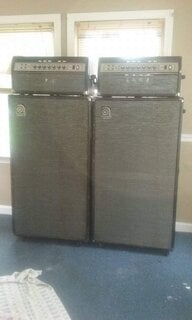
By the way--no affiliation with this auction but all this talk of early Ampegs made me look and figured I'd share:

Ampeg SVT Bass Amp & 8X10 Cabinet | eBay

Wow that thing is nice, cab doesn't match the head though. I have exactly the same thing, two late 70's heads just like that one and two squareback cabs. One of my heads is pretty nice but no where near as nice as that one, my cabs look like they've been dragged from Ca to Ma behind a station wagon.
 
As an eBay Associate, TalkBass may earn a commission from qualifying purchases.
I totally agree that a tube amplifier shall be well adjusted to get best performance possible as intended by the manufacturer.
The big benefit with matched tubes is an evenly balanced strain to the tubes thus even balanced wear over time.

Unfortunatelly brand new tubes tend to differ their electrical characteristic during the "burn in" process and thus settle characteristics only after several hours of playing.
After around 50 hours hours of playing it may be useful to (re)match the tubes again which means the matching of triples for bank A and B and also (re)adjust bias for bank A and B.
I don't think there was a noticeable tonal difference but it helps to get best performance as possible and also balances wear over time.

It just reminds me on a funny story with the svt a couple of years before. On stage while playing the svt did a short nasty noise but after that happend still worked fine during the whole show. After that happened I played the svt for a couple of rehearsals till I serviced the svt just to figure out if something might happened to the svt.
To my big amazeing one of the pentodes was totally gone (out of working) but, it was very astonishing that I didn't notice the "missing" of one of the pentodes by ears.
Probably the smallish lack of power was to small to be instantly noticed and, very likely the generated THD sounded to harmonical to be noticed as nasty THD. The generated THD spectrum emphasised the even order Harmonics so (may be) the svt was actually a bit more "musical" sounding just this moment.
It's sometimes very impressing to notice that ears may interpret obvious deviations in a totally different way than measurement results might lead to expect


I sometimes blame nasty noises on the amp. :laugh:

Some guitar players like using mismatched tubes to get that extra bit of desirable dirt. Mixing speakers, in separate chambers, is another way of tuning the sound. Then there is setting a hot bias. It burns out the tubes quicker but players like the sound. Lowering the line voltage, as was discussed, and rebiasing the amp provides more distortion. This can be harder on the amp but people care more about the sound than any associated costs. I've seen people pushing amps so hard that they were literally smoking. People that do this can afford to have it fixed.


A good tube reseller will burn-in tubes for at least 24 hours, it helps to weed out issues. They should be tested for shorts, noise and microphonics. Then matched based on cathode current and transconductant at the operating voltage and typical bias of the amp. There are other tests that be done to evaluate how they will perform in an amp.

Even after installing tubes that have gone through that process, I like to check the bias after three months, then at least once a year.


Maximatcher sells a product called maxiburn for burning in power: Maxi Test : Digital Tube Tester, Vacuum Tube Testing, Power Tube, Dual Triode, Maxi-Matcher, Maximatcher. They sell testers as well. Some companies that sell tubes have custom built machines. Mesa has RoboTube (VIDEO: Randall Smith ~ Tube Manufacturing, Testing and 'Tube Town' | MESA/Boogie®), AES has Apex tube matching (Apex Tube Matching |).
 
Last edited:
  • Like
Reactions: Sartori
I sometimes blame nasty noises on the amp. :laugh:

Some guitar players like using mismatched tubes to get that extra bit of desirable dirt. Mixing speakers, in separate chambers, is another way of tuning the sound. Then there is setting a hot bias. It burns out the tubes quicker but players like the sound. Lowering the line voltage, as was discussed, and rebiasing the amp provides more distortion. This can be harder on the amp but people care more about the sound than any associated costs. I've seen people pushing amps so hard that they were literally smoking. People that do this can afford to have it fixed.


A good tube reseller will burn-in tubes for at least 24 hours, it helps to weed out issues. They should be tested for shorts, noise and microphonics. Then matched based on cathode current and transconductant at the operating voltage and typical bias of the amp. There are other tests that be done to evaluate how they will perform in an amp.

Even after installing tubes that have gone through that process, I like to check the bias after three months, then at least once a year.


Maximatcher sells a product called maxiburn for burning in power: Maxi Test : Digital Tube Tester, Vacuum Tube Testing, Power Tube, Dual Triode, Maxi-Matcher, Maximatcher. They sell testers as well. Some companies that sell tubes have custom built machines. Mesa has RoboTube (VIDEO: Randall Smith ~ Tube Manufacturing, Testing and 'Tube Town' | MESA/Boogie®), AES has Apex tube matching (Apex Tube Matching |).
I'm not sure if tube resellers in Germany do a burn-in before set-matching. At least the resellers do not mention a burm-in procedure for offered tube sets thus I suppose there isn't any.
 
I'm not sure if tube resellers in Germany do a burn-in before set-matching. At least the resellers do not mention a burm-in procedure for offered tube sets thus I suppose there isn't any.

If they don't mention it, chances are they don't perform the burn-in. One way to cut corners. Often places that perform these extra services do not charge more, they do it to attract the customers..
 
The price is attractive which makes it easier to stockpile them.

Having a reliable and cost effective supply of tubes is important. It's a lot easier to find commonly used tubes such as a 6550, 6L6GC, 12AX7, etc. in a music store than having to order a 6146B (or W). Manufacturers today need a steady supply of tubes so they have adopted a very narrow range of tube types based on the best of what is available For instance, Loud found it better to go with 12AX7's rather than 6SL7's for the current reissue of the B-15. The 12AX7 is available from many suppliers, the sound quality is excellent. It wins over the 6SL7 when a manufacturer needs a large supply and low cost. The more they buy the better the price so it pays to use the same tube in multiple products. Same was true for the SVT amp family. Gone are the 12DW7 and 6C3 tubes, they have been replaced with more standard alternatives.


Many claim that they can't tell the difference. But this can be a can of worms. They are different tubes and perform differently. Differences would be more evident when the amp is pushed. They are both very good, but when you are chasing tone, everyone has their favorites.
Certainly you could get a custom amp built for 6146Bs, though?

One problem with using a very low distortion figure is that if the amp is designed to highlight and emphasize those harmonic characteristics, the raw distortion may very well exceed .1% or 1% or even 5% in normal, desirable operation even though to power amp is or is not directly responsible for the distortion numbers. You could be stopping the test at an unintendedly low distortion threshold even though the product was designed with this specific attribute as part of its voicing.
This is true. Sometimes it's part of the desired sound for the amp.
 
Interesting. So I guess the 6146Bs do... odd... things when cranked?

Some design changes would have made a difference. Performance aside, there is also supply and cost considerations that a manufacturer looks at.

I can tell you one thing, they never would have dreamed that the 6550 revision of the amp would still be in production today, 48 years later. A tribute to the design.
 
Some design changes would have made a difference. Performance aside, there is also supply and cost considerations that a manufacturer looks at.

I can tell you one thing, they never would have dreamed that the 6550 revision of the amp would still be in production today, 48 years later. A tribute to the design.
I mean, if some design changes would have made them a bit more stable, then they could be usable in a custom build. Just curious really.
 
Of the 5 SVT Blue-Line heads I have... 3 of them are 6146 heads... I play out with them all the time ( I rotate the usage of them) and have no reliablity issues with 6146 head...
The nights I use the 6146 amps, I get more compliments on the bass sound...being that it is deeper and punchier with more growl in in the lower mids...
One of the heads is a factory conversion from 6146 to 6550... it has steel color chassis with the reminents of originally having 6146 tubes.... very interesting what AMPEG did to get the screen voltage to go up a little...
I did document it before I put it back to 6146 tubes...for historical purposes..
I agree that the original schematic for 6146 SVT heads were not reliable and it's really not the tube's fault...the driver tube was the problem....once this is re-wired... the amp is very reliable with 6146 tubes..
 
Last edited:
There are about 2 or 3 different power amp schematics I believe for the 6146 amps. Mine had a factory mod done which involves cutting traces and adding jumpers to make it match the later schematic.

I posted about it a long time ago pointing out the differences on them.

I think that the 5-69 and 7-70 are the ones that you posted. I included a few others.
 

Attachments

  • 5-69 6146 differences.jpg
    5-69 6146 differences.jpg
    289.8 KB · Views: 83
  • 5-69 6146 poweramp.jpg
    5-69 6146 poweramp.jpg
    284.2 KB · Views: 82
  • 5-696146poweramp.jpg
    5-696146poweramp.jpg
    280.7 KB · Views: 99
  • 7-70 6146 differences.jpg
    7-70 6146 differences.jpg
    360.5 KB · Views: 101
  • 7-70 6146 power amp.jpg
    7-70 6146 power amp.jpg
    301.1 KB · Views: 140
  • 7-706146 power amp.jpg
    7-706146 power amp.jpg
    301.5 KB · Views: 78
  • ampeg svt 6146B.gif
    ampeg svt 6146B.gif
    51.5 KB · Views: 164
  • SVT (6146) Schematic-Power (Ampeg Version).pdf
    SVT (6146) Schematic-Power (Ampeg Version).pdf
    818.4 KB · Views: 128
  • SVT (6146) Schematic-Preamp (Ampeg Version).pdf
    SVT (6146) Schematic-Preamp (Ampeg Version).pdf
    539.3 KB · Views: 208
  • Like
Reactions: Sartori and timv

Latest posts