• TalkBass has been independent since 1998. Add your voice.
    Create a free account to reply to discussions, view embedded media, and browse with fewer display ads.
    Join freeLog in
    Want zero display ads or expanded classifieds tools? Compare plans.

7th Scale?

Mar 13, 2016
76
39
62
All,

I have a question about something I've read in an instruction book, Harvey Vinson's Bass Guitar Scale Manual, published by Amsco in 1985. I like to check up on the things I read, to avoid issues. This one didn't check out, and I was wondering if anyone knew anything about it.

Vinson wrote quite a number of guitar books, including some good classical guitar collections, in decades past. I don't know if Mr. Vinson is alive, passed away, or alive but not online.

The book is well laid out, with straightforward explanations followed by useful exercises. Generally, I'm impressed with it.

One of the scales he makes a priority to teach early is what he calls a "7th scale." Spelled out half-step intervals, where 1 is a half step and 2 is a whole step, he constructs the scale like this:
2113212

The A scale would then be: A-B-C-C#-E-F#-G-A.

This is the only scale I've ever seen with three consecutive scale degrees each a half-step apart.

Looking online, I find that the Mixolydian mode is sometimes called the 7th scale. Ok, but this is not a Mixolydian mode.

I can't find any scale like this on land or sea, in fact.

Maybe this was a popular scale among bassists in some music scene back in 1985, and times have changed and it's no longer played.

Or maybe someone on the forum's about to wise me up to as to how this is used all the time, only it's called something else. I'm here to learn, so lay it on me, please. Extra points if Mr. Vinson posts.

I'm pasting an image from the book below, so you can see what he said. Thanks in advance.
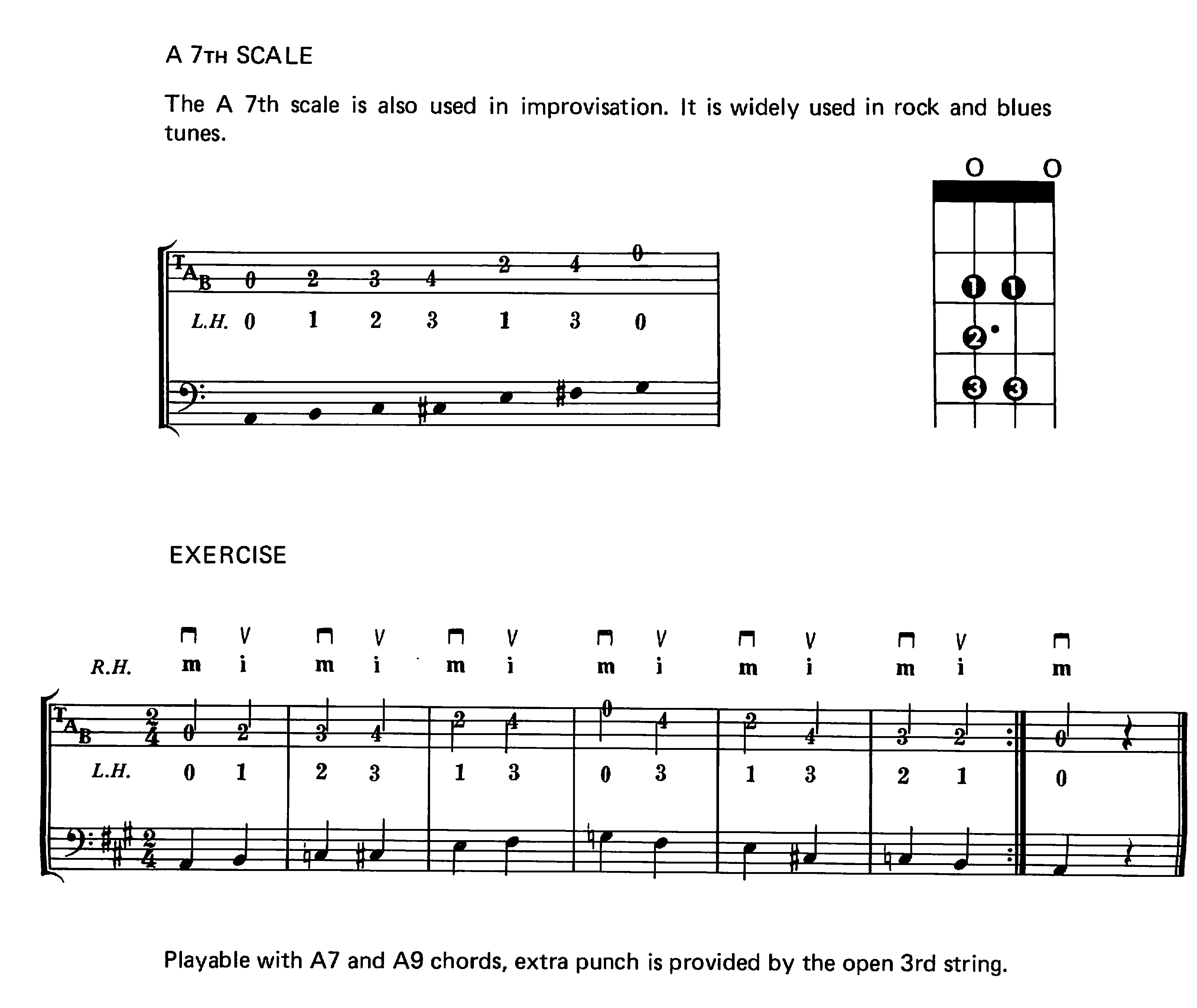

upload_2016-3-13_17-31-49.png
 
This a non-diatonic scale - if I recall it is an alternate scale - contains a 5th (in you example it is the E) a major 3rd (C#) and minor 7th (G) it can therefore be used on a A7 chord.
The mixolydian scale is most often used on 7th chord though. Both can work depending on your mood and the context.
 
Last edited:
  • Like
Reactions: Charlzm
Given his comment that this is "widely used in rock and blues tunes," I think he's just referring to what I would think of as variant of a Mixolydian scale/mode with the minor 3rd added (and the 4th, which isn't often used anyway, except as a passing tone, omitted).

A very common bass line in old rock-and-roll tunes follows the basic pattern 11-33-55-65. In some of these -- usually shuffles -- the first "3" is the minor 3rd and the second is the major 3rd. The first example that comes to my mind is the chorus ("Roll, baby, roll") in Roadhouse Blues; Jerry Garcia's "Deal" uses the exact same line. In these tunes the 7th isn't part of the main riff, but if you were to throw a 7th into your line in either tune it would be the flatted 7th.
 
French-Lefty, Lobster11,

Thanks for the quick replies.

So you think that by "7th scale," he meant the Mixolydian, and wrote it out this way because the regular, unmodified Mixolydian structure wasn't as "useful" as this variant?

Maybe he was right. But if he was teaching a modified modes, he should have said it was modified in his book. Not to knock him, it's not like I ever wrote a bass book.

Or are there still other theories?
 
It sounds to me like maybe you are confusing "scale" and "modes." To my understanding, a scale is just any subset of the 12 notes available (in our modern Western system of music) to which you restrict yourself in a given musical context. A scale can contain any number of notes: For example, "pentatonic" scales contain (by definition) 5 of those notes. In contrast, "modes" of a scale refer to alternative versions of any given scale that simply start in different places. (For example, the major and minor pentatonic scales contain the same notes, starting in different places -- they are essentially different modes of each other). But these two things often get confused because the term "modes" is so frequently used with respect to the one particular scale: the "major scale," which happens to contain seven notes, and thus yields the seven classic modes of Ionian (starting on the first note of the major scale), Dorian (starting on the second note of the major scale), and so forth.

So, to understand what Vinson means by his "7th scale," forget about modes and just think of it as one of a zillion possible scales that, coincidentally, just happens to have seven notes (like the major scale). Think of it merely as a subset of available notes from which you might build a bass line or guitar riff to a song like Roadhouse Blues or Deal, to cite two examples I mentioned previously. (Theoretically you could create seven "modes" of this scale, but that's probably not useful in most contexts.)
 
Lobster11,

I prefer your original conjecture, that it's Vinson's version of the Mixolydian mode. According to Mr. Google, the Mixolydian mode is traditionally called the 7th scale, so that would explain that.

Maybe that modified version of the Mixolydian mode was so popular in Vinson's day, that everyone he knew played it that way instead of the real version. So that's the version he taught in his book. I think he should have pointed out that it was a modified version, because I thought it was confusing. But maybe if we could ask him, he'd say that he gave the "useful" 7th scale, and that talking about "original" vs. "modified" would have been too much information.

But Vinson calling it a seventh scale due to the number of its pitches? There are so many 7-tone scales that that would be meaningless, no? I think your first answer makes more sense.

Any pre-defined series of tones ordered ascending or descending by pitch may properly be called either a scale or a mode. They don't have to be semi-tones, either, check out Indian music. Or Harry Partch.

Certain tone structures are traditionally called scales, others modes, but they're the same concept. Some tonal series have two names, like the Ionian mode, which is also called the Major scale, or the Aeolian mode which is also called the Natural Minor scale.

Don't tell me modes are alternate versions of scales, that you can't have a mode without modifying a scale. Their structure might (or might not) be arrived at that way, like starting on the 6th tone of a major scale and getting a natural minor scale. But that doesn't make the natural minor scale a "mode" of the major scale. That would be like saying the Aeolian mode is a mode of the Ionian mode. They're BOTH modes, and they're BOTH scales.

That said, let's go download some Harry Partch!
 
Looks like simply the major pentatonic scale plus the minor pentatonic scale.

Major pentatonic is a popular scale for blues/rock improvisation. 1-2-3-5-6. In the key of A: A-B-C#-E-F#

Minor pentatonic is also a popular scale for blues/rock improvisation. 1-b3-4-5-b7. in the key of A: A-C-D-E-G

Vinson omits the 4th (D in the key of A) because the sound would clash with the 3rd of popular blues/rock chords such as A7 or A9.

Put the two scales together (major pentatonic plus minor pentatonic), omit the 4th, and you get Harvey Vinson's "7th scale."

Vinson's 7th scale is not the same thing as the Mixolydian mode, although I can see why you might say that (they share 6 of 7 notes in common).
 
Don't tell me modes are alternate versions of scales, that you can't have a mode without modifying a scale. Their structure might (or might not) be arrived at that way, like starting on the 6th tone of a major scale and getting a natural minor scale. But that doesn't make the natural minor scale a "mode" of the major scale. That would be like saying the Aeolian mode is a mode of the Ionian mode. They're BOTH modes, and they're BOTH scales.
Sorry, I didn't mean to start an argument about the semantics of "modes" and "scales." My comment was prompted by the statement in your first post that "Looking online, I find that the Mixolydian mode is sometimes called the 7th scale. Ok, but this is not a Mixolydian mode," and the statement in your second post that "if he was teaching a modified modes, he should have said it was modified in his book." My point was simply that bringing the concept of modes into the picture isn't necessarily useful, and might be creating more confusion than clarity. It's just a scale, and the fact that it happens to contain 7 notes doesn't mean it is necessarily useful to think of it as a "variant" of the major scale or any of its modes. Sure, you could think of it as a variant of the Mixolydian mode of the major scale (with an added minor 3rd and omitted 4th), or as a variant of the Dorian mode of the major scale (with an added major 3rd and omitted 4th), but you could just as well think of it as a variant of the major scale (with an added minor 3rd and flatted 7th, and omitted 4th), or as a variant of the major pentatonic scale (with added minor 3rd and flat 7th), or as a variant of the minor pentatonic scale (with added major 3rd and 6th). Or, you could just think of it as a variant of the chromatic scale with 5 particular notes omitted. This "7th Scale" is just scale that happens to contain 7 notes, and that is similar to and different from other scales in various ways. It isn't inherently a variation of any of those other scales -- it just is what it is -- so you are free to think about in whatever way you find most useful in a given context. Does that make sense?
 
  • Like
Reactions: Mushroo
The use of both C and C# in the key of A refers to what is called by some people (but not all) a major blues scale.

I first saw this scale shown (but not named) in an old Guitar Player magazine bass column where it was described as the most common scale used in rock music. I first saw it (minus the flat 7th) called the major blues scale in the the book "The Blues Scales" by Dan Greenblatt.

This is different than what most people just call the blues scale which is minor: A B C D D# E G A

I've never heard of a scale described as "the seventh scale" in a music book before.
 
The use of both C and C# in the key of A refers to what is called by some people (but not all) a major blues scale.

I first saw this scale shown (but not named) in an old Guitar Player magazine bass column where it was described as the most common scale used in rock music. I first saw it (minus the flat 7th) called the major blues scale in the the book "The Blues Scales" by Dan Greenblatt.

This is different than what most people just call the blues scale which is minor: A B C D D# E G A

I've never heard of a scale described as "the seventh scale" in a music book before.
The "major blues scale," huh? That's really interesting. The (minor) "blues scale" was actually the first thing that came to my mind when I initially read the OP, in which he emphasized how unusual it was for a scale to contain "three consecutive scale degrees each a half-step apart." It's also interesting that the (unnamed) version you saw omitted the (flat) 7th, because in all of the examples I can think of that use the scale described in the OP, such as (the chorus in) Roadhouse Blues, that 7th isn't used -- but it nevertheless sounds very bluesy because of the added b3.
 
  • Like
Reactions: Mushroo
Yes, a modified Mixolydian. Notice he says "extra punch is provided by the open 3rd string."

Playing the A as an open string does not change the identity of the scale. Any scale is defined by its pitches, not by the fingering on the instrument. You could play it with an open A string, fretted A at the 5th fret on the E string, or any other fingering, and it would still be a "Harvey Vinson A 7th Scale."

You probably understand perfectly well that scales are musical sounds, not shapes on the fretboard. I just wanted to clarify that point, in case a beginner reads this discussion they are not confused.
 
Last edited:
  • Like
Reactions: Lobster11
Playing the A as an open string does not change the identity of the scale. Any scale is defined by its pitches, not by the fingering on the instrument. You could play it with an open A string, fretted A at the 5th fret on the E string, or any other fingering, and it would still be a " Harvey Vinson A 7th Scale."

You probably understand perfectly well that scales are musical sounds, not shapes on the fretboard. I just wanted to clarify that point, in case a beginner reads this discussion they are not confused.
Not only that, but from the material posted by OP, a beginner might also be misled into believing that the scale only exists in the key of A. I certainly hope that Vinson clearly makes the point elsewhere that the scale is independent of the key. What he really should have written in the quoted section is something like, "One advantage of this particular fingering of the scale, in the key of A, is the extra punch provided by the open 3rd string."

And as long as we're being critical, I'm not even sure that having "extra punch" on that particular note of the scale would even be desirable in most contexts.

I sure hope the rest of the book is better than this excerpt!

Edit: I now see that the excerpt shown in the OP does in fact specify that this is the "A 7th scale" -- i.e., that this particular example is in the key of A. I had misread "A 7th scale" to mean that this is one (of perhaps many) 7th scales, rather than the intended meaning of "7th scale in the key of A." Stupid me.
 
Last edited:
  • Like
Reactions: Mushroo
All this is semantic, again, on a 7th chord you can use any scale or mode that is major (although in a blues contest a minor blues scale works too) and contains a minor 7th, period. Although, for bass playing purposes I suggest, as Jaco himself would, to focus more on triads and passing tones than scales in general.
 
Looking at the notation and hearing it in my head... sounds like a blue note resolving to the third (B# --> C#). And it's more of an arpeggio of the A7 chord with some passing tones, with the skip from the 3rd to the 5th. I wouldn't think of that as a scale, really.

Hey, just the way I'd hear a run like that.
 
  • Like
Reactions: Mushroo
The "major blues scale," huh? That's really interesting. The (minor) "blues scale" was actually the first thing that came to my mind when I initially read the OP, in which he emphasized how unusual it was for a scale to contain "three consecutive scale degrees each a half-step apart." It's also interesting that the (unnamed) version you saw omitted the (flat) 7th, because in all of the examples I can think of that use the scale described in the OP, such as (the chorus in) Roadhouse Blues, that 7th isn't used -- but it nevertheless sounds very bluesy because of the added b3.

T
The use of both C and C# in the key of A refers to what is called by some people (but not all) a major blues scale.

I first saw this scale shown (but not named) in an old Guitar Player magazine bass column where it was described as the most common scale used in rock music. I first saw it (minus the flat 7th) called the major blues scale in the the book "The Blues Scales" by Dan Greenblatt.

This is different than what most people just call the blues scale which is minor: A B C D D# E G A

I've never heard of a scale described as "the seventh scale" in a music book before.


This seems like the best explanation to me. This "A Major Blues Scale"/"7th Scale" is pretty close or exactly the same notes what would be its relative minor blues scale, an F# blues scale. Same relationship as an A major scale and it's F# relative minor. Never heard it called a "7th scale" but thats not surprising, musicians are full of little quirky things like that that can differ between regions and generations.
 
  • Like
Reactions: Mushroo
F# blues scale... A major scale and it's F# relative minor

Nail. Hit. Head.

F# "minor blues scale" = 1-b3-4-#4/b5-5-b7 = F#-A-B-B#/C-C#-E
A "major blues scale" = 1-2-#9/b3-3-5-6 = A-B-B#/C-C#-E-F#

Harvey Vinson adds the b7 (to accommodate the G natural in chords like A7, A9, or A7#9) and calls it his "7th scale".

Skilled improvisers would instinctively think of this as a hybrid of major and minor pentatonic sounds, typical of blues/rock-influenced 20th or 21st-century music.
 
Ha! Shame on me for not noticing that this "7th scale" contains exactly the same notes as the (minor) "blues scale" in the relative minor key, apart from the addition of the 7th. Thanks to @whitelines and @Mushroo for pointing that out.

I gotta say, though, that this only makes the name "7th scale" seem even odder to me. The characteristic of the scale that gives it its distinct flavor isn't the 7th, but rather the inclusion of both the major and minor 3rd. And as I noted in an earlier post, a lot of applications of it (e.g., the bass line in the chorus of Roadhouse Blues) don't use the 7th at all, yet still sound "bluesy." The name "major blues scale," as noted by @brianrost, seems much more apropos to me.