It depends on what sound you want. If you're chugging away at a downtuned string with a pick trying to sound like a freight train, then the 15" is probably going to get you a deeper rumble.
On the other hand, if you're thumping away in a disco band you probably want the faster response of the smaller speakers and more highs and clarity than you're going to get with a 1x15.
This isn't necessarily true anymore. It absolutely was true back in the early 70's when I was touring with a nightclub group for 3 years. I started the tour with my 1966 Fender Bassman amp (212 cab); found out it wouldn't cut it for some of the venues we played That Bassman amp would fart out its Jensen speakers if it turned the volume knob above #7, and that just wasn't loud enough for some of the places we played. So while we were playing a large club in Lincoln, Nebraska in late 1971, I bought a Standel MCIIb/SAM30b piggy-back amp (215 cab) .
The head was just the preamp and very light. The speaker cab however was something else. It was a powered bass reflex cab that was twice as deep as a Vox Super Beatle or my Fender Bassman. As explained to me at the time, the sound coming out the back of the speakers was redirected around and came out through 4 round ports that were mounted vertically next to the 2x15" CTS speakers. It was a really loud cab and pushed enough air out of those ports that if I stood within 3 to 4 feet of it with the volume knob on #3 (9 o'clock), it would flap my bell bottoms.
It provided a much bigger bottom end than my Fender Bassman did and it also had 4-times the power. That cab was really heavy because it was a lot of wood; the CTS 15" speakers had massive magnets; and the amps were inside the speaker cab (one amp for each speaker). Was louder than the SVT, which was new at the time, and right there with the acoustic 360/361.
You can see part of my Standel amp in the pic below next to my guitarist's Vox Super Beatle amp. Easy to see how much deeper my Standel was there.
Now days I use a DNS-210 cab for my indoor venues. It's a little unusual for a 210 though in that it handles 700-watts rms, can replicate the fundamental down at 34Hz; and is amazingly LOUD. It has the tightest, most focused, full, and clear bottom end of any cabs I've played through over the year. It's definitely a better sound than my old 215 Standel amp/cab was, but that was over 50-years ago. The clarity and articulation is superb.
I also have the DNS-410, which I bought back in 2015, thinking it was the last cab I'd ever need to buy...boy was I wrong. Couldn't use it in small venues because owners would say, "that's too much for here". Then I bought a couple of Eden 112 cabs and finally in 2019 bought my DNS-210 cab for small and medium venues. Ended up using it in all my indoor venues because it is so loud. Just use my 410 for outdoor venues and music festivals.
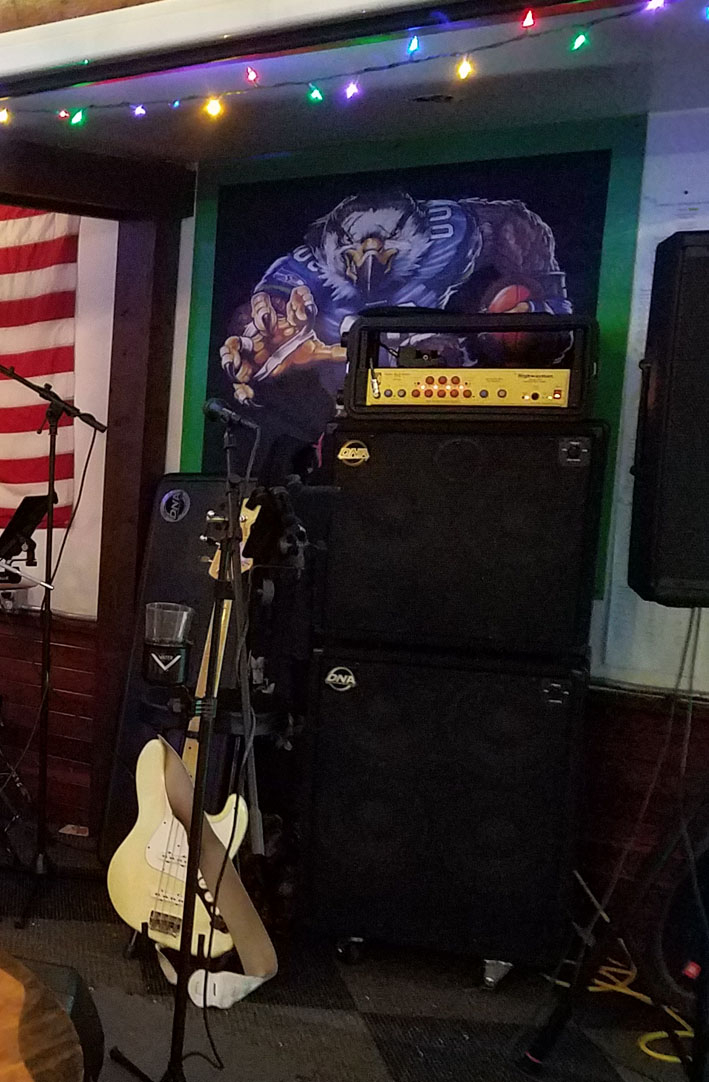
Here's a picture of both my DNS cabs the one time I stacked them. Was the first large venue I played with my 210 and wasn't sure it would cover it. So I brought my 410 with me and could simply unplug my 210 and plug in my 410 if needed. Didn't need to. The DNS-210 was more than enough and my 410 just performed amp stand duties that evening (made me promise not to relegate him to that ever again...).
Point is that my 210 has better low end than any other cab I've found. So a 210 cab can absolutely have a lower bottom end than a 115. Speaker designs have advanced by leaps and bound over the last 50-years. The old sayings about the 10's being punchy and quick but weaker in the bottom end; the 15's giving the best bottom end but the least punch; and the 12" speakers as a mix in between the two, just doesn't hold water anymore. It depends upon what the designer of the cab designs the speakers to do in the cab he's designed to put them in. There's actually a whole science in designing and matching speakers, tweeters, crossovers, baffles, and porting in a cab and today's designers can do some wonderful things with them. Back in the 60's it was trial and error...and a LOT of error. Now days, it's science and math. If at all possible, take your bass and try the different rigs with it. That way you hear what you sound like through it. It may surprise you where you end up.