• TalkBass has been independent since 1998. Add your voice.
    Create a free account to reply to discussions, view embedded media, and browse with fewer display ads.
    Join freeLog in
    Want zero display ads or expanded classifieds tools? Compare plans.

Double Bass A hard-to-lift bass

I have bought a 4/4 gamba-shape bass whose middle bout curves are rather shallow and do not give sufficient grip for the fingers. I have thought of glueing/screwing a nicely shaped strip under the upper block to give my fingers more to hook onto. At the moment I very gingerly and awkwardly roll the bass further before being able to lift the bass without scraping the edges or even slipping and dropping the bass.

I have wondered how people with pear shaped basses cope with this and whether anyone has resorted to such a strip. Any clues would be welcome?

 
I have wondered how people with pear shaped basses cope with this
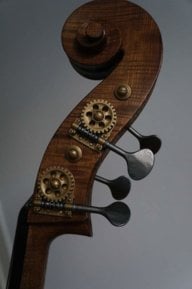
DSC_0529 (1).jpg

My bass has a little handle attached to it... It is not much - you can squeeze two fingers in, but not good for carrying it a longer distance... This wouldn't be enough for a heavier bass.
 
Put a finger into one end of the f-hole and only apply pressure sideways (towards the edge of the top) never inside or out.

Alternatively let the luthier put an external a bit wider lining on the rib and let the bass slide. The lining would loose laquer and color over time but rib and top are safe. If the lining ever wears down, it can be replaced.
 
There would be a lot more damage if the fingerboard separates from the neck if grabbing the end of the fingerboard.
Before trying any potentially dangerous hint it would be a good idea to inspect the bass if a certain method could be applied.

At home I have a strip of PVC floor where I leave and slide the bass.

I also have a lengthwise slit PVC tube put on the edges of the top. Probably not the favourite solution for a professional classical player, but since it is clear and colorless it could hardly be detected in a few meters distance.
Works well in the beginning, but after some time the tube can easily drop off when you put the bass into or out of the bag. Glue does not stick to inner side of the tube.
 
Without its cover and both on stage or at home I like to roll the bass up with both hands, one at the base of the neck and the other hooked over into the top of the C bout, until I feel it safe to lift it the rest of the way to vertical. This avoids sliding the bass on the floor that will wear the edges, particularly of the spruce front. Trouble is that the heavy new bass needs to be much more vertical before I can safely lift it and avoid dropping it with my RH . A strip of varnished wood attached to the block through the rib at the top of each C bout would give fingers something more positive to hook over (never a worry with violin corners!). They would not have to be deep or wide. Has anyone seen these strips used?
 
A strip of varnished wood attached to the block through the rib at the top of each C bout would give fingers something more positive to hook over (never a worry with violin corners!). They would not have to be deep or wide. Has anyone seen these strips used?

Yes. The ones I've seen were just glued to the rib and were ebony. They seemed to work just fine without being attached to the block.
 
  • Like
Reactions: Chris Fitzgerald
Perhaps you could slightly repurpose something like this.

Bass Edge Protector Set - Bumpers (Leather or Rubber)
That's what I'd do. I made my own bumpers:

I took two 1/2" wide strips of 1/4" thick belting leather (bought from McMaster-Carr), glued the first one down with contact cement (it will loosen up with oil), glued the second one on top of the first one, used a fresh razor blade to bevel the edges, and stained them with two or three coats of Zinsser Bullseye Amber Shellac. These are edge bumpers (and when they eventually get worn down, it'll be easy to add on top of them) but I see no reason on earth why a single or double layer, just inside the upper corner, wouldn't work just fine and be visually unobtrusive. Plus easy to remove if need be.
 
Maybe it's me, but particularly with a heavier instrument I'd worry that glue holding a wood strip under the corner could easily give way at the worst time. You're using adhesive on the finish, which won't work securely for anything reversible. "I know, but I've done it and it's okay" just wouldn't satisfy me. Most often when you have to pick it up and carry it, you need it to be horizontal or on a 45-degreeish angle, and even if it were secure that little handle would be close to useless there.

I'm not shy about grabbing the bass (consciously!) by the neck and f-hole, but I don't own a carved-top bass either, and I understand the risk there. I don't have experience with this, but in your place I might try rigging up a strap, like what cellists use to keep the pin from sliding away from the chair, with a strong loop for the endpin and a big D handle, preferably of sturdy nylon, wide for more stability and just long enough to come around the bout to where you'd put a sensible handle on your bass cover.

Okay, now everyone can tell me why that won't work.
 
Is this a recent build? Can you contact the original builder and ask what he or she recommends?

Or, perhaps contact another luthier and ask for a recommendation?

It might be nice to get an opinion from someone who can fully assess the technical details involved in person.

The idea of bumpers seems like a natural thing to have on this instrument anyway, but I don't know if I'd trust a contact adhesive with the whole weight of carrying a fine double bass.