• TalkBass has been independent since 1998. Add your voice.
    Create a free account to reply to discussions, view embedded media, and browse with fewer display ads.
    Join freeLog in
    Want zero display ads or expanded classifieds tools? Compare plans.

Double Bass A twisted tailpiece.

PaperbackRyder

Supporting Member
Apr 21, 2007
919
1,068
69
Maynard, MA
The title should get some fun comments all by itself....But I just noticed:
I have gut D and G, installed conventionally with the washer underneath and the string running over the top of the tailpiece.
Velvet Anima A and E are installed with the loops over the top and the string running from the underside of the tailpiece.
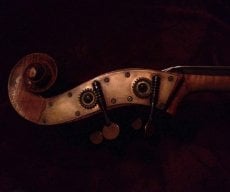
Tailpiece is twisted, with the G side about 3.5 inches off the top and the E side about 5 inches off the top.
Is this a problem and if so do I simply reverse the Velvet installation?
I appreciate any insights.

14877705764982084181820.jpg
 
KFS is right, the tail gut might have slid a bit to the bass side.

An increased static individual string load on the bridge (sharper break-over) can emphasise harmonics in that string. And then there's looks.
 
Last edited:
The tailgut has nothing to do with how the strings are mounted, but if you look at the vague bit at the bottom of the pic you can see that the end of the TP seems offset a bit to the left wrt the saddle. In less technical speak: looks dodgy.

And that bit from #7 translates to: string relatively more bent --> might become brighter & more direct. Would be interesting to hear what difference, if any, the OP hears in particularly the A & D strings. I have never tested this on a per-string basis (where the total load on the top remains constant), but I do have a test bass w/ adjustable saddle height.
 
Last edited:
Well, I certainly do sometimes experience excitation by a specific tensional component. Now then, this phenomenon is described a statistical probability, not and frequency occurs only when certain background parameters, as well as, but not specific to. Foreground stimuli, within described limits, can create aforementioned boner effect. Limitations, however, on observational effect, i.e. "Heisenberg Principal" are causal, as opposed to correllatory, so it is determined that no excitation is demonstrated. Just annoyance.
 
Well, I certainly do sometimes experience excitation by a specific tensional component. Now then, this phenomenon is described a statistical probability, not and frequency occurs only when certain background parameters, as well as, but not specific to. Foreground stimuli, within described limits, can create aforementioned boner effect. Limitations, however, on observational effect, i.e. "Heisenberg Principal" are causal, as opposed to correllatory, so it is determined that no excitation is demonstrated. Just annoyance.
Prof. Irwin Corey (RIP) would be proud!
 
  • Like
Reactions: SAlcott
Mulitple efficacious stimuli aside...
I flipped the Anima's because the underside edge of the tailpiece is squared-off and did not want to run the guts over that edge, get to sanding it round at 11:30 on a weeknight. The strings now feel similar tension-wise and sound good across all four. Arco is TBD.
End result is the tailpiece twist (a Chubby Checker B-side?) is about 3/4's improved. The difference being that flipping the Velvets removed about 3/4 of the difference in break angle from TP to Bridge. The Animas now leave the tailpiece from the top edge instead of the bottom edge, while the guts are still coming off the top of the TP's rounded bar-thingy.
SO the angle of dangle is directly proportional...
And yes the bottom of the tailpiece does look a little wonky at the cleat, but that's just some photo parallax. Straight-on it looks fine.
IMG_20170223_162750217.jpg
 
Just because I have seen your picture:
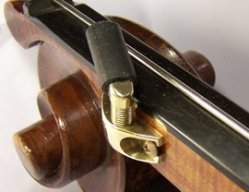
I would put the jack assembly as close as possible to the tailpiece (maybe with a few millimeters distance). That way the underlength has more room for vibration.
If there are no sharp edges at the clamp you might even want to move the jack assembly to the G and D strings and close to the tailpiece.

For a conventional mounting method for the Animas you might want to take a short rod, about half an inch long and turn the strap around as much as needed and fiddle the string through the loop then. Might want to fix the strap to the rod with tape and mount conventionally.
Just have a look that the rod is perpendicular to the slot in the tailpiece when tuning up.