
• TalkBass has been independent since 1998. Add your voice.
    Create a free account to reply to discussions, view embedded media, and browse with fewer display ads.
    Join freeLog in
    Want zero display ads or expanded classifieds tools? Compare plans.

A "why" about bolt on neck joints....

My guess would be that

97% of instruments are common production bolt-ons, with little time spent on the joint
1% are high-end assembled or "luthiered" bolt-ons, with more time spent on the joint
1% are set necks, which require time spent on the joint
1% are neck-throughs, with no time spent on a joint!

or something like that.

 
So Brad those two are basses you have built? How does the neck joint work? Obviously you've got a very long neck tenon. Does it slide in under the top of the guitar? Looks pretty wild!

I'm really interested in this because I want to do a nice smooth joint and originally the customer asked for a bolt on. After talking to him, he said he wouldn't mind a set neck, but I was wondering if I could do it bolt on anyways.

This is the joint I would really LIKE to do. (I'm pretty sure Scott won't mind me using this picture...) I'm not sure if it's possible with a bolt on though. Well, I think anything's possible... but ya know...

[Invalid or Expired Link Removed]
 
So Brad those two are basses you have built? How does the neck joint work? Obviously you've got a very long neck tenon. Does it slide in under the top of the guitar? Looks pretty wild!

I'm really interested in this because I want to do a nice smooth joint and originally the customer asked for a bolt on. After talking to him, he said he wouldn't mind a set neck, but I was wondering if I could do it bolt on anyways.

This is the joint I would really LIKE to do. (I'm pretty sure Scott won't mind me using this picture...) I'm not sure if it's possible with a bolt on though. Well, I think anything's possible... but ya know...

[Invalid or Expired Link Removed]

Kevin Brubaker designs and builds the basses... I just play 'em;). You're right, it's a mortise and tenon with a very long tenon (relatively speaking of course). The pocket goes about 8" into the body.

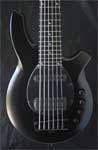
It would be nice if it were as simple as just building a pocket to put the neck in but the challenge is really amplified by doing a singlecut (which of course you know). Getting everything at the right angle and not having to secure the neck towards the end of that upper horn area... I got to see some of the work involved in getting that right and it took a while to get everything worked out. Since around 2002 (when I got my first singlecut Xtreme) the basic joint has remained the same, the upper horns have evolved and he's done a few different lower bouts too, the most drastic (so far) being the white bass above for Rev. Jones. The latest basses were a couple of sixes that have a smooth taper that really gets out of the way for upper fret access... without eliminating the lower horn. I have a personal semi hollow six that should be done soon, I can PM you pics when it is.

To achieve a smooth taper, instead of the neck and body meeting at a fairly perpendicular angle, there's extra wood on the neck that's used to share the taper, pretty much like the pic you put up. That way you don't end up with a thin wedge meeting a flat neck which was mentioned as a possible issue earlier in the thread.

If having that bolt up the neck isn't an issue you could use a more standard 3 sided neck pocket. One idea I had as a way around that upper body bolt would be to build a tight neck pocket and do something along the lines of a dovetail joint (one side of the neck mating with the singlecut horn) to eliminate side to side and up and down movement. Again, getting the angle right would probably be the fun part.

And I could easily be talking out of my butt. These are my observations. You tell me:D
 
I originally designed it so there would be a strip of the body wood that ran up the bass side of the neck so I could have bolts there. On a six-string bass neck though, this strip takes up about half of the neck, which means you would have to scrunch your thumb to get up in the higher frets.

So I'm thinking I either need to have wood behind the whole neck, or of course if I do a set neck I can do just like Scott has done.

I can definitely imagine how much of a pain in the rear it must be getting all of the angles just right on that neck joint and still keep a nice tight/clean looking fit... phew!!!
 
One thing also that may speak against a lot of sculpting at the heel of a bolt on bass is also that one needs a decent amount of wood to support the bolts.
In my experience more wood at that point sounds better than less wood.
I am by no means saying that it is always the case.
 
Ron Couts of Link Removed builds some really sharp, and really innovative basses and guitars, and he does them with bolt-ons. His trick, is to make a cover plate that creates a smooth tapered transition from the neck to the body. He's got really neat design elements. Unfortunately, I tried checking his website and Myspace pages for pictures that show that neck joint, but he doesn't have any right now.
Here ya go!

Neckjoint.jpg
 

Latest posts