
Enjoy the benefits of a premium membership!
Upgrade Account
-
TalkBass has been independent since 1998. Add your voice.
Create a free account to reply to discussions, view embedded media, and browse with fewer display ads.
Join free Log in
Want zero display ads or expanded classifieds tools? Compare plans.
You are using an out of date browser. It may not display this or other websites correctly.
You should upgrade or use an alternative browser.
You should upgrade or use an alternative browser.
According to Fender…
- Thread starter unclebass
- Start date
More options
Who Replied?


Yes. It’s not 110. It’s 0.110. The difference between that and 0.105, for example, is 5/1,000 inch. That’s approximately 1/8 mm. Should fit fine in a factory cut nut. Squier nuts are not cut to order, they’re formed for mass production.
Yes. It’s not 110. It’s 0.110. The difference between that and 0.105, for example, is 5/1,000 inch. That’s approximately 1/8 mm. Should fit fine in a factory cut nut. Squier nuts are not cut to order, they’re formed for mass production.
the 110 is the least of my worries. More worried about the other strings, especially the 58G string.

Those strings will fit, but they won’t fit properly. Nuts aren’t cut to extremely precise tolerances on affordable instruments, but you’ll likely have to look into widening out the nut slots.

As others have pointed out, it's likely pre-cut nuts in keeping with the price point, and you'll have to see if they made a batch for this fretless to fit these somewhat larger tape wounds. On the other hand they may have cut enough width to allow for different user gages.
If this bass turns into a long-term keeper, you might think about a full-on pro setup including a new nut cut to your preferred strings.
If this bass turns into a long-term keeper, you might think about a full-on pro setup including a new nut cut to your preferred strings.

JeezyMcNuggles
Inactive
- Feb 23, 2018
- 14,723
- 20,970
- Disclosures
- I suck, but nobody really notices
Yeah, it'll work fine. But, without filing the nut out for a larger Guage string, your strings will be farther away from the fretboard then you might enjoy. Standard cut is 100 - 45 I believe. I play medium guages 105 - 50 (55 if I can find one)View attachment 5355876
Fender tapes are 58, 72, 92, and 110. Unsure about their information, wanting to see if anyone here can verify this…
Guitar Center sells nut files for pretty cheap. If you end up loving those strings, I'd invest in a set of the same gauge files as the strings you like. That way, you can set it up much nicer.
D
Those strings will fit, but they won’t fit properly. Nuts aren’t cut to extremely precise tolerances on affordable instruments, but you’ll likely have to look into widening out the nut slots.
And if they won't fit properly (which I'm 95% certain will be the case here) the strings will not be seated properly in the nut slots. This can cause several issues:
-A negative impact on the tone of open strings because the point of contact between string/instrument is reduced (basically an air gap under the strings).
-It can also cause buzzing at the nut. Particularly on the open A-string which has a very poor break angle over the nut on Fenders/Squiers even when the nut is filed correctly (Ultras with "stealth" retainers excepted).
-Tuning stability issues because the strings are "pinched" inside the nut slots and get stuck. This tension will gradually be relieved when you play the instrument, causing it to go out of tune.
-You will also get a higher action and a bass that will be harder to play in the lower positions. The intonation may suffer from this too.
You can even risk that the nut itself cracks when the strings are pressed into slots that are too narrow.
I'm 95% certain that the person you talked to at Fender didn't have a clue what you were actually asking about.
If it becomes necessary to widen the slots (which I'm pretty sure will be the case) you need to be careful that you don't file them too low. You only want to widen them, not go any lower (unless of course the slots are too high from the factory, which is very often the case).

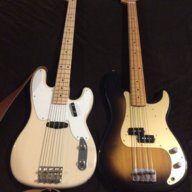
Whenever I cut a new nut I “lap in” the slots using used roundwound strings with a bit of abrasive (usually lapping compound) . Alternatives could be something like rubbing compound or even a coarse toothpaste. I use the string in a saw like fashion going back and forth. You’ll likely have to widen one or two of the slots to fit that particular string gauge.

I have played the Fender tapes. All instruments should have the setup tweaked for the make, model, and gauge of strings desired: nut, truss rod, intonation, string height, pickup height. The tape is the thickest of any of the common tapewounds, but doesn't add significant mass, therefore doesn't add measureable tension. These strings are about the lightest gauge strings under the tape of any tapewound. I unwound the tape off a set that I had played until the divots in the tape caused the strings to be unstable. Underneath the tape I measured the strings as 37 through 88. Yes, I could not believe it either and double checked my micrometer against known standards. I confirmed: under the tape, the strings are conventional rounds 37 through 88.
That works so long as you keep the string at a perfect angle to provide a good witness point on the fret board side of the nut and gradually slope the slot back towards each tuner. It is very, very difficult to keep the string straight and not succumb to the tendency to wobble, which defeats the purpose of providing a proper witness point.Whenever I cut a new nut I “lap in” the slots using used roundwound strings with a bit of abrasive (usually lapping compound) . Alternatives could be something like rubbing compound or even a coarse toothpaste. I use the string in a saw like fashion going back and forth. You’ll likely have to widen one or two of the slots to fit that particular string gauge.

When switching a bass from rounds to tapes I always dress the nut and do a full set up.
It reduced friction for noticably better tuning key response and overall stability.
I remove the material on top of the nut between string grooves. Until only half of the strings diameter is in contact. Dress the slots as iiipopes described, polish with graphite before re-stringing.
It reduced friction for noticably better tuning key response and overall stability.
I remove the material on top of the nut between string grooves. Until only half of the strings diameter is in contact. Dress the slots as iiipopes described, polish with graphite before re-stringing.
That’s why I glue lengths of string onto the edge of pieces of wood and use them like a file.That works so long as you keep the string at a perfect angle to provide a good witness point on the fret board side of the nut and gradually slope the slot back towards each tuner. It is very, very difficult to keep the string straight and not succumb to the tendency to wobble, which defeats the purpose of providing a proper witness point.
Latest posts
-

-
Post a funnier picture than the one above - Parallel Universe Edition
- Latest: BassicJazzy
-

-

