
Enjoy the benefits of a premium membership!
Upgrade Account
-
TalkBass has been independent since 1998. Add your voice.
Create a free account to reply to discussions, view embedded media, and browse with fewer display ads.
Join free Log in
Want zero display ads or expanded classifieds tools? Compare plans.
You are using an out of date browser. It may not display this or other websites correctly.
You should upgrade or use an alternative browser.
You should upgrade or use an alternative browser.
Acme Full Range Series III 112
- Thread starter KJung
- Start date
More options
Who Replied?
Phew! Read the whole thread in one go! (Well, one with snack breaks.) Following with interest.
I'm not ready to drop $1200 on cabs just yet (and I do slap), but I wonder how you think two of these (either two fullrange, or a full + flat) would match up with a Shuttlemax 12.0? Two, 4 Ohm cabs would let you take advantage of the amp's 600 watts/side.
If I, for whatever reason, decided to use the Acm12's as my primary rig, I would purchase a ShuttleMax 12.
However, if slap was a significant part of my performance technique, I would personally choose other cabs.
I was wondering about the ShuttleMax 12 myself. I have had the FlatWound now for 2 weeks and have not yet parted with my Low B Series II. Andy told me he had a chance to hear a bass player with that combo and said that it was quite amazing. I have a Shuttle 9.0 now and to use both boxes I would have to break out my old pre-power rack. Kind of defeats trying cutting down the weight....Maybe just once....
Also curious, Ken (or any other Thunderchild owners reading), if you've tried the port plugs with that cab and what effects you've noticed with respect to the low end feel/extension/slappability at higher volume.
I have not found the need to use the port plugs on the Thunderchild in any situation at any volume myself. Putting both in raises the tuning, which for anything other than a boomy DB in a boomy room, is not necessary with the Thunderchild, which is pretty punchy and tight to begin with. I guess putting one in lowers the tuning a bit, but I assume there is a price to pay with that also.
I find the whole package of the Thunderchild pretty perfect (and by perfect, I mean a pretty optimal compromise of low end to volume with a small cab). I just don't feel the need to mess with it! It will never sound as full as my big Bergs, but for its size and weight, it is a blessing from god for the freelance gigging bassist!
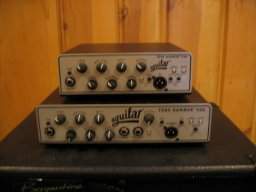
Huh? A Flatwound stack is comprised of two one way 112 cabs. A Flatwound/Fullrange stack has a signel tweeter.
Edt: FYI, I undersand what you are saying regarding getting the 12's closer together, but there is not a human alive who could reliably tell the difference between those stacking configurations in a live setting regardless of position around the room (I would suggest in ANY setting) given the few inches of difference. You've done a pretty good job of education yourself on acoustic science. Your next step would be to get a bit of information on the scientific method in general, especially in the area of variance explained (i.e., the fact that there are MANY effects that are valid and real, but trivial in impact in the real world).
+1. IMO, for players seeking the sound for which the Flatwounds and FullRanges are optimum, the whole discussion about driver proximity in a stack and dispersion in general is overblown. In the real world, the tone and register at which these cabs will typically be used (by knowledgeable players, anyway) is pretty pervasive and omnipresent. After just a few feet, "off axis" is simply not a practical issue. Just ask my guitar player who stands laterally from me, directly on the other side of the drums. I think the players who have actually gigged with these cabs--or who have at least heard them in the context of all the real-world variables--will conform this.

Bluesy Soul, Did you need to take the rubber feet off of one of your cabs to get them to stack?
Bluesy Soul, Did you need to take the rubber feet off of one of your cans to get them to stack?
Good question. I don't HAVE feet on my cabs! I got both cabs from Andy in what was essentially the prototype stage. He may have decided to add the feet after that; or, knowing that I would be stacking them sometimes, he may have left the feet off intentionally. I'll ask him.
Thanks for the answer, Ken.
Just to make sure I'm straight on this: Putting in both plugs raises the tuning. (And basically turns the Thunderchild into a sealed cab, does it not?) However, putting in one plug lowers the tuning? It seems to me like it should raise the tuning, just not so much... Assuming that it does lower the tuning and I just don't understand the mechanism by which this works (a likely enough scenario, and Duke's own post earlier in the thread says as much, unless I misread it), I guess you'd start to see some of the same compromises you see with the Acme cab.
Sounds like the Thunderchild might be more tolerant of high-volume transients (as in slap) than the Acme, at the expense of deep low end. Is this accurate?
Just to make sure I'm straight on this: Putting in both plugs raises the tuning. (And basically turns the Thunderchild into a sealed cab, does it not?) However, putting in one plug lowers the tuning? It seems to me like it should raise the tuning, just not so much... Assuming that it does lower the tuning and I just don't understand the mechanism by which this works (a likely enough scenario, and Duke's own post earlier in the thread says as much, unless I misread it), I guess you'd start to see some of the same compromises you see with the Acme cab.
Sounds like the Thunderchild might be more tolerant of high-volume transients (as in slap) than the Acme, at the expense of deep low end. Is this accurate?
I have not found the need to use the port plugs on the Thunderchild in any situation at any volume myself. Putting both in raises the tuning, which for anything other than a boomy DB in a boomy room, is not necessary with the Thunderchild, which is pretty punchy and tight to begin with. I guess putting one in lowers the tuning a bit, but I assume there is a price to pay with that also.
I find the whole package of the Thunderchild pretty perfect (and by perfect, I mean a pretty optimal compromise of low end to volume with a small cab). I just don't feel the need to mess with it! It will never sound as full as my big Bergs, but for its size and weight, it is a blessing from god for the freelance gigging bassist!

Good question. I don't HAVE feet on my cabs! I got both cabs from Andy in what was essentially the prototype stage. He may have decided to add the feet after that; or, knowing that I would be stacking them sometimes, he may have left the feet off intentionally. I'll ask him.
Thanks. I figured if they were going to interfere I could have him leave the feet off the second cab.
Same thought, same time...
Great minds think alike.... or something like that
 .
.
I had a Shuttlemax 9.0 at the time I received these cabs. Personally, I prefer the voicing of the G-K MB series with the Flatwounds and Full-Ranges, so I sold the Shuttlemax 9.0. I really did like the sound of the Shuttlemax 9.0 with them, however. For my tone goals, etc., it was honestly the difference between great and really great.Phew! Read the whole thread in one go! (Well, one with snack breaks.) Following with interest.
I'm not ready to drop $1200 on cabs just yet (and I do slap), but I wonder how you think two of these (either two fullrange, or a full + flat) would match up with a Shuttlemax 12.0? Two, 4 Ohm cabs would let you take advantage of the amp's 600 watts/side.
Admittedly I've not had the opportunity to try this combination yet; but I would speculate that two, 4-ohm Acmes, each being driven by one of the 600-watt sides of a Streamliner, should sound nothing short of fantastic and you could take them anywhere.
Thanks. I figured if they were going to interfere I could have him leave the feet off the second cab.
Or stack the cabs on their sides. I didn't mean to be so snarky with RPSANDS. Little downside to doing that, and perhaps a slight positive in some cases, along with the ability to use the stacking/locking corners.
Thanks for the answer, Ken.
Just to make sure I'm straight on this: Putting in both plugs raises the tuning. (And basically turns the Thunderchild into a sealed cab, does it not?) However, putting in one plug lowers the tuning? It seems to me like it should raise the tuning, just not so much... Assuming that it does lower the tuning and I just don't understand the mechanism by which this works (a likely enough scenario, and Duke's own post earlier in the thread says as much, unless I misread it), I guess you'd start to see some of the same compromises you see with the Acme cab.
Sounds like the Thunderchild might be more tolerant of high-volume transients (as in slap) than the Acme, at the expense of deep low end. Is this accurate?
This gets beyond my knowledge base, but from what I've learned reading the posts about the port blocking, +1 to the above.

I'm not ready to drop $1200 on cabs just yet (and I do slap), but I wonder how you think two of these (either two fullrange, or a full + flat) would match up with a Shuttlemax 12.0? Two, 4 Ohm cabs would let you take advantage of the amp's 600 watts/side.
Well I haven't yet gigged 'em, as Ken & Bluesy have, but I own a pair of the new Series III Acmes - two Full Ranges. My sense is that a ShuttleMax 12.0 would be an ideal match for two Full Ranges @ 4 ohms each - not only because of the optimum match between amp power output and cab headroom requirements, but especially because of the superb match between the ShuttleMax's extensive EQ capabilities and the Full Range's relatively neutral voicing.
In fact, listening to the crisp high end that comes out of my Full Range, I suspect that the rig you're describing could make an excellent slapper's rig - with a caveat or two (I personally am not a big slapper. I play mostly finger style and I like high end that is present, but subtle and smooth - not "in yo face"...
 ):
):1) Use the ShuttleMax EQ to notch out a bit of the very deepest of the low frequencies - so that your woofers don't come leaping out of your cabs at high volume;
2) Use a high-quality limiter - probably set at high threshold / high ratio - to make certain that no rogue volume spikes get through to trash your woofer(s).
MM

I have not found the need to use the port plugs on the Thunderchild in any situation at any volume myself. Putting both in raises the tuning, which for anything other than a boomy DB in a boomy room, is not necessary with the Thunderchild, which is pretty punchy and tight to begin with. I guess putting one in lowers the tuning a bit, but I assume there is a price to pay with that also.
Even with a Double Bass, the port plugs really change the
sound of the cabinet, so I try to avoid using them unless their absolutely necessary. I have a Gramma Platform from Auralex Audio that usually solves the boomy room problem and the Walter Woods is voiced in a way that also solves the problem. I had a lengthy discussion with Duke about raising the cabinet up of the floor and his recommendation was to go ahead and do that if you have to, we were not talking about mounting it on poles however.
Duke had a problem with speaker cone rocking on the pro-type. At that point, the ports were opposite the horn. Eminence engineers recommended that he lower the ports to put them directly behind the speaker and that design change solved the problem. When you only use one plug it creates an asymmetrical load on the rear of the speaker. Some folks recently tried using one plug and didn't like the sound it produced.
Ric


