As I posted in the other Acoustic thread, the 360 I had in 1975 or 1976, didn't have enough preamp gain. I got the amp from a friend, and really didn't have a use for it. I then decided to use it as an extension cabinet for the 140/106, and it kicked major ass. Perfect funk/rock/top 40 rig. My .02, based on my experience. By the way, I **** canned a Sunn Colliseum with the twin 18" enclosures just before the Acoustic amps. Most useless pos I ever had a loan for.

Enjoy the benefits of a premium membership!
Upgrade Account
-
TalkBass has been independent since 1998. Add your voice.
Create a free account to reply to discussions, view embedded media, and browse with fewer display ads.
Join free Log in
Want zero display ads or expanded classifieds tools? Compare plans.
You are using an out of date browser. It may not display this or other websites correctly.
You should upgrade or use an alternative browser.
You should upgrade or use an alternative browser.
Acoustic bass 361 amp reissue question
- Thread starter bassgod76
- Start date
More options
Who Replied?With driver technology as it existed back then there was justification for the 360, although the design was seriously flawed by not being a two-way. The lack of mids that resulted in is why it gained a reputation as a cab you couldn't hear until you were 30 feet away from it. With today's driver technology there's no justification for it at all.
We also don't play like we did 30-40 years ago either. In 1969, I was playing with a NECK pickup only, the bass up full and the treble turned down and the bass just roared. No matter what amp you played back then you had no stage volume but it was busting eardrums 30 feet out. BOB

A quick WWW search produced the scaned schematics for the 360 series. Like a blast from the past seeing all those semiconductor part numbers. The drawings are dated 1969, how on earth you could think to "replicate" this circuitry composition is beyond me. If you could do that then the Saturn 5 reissue cannot be far off....
In the 60's we basicly had germanium transistors, npn were almost non exsistent. So circuits were done with pnp only type devices. FETS were around though soooo expensive, MOSFET's were supposed to"emulate" valve sound....laughable these days i know, however it was a reality back then for makers or so they thought. We even used logic gates in linear circuits to emulate "valve/tube" sounds...desperate people do desperate things...
To me there is nothing magical about Acoustic circuitry, inovative for the period yes, relevent these days? Not a word of it....god bless the days of germanium thermal runaway in power stages...i do not miss that technology one bit....doffs me hat to RCA for the 40411 as the 2N3055/MJ2955 were taking a beating in amps all around the world....ah then there was the MJ10003/4...NAD amps used those...old timer fading away into the sunset.....) Regards John
You may not be aware that Nasa will be using the Rocketdyne J-2 as the basis for the new Orion Spacecraft, and that Space-X has been using the engine that the Soviets designs for the Soyez space program in their own craft, right? Just because somethings "new" doesn't make it... new or necessarily better.
To my knowledge a sound wave pretty much still looks/sounds the same as it did back then and oh yea, the ear canal is still connected to the same place as it was four decades ago too.

Honestly, I like learning about amp technology but I couldn't give a crap how an amp is made if it sounds like what I like. What technology is used, while I can't say it's totally irrelevant to me, can easily be rendered relevant if the end result is good. Like tube amps...the only ones who say tube amp technology is irrelevant are techno-nerds and weight wussies. You still see tubes being used on pretty much every stage in the world on a regular basis, and this so-called antiquated and irrelevant technology is still being incorporated in new designs. So my test for the new Acoustics, as always, will be how it sounds, not how it looks on paper.
You may not be aware that Nasa will be using the Rocketdyne J-2 as the basis for the new Orion Spacecraft, and that Space-X has been using the engine that the Soviets designs for the Soyez space program in their own craft, right? Just because somethings "new" doesn't make it... new or necessarily better.
To my knowledge a sound wave pretty much still looks/sounds the same as it did back then and oh yea, the ear canal is still connected to the same place as it was four decades ago too.
Not sure we understand one another bottomend, i am from the old times i did hear the equipment when it was new then, i also hear a world of difference in the sound of today, subjective perhaps, though it is real enough to me. Play only all tube amps, no tone control at all on the amp ( mean the circuitry is not inside the amp or outside ), basses are from the 70's i play to this day. Have some modern basses and they sound good to my ear, very different from the basses of the 70's however.
Aquiesce to your rocket motor knowledge, should imagine modern materials will make many changes however. One of my inspirational reads is Skunkworks by Ben R. Rich. I reread often when my motivation is waning. Still have my slide rules, even circular one. Dont reach for my slide rule too often these days when i am crunching numbers...indeed you have a point about old does not imply worse, though new in a lot of cases is better, at least for me...
Regards to your ears and ancillary connections, John.

Link Removed
This is the vintage acoustic fan site
They have plenty of info on the new USA Acoustics in their forum.
I looked at this "site" today. It's kind of an odd ball website. Anyways, they have no new info on the USA reissue. Infact the newest info on there is from July. Oh well, I'm sure the new setup wil be reviewed in Bass Player...someday.

The site itself won't list them till they actually come out, but if you go to the forum, there has been much discussion of the new American amps that are in the works. One of the principals of that operation posts there pretty regularly. Check out the "New Acoustic" board in the forums. It also deals with the new GC Acoustics, but there are threads on the American models as well.

Back in the thrilling days of yesteryear (early '70's) I used two 360's w/ the 18" speakers for a while after hearing John Paul Jones' stage rig. It was a good combo and complimented the drummers tones well. Except for the electronic failures (we always kept spare heads), I was happy until I was persuaded to go to Marshall stacks. All Marshalls were then were LOUD.
Not sure we understand one another bottomend, i am from the old times i did hear the equipment when it was new then, i also hear a world of difference in the sound of today, subjective perhaps, though it is real enough to me. Play only all tube amps, no tone control at all on the amp ( mean the circuitry is not inside the amp or outside ), basses are from the 70's i play to this day. Have some modern basses and they sound good to my ear, very different from the basses of the 70's however.
Aquiesce to your rocket motor knowledge, should imagine modern materials will make many changes however. One of my inspirational reads is Skunkworks by Ben R. Rich. I reread often when my motivation is waning. Still have my slide rules, even circular one. Dont reach for my slide rule too often these days when i am crunching numbers...indeed you have a point about old does not imply worse, though new in a lot of cases is better, at least for me...
Regards to your ears and ancillary connections, John.
Not sure we understand one another bottomend, i am from the old times i did hear the equipment when it was new then, i also hear a world of difference in the sound of today, subjective perhaps, though it is real enough to me. Play only all tube amps, no tone control at all on the amp ( mean the circuitry is not inside the amp or outside ), basses are from the 70's i play to this day. Have some modern basses and they sound good to my ear, very different from the basses of the 70's however.
Aquiesce to your rocket motor knowledge, should imagine modern materials will make many changes however. One of my inspirational reads is Skunkworks by Ben R. Rich. I reread often when my motivation is waning. Still have my slide rules, even circular one. Dont reach for my slide rule too often these days when i am crunching numbers...indeed you have a point about old does not imply worse, though new in a lot of cases is better, at least for me...
Regards to your ears and ancillary connections, John.
My two ears and whats nestled between them are more important than any box with electricity running through it... and they dont lie. Sound, as a physically perceived phenomenon can obviously be very subjective, and having never had the opportunity to sit down with any of the good people from this forum and have a listening party ect. there can really be no common gauge from which the participants can build their case for discussion. Most of these kinds of debates tend to follow the typical path of " I remember this" or "I remember that", which is great and helpful and entertaining and sometimes this stuff can be very informative too but alas, in the end it's all kind of "him against her".
Rick Turner used to work on my gear when he was in located in Los Angeles and hanging around his shop was always an education in all things sound to say the least. One day he wanted me to listen to a bass he was building so he had me plug into his DC300 amp that was hooked up to a couple of cabs with JBL 140's (I dont know if they were D's or K's... sorry) loaded in them and play. To this day it was one of the finest and most toneful aural experiences I've ever had and I can still solidly maintain the imprint of it in my minds ear. I keep abreast of the newest components and the latest innovations as best I can, and absolutely love going to the NAMM show to check stuff out but at the end of the day, the sound I hear is not coming from a bass or an amp, it's coming from inside my head. Obviously its my job with the help of an amp and an instrument to encourage that sound to find it's way out through my fingertips and into someone elses head so they can (hopefully) enjoy what I'm sensing/feeling internally. My personal model of a great bass tone has been developed by me over the span of time I've been listening to and playing music so I'm simply a product of my environment in that respect, but it's still ME being the product of MY environment that might give the player that is me a fighting chance to express my tone in an individual manner.
I love reading and learning about the space program as it is in my estimation, mans crowing achievement thus far in the area of engineering so I couldn't resist throwing out some stuff I had recently discovered and felt would benefit the conversation. I was also trying to be a bit of a wise guy but I'm glad that part was lost on you!
billfitzmaurice
Commercial User
- Sep 15, 2004
- 16,860
- 278
- 76
- Disclosures
- Owner, Bill Fitzmaurice Loudspeaker Design
OTOH the advantage to using paper (or a screen) to first determine how a cab will work before building it for real saves a lot of plywood. BTW, the 360 was an almost exact copy of the JBL Keele W horn, a late version shown here:So my test for the new Acoustics, as always, will be how it sounds, not how it looks on paper.
http://http://www.geocities.com/loudspeakerguru/Keele_W_Box.doc
It was intended as a bass bin to be used with a separate midrange cab handling above 300 Hz; Acoustic left the mid cab out. Any knowledgeable acoustical engineer would take one look at the response charts and conclude in ten seconds or less that without a separate midrange cab it would be weak in the mids, and that on a typical stage room interactions could make it very difficult to hear up close, while further away it could be overwhelming in the low end.

- Dec 18, 2000
- 13,201
- 340
- Disclosures
- greenboy designs: fEARful, bassic, dually, crazy88 etc
Paper BAD, papyrus good (or better at least).

And we should use an adze to shape the interiors of rough-hewn logs to build enclosures ; }
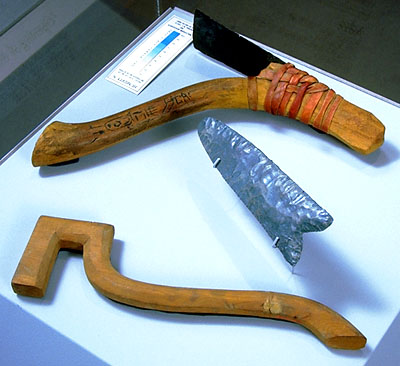
And we should use an adze to shape the interiors of rough-hewn logs to build enclosures ; }
It was intended as a bass bin to be used with a separate midrange cab handling above 300 Hz; Acoustic left the mid cab out. Any knowledgeable acoustical engineer would take one look at the response charts and conclude in ten seconds or less that without a separate midrange cab it would be weak in the mids, and that on a typical stage room interactions could make it very difficult to hear up close, while further away it could be overwhelming in the low end.
That's why I used a JBL midrange horn powered by a Kustom 2300 guitar head with my 360. Capacitor for a crossover. It worked.
And we should use an adze to shape the interiors of rough-hewn logs to build enclosures ; }
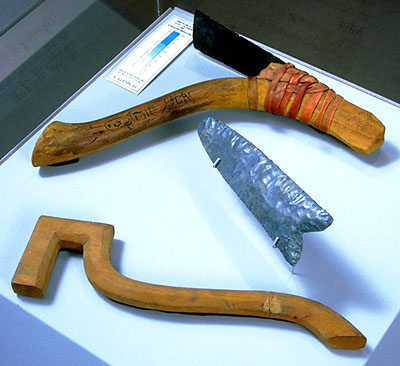
Can I rout a J bass body with one of these?

billfitzmaurice
Commercial User
- Sep 15, 2004
- 16,860
- 278
- 76
- Disclosures
- Owner, Bill Fitzmaurice Loudspeaker Design
When I saw Cheryl Crow the entire band was playing through tuck and rolls. I didn't go on stage to get a close look, but from the FOH they looked showroom new, so probably they were custom, as opposed to Kustom, made.what's next, re-issue Standels, roll & pleat Kustoms??
Invalid Link Removedwhat's next, re-issue Standels, roll & pleat Kustoms??

I looked at this "site" today. It's kind of an odd ball website. Anyways, they have no new info on the USA reissue. Infact the newest info on there is from July. Oh well, I'm sure the new setup wil be reviewed in Bass Player...someday.
I'm sorry that better information hasn't gotten to you. Here is a site with more than enough info:
http://unofficialacousticcontrolcorpmessageboard.yuku.com/
The new stuff (as George said) is about ready for the public. If it is half as good as the old stuff, I will be in heaven.
I have placed my SVT4Pro in the back of the van to be used as a backup only. I now run my 370 through a SVT6X10 and a 8X10E exclusively. The 370 blows the Ampeg head out of the water without batting an eye.
These "urban myths" about the old Acoustic products are just that - myths.
Mine was close to 40 years old when I bought it. My amp tech says that there is absolutely no reason why I shouldn't get at LEAST 50 more years out of it.
When's the last time Ampeg could promise that?

svtb15
Inactive
- Mar 22, 2004
- 13,004
- 4,741
- Disclosures
- I play it all. Whatever works for the gig. Q+
+1 to the 360 amp top as just a preamp..I used my friends for a few gigs years ago.. the 1970 360 preamp amp top into my crown poweramp into some custom 12" birchwood 2 ways cabs i had built for me in the late 80s..
The pre was very clean and clear through the crown.. and had a round bottom with mids that were rather interesting and different due to the Vari Mid control..
Another friend was playing in foghat , craig .. and he used that 360 preamop into a pile of Phase Linier power amps then some cabs.. that rig was somewhat muddy... but it sure ws punchy.. it had that fool for the city tone.
The pre was very clean and clear through the crown.. and had a round bottom with mids that were rather interesting and different due to the Vari Mid control..
Another friend was playing in foghat , craig .. and he used that 360 preamop into a pile of Phase Linier power amps then some cabs.. that rig was somewhat muddy... but it sure ws punchy.. it had that fool for the city tone.
Wow. Sometimes a name's just a name, and then other times...
Anyway, I'm surprised nobody's said anything about the Acoustic 360 head / preamp, and how sonically pleasing it, as a stand-alone preamp, is. Long story short, I was in a touring band in the 90s, relegated to using an old Carvin PB200 SS head (all I had at the time). Through only the Carvin, my tone was sterile, boring, and lifeless. But using the 360 as a preamp brought my tone to life and warmed it up beautifully. And then there's the built-in FUZZ circuit - sicker than sick.
A gentleman in Canada (to which I have no affiliation) has gone to great lengths researching and consequently cloning the preamp's Class-A circuit. Here's a link to his Acoustic 360 page:
http://www.lynx.net/~jc/pedals360.html
By the way, Mr. Imbecil, I've watched ebay auctions for the 360 head ALONE finish at $600+; whatever the motivation, there's still a demand for this amazing tone box.
svtb15
Inactive
- Mar 22, 2004
- 13,004
- 4,741
- Disclosures
- I play it all. Whatever works for the gig. Q+
I could care less about what it looks like on paper or how perfect engineered it is..
what does it sound like.. half the sounds you hear Justin on a Beck record may not be sonically acurate in an engineers point of view.. but artistically it works. .and that is all that matters to me..
its art.. not science.
what does it sound like.. half the sounds you hear Justin on a Beck record may not be sonically acurate in an engineers point of view.. but artistically it works. .and that is all that matters to me..
its art.. not science.
OTOH the advantage to using paper (or a screen) to first determine how a cab will work before building it for real saves a lot of plywood. BTW, the 360 was an almost exact copy of the JBL Keele W horn, a late version shown here:
http://http://www.geocities.com/loudspeakerguru/Keele_W_Box.doc
It was intended as a bass bin to be used with a separate midrange cab handling above 300 Hz; Acoustic left the mid cab out. Any knowledgeable acoustical engineer would take one look at the response charts and conclude in ten seconds or less that without a separate midrange cab it would be weak in the mids, and that on a typical stage room interactions could make it very difficult to hear up close, while further away it could be overwhelming in the low end.



