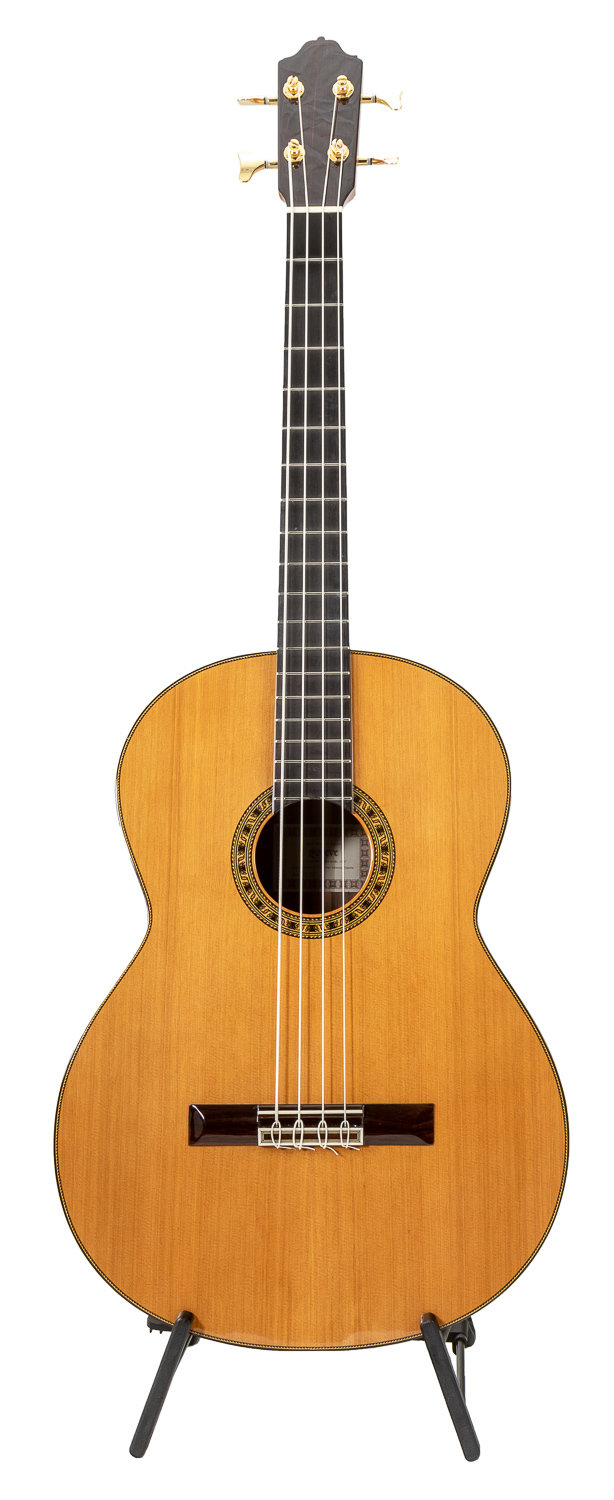
Hi! I wanted to ask if I can put acoustic bass strings on electro-acoustic bass, because I bought an electro-acoustic bass, but I cannot find electro-acoustic bass strings, only electric bass strings and acoustic bass strings. I already know that I cannot put electric bass strings on electro-acoustic bass.
Can you help me?
Thanks! <3
An addendum on instrument types (I should have led with this, but it only occurred to me later).
Acoustic guitars (or, really, any sort of acoustic instrument) has enough volume to be heard ...until it has not (depending on concomitant sound - other instruments in the ensemble - as well as room size and audience size), and this is why, in most live situations, they get microphoned, or amplified thanks to the internal preamplification system they often come with.
Now, for acoustic bass guitars it's the same, but their threshold of audibility is even lower, because bass frequencies are more difficult to amplify through purely acoustic means (body size, efficiency of the body top "air pump"), and because bass is typically played in single notes (as opposed to the "orchestral mass" of the guitar chord).
For the above reasons, the ratio of instruments that have no onboard pickups vs. those that do, which may be around 65/35 for 6-string acoustic guitars, is closer to 1/999 with acoustic bass guitars: totally acoustic ones are
very rare, because manufacturers know that most players are going to need to plug in at least once. It only makes sense to install a pickup, even if it may never be used, rather than not to, and leave the musician who suddenly needs one to their own devices.
^
In other words, there is no separate commercial category of "acoustic bass guitar" as opposed to "electro-acoustic bass guitar": the former is, in practice, shorthand for the latter.
Finally, "acoustic bass guitar strings" are really "bronze bass guitar strings" (pure copper-wound strings are another option, but they are uncommon because of their shorter lifespan: they oxydise fast, particularly through direct skin contact; they are still standard in pianos, where there's no such contact).
^
Regarding bronze strings vs. other types, see my post above (and the quoted post inside it).





 There's always one in the crowd! lolz