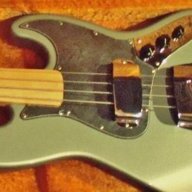
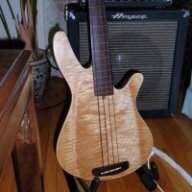
It's hard to say "buy THIS bass". I can tell you that the first bass you buy will probably not be the right instrument for you so with that in mind.... DEFINITELY BUY USED! When buying a used instrument it's already lost some value so if you don't like it you can turn around and sell it on Craig's List without losing much (plus you'll get much more bang for your buck). I wouldn't say there's a particular brand you should be looking at, what important is that it feels right in your hands and this is purely personal preference.
I have some repetitive stress injuries I acquired from practicing piano 4 to 6 hours a day in college (and while that may sound like a lot... I wasn't even a performance major, some of those folks would lock themselves in a practice room for 8+ hours a day) so I'm pretty sensitive to what I play. For me, both the neck and the body itself played a factor in my choice. I started with a Fender Aerodyne which actually had a very nice neck but the body wasn't right. I ended up with an Ibanez SR700 (btw, the much less expensive basses in the SR series play pretty similarly to the 700, and the 1200 and 1400 etc, the biggest difference between the Ibanez basses in the SR series are the materials used to make it (the type of wood used for the neck and body), the pickups, the electronics, and the bridge. Anyhow, the SR series has a very slender body and thin neck. Meets *MY* personal needs. Those might not be right for you.
I suppose there's a bunch of things to consider when purchasing a bass but I'd advise you to focus only on how the instrument feels and plays. Disregard other features (number of pickups, pickup configuration, active vs. passive pickups, the controls on the bass... the color of the bass, etc, they are unimportant). You'll often hear people refer to an instrument's "action". On a piano that would reference several things such as the weight of the keys, and the linearity of the hammer action from the low notes to the high notes. On bass it typically refers to the height of the strings above the fret board. A bass with a low action (strings close to the fretboard) is often said to be "fast". You don't necessarily need a bass with a fast action but I'd say you do want to avoid a bass with a really high action which is often found in lower quality instruments. Also keep in mind that an instrument's action is not necessarily fixed. Most bridges (the bridge is what strings are connected to on the body of the bass) have adjustments for string height and this can be changed by a guitar tech or someone who has experience setting up guitars. Players who play aggressively often opt for a higher action but you'll find preferences all over the place.
Another easy difference to spot about a bass is going to the be neck. The difference between the neck on a Fender P bass, and a Fender Jazz bass would be a good example. The Fender P bass has a thicker neck (thickness in terms of from the top of the fretboard to the back of the neck) where as the Jazz basses have thinner necks. What works best for you will depend on your personal preferences. If you have bigger hands you might prefer a P bass, smaller you might prefer a jazz neck. I'm 5'9" so I'm pretty average height wise but my preference is for thinner necks like that of the Jazz bass or the ultra thin necks in Ibanez's SR series.
What I might suggest is find a bass on Craig's List, research the model (you can use Invalid Link Removed ) to make sure you're getting it at a fair price (you want to be able to turn around and sell it for the same price) and then buy something with the intention that you'll be selling it within a few months to get something that feels better to you. So, buy a bass and take some lessons. After you have some basic skills, you'll be better prepared to go into a music store and tell the difference in playability from one bass to another. When you find something more comfortable, sell your bass and buy one that better suits your needs.
BTW - The classifieds right here on TB has TONS of used instruments listed and with the search feature you can also research what equivalent models have sold for in the past.
Cheers, Joe