That's exactly what I was going to offer to the OP...this is a great choice for first set of flats!!!First flats ? I'd try something not too floppy, not too stiff, not too modern, not too old school.
And definitely not too expensive. GHS Precision flats, 95 gauge.

Enjoy the benefits of a premium membership!
Upgrade Account
-
TalkBass has been independent since 1998. Add your voice.
Create a free account to reply to discussions, view embedded media, and browse with fewer display ads.
Join free Log in
Want zero display ads or expanded classifieds tools? Compare plans.
You are using an out of date browser. It may not display this or other websites correctly.
You should upgrade or use an alternative browser.
You should upgrade or use an alternative browser.
Advice for first Flats
- Thread starter Peter - Oregon
- Start date
More options
Who Replied?
It all depends on what goals you have.I have been playing bass for about a year. I have an Ultra Jazz and a 2004 Stingray, both are strung with D'Addario Nickel Wound EXL170 regular light guage 45/100 long scale round wounds (those are what my brother, who sold me the Stingray, always uses). The only other strings I have played are the Fenders that have come on my guitars. I just received an American Professional II P for my 60th. As you can tell, I have limited knowledge about strings, but I would like to try flats on the new bass. Would love your opinions or links to threads on this topic. I am pretty much solely a classic rock player. Thanks ahead for your thoughts. Specifics on brands, gauges, lengths, etc would be great.
In general there are two flavors of flats: traditional (think Motown & Stax), and modern. The traditional sets tend to have a darker sound, while modern sets are a bit brighter.
Looks like we have similar baselines-- my go-to strings for decades have been nickel wrapped rounds. To my ears, many of the modern sets remind me of nickel rounds that have worn in. Flats I find fit that description are:
*Note these are 45-100, and cost roughly $30 - $40
- Fender 9050
- D'Addario Chromes
- Ernie Ball Group III
Tension and feel:
The tension of these strings isn't very perceptible to me. However, the feel is different between the two; frankly I find the flats to be easier to fret.
Then of course there is the feel of the flats under your fingers-- flats are smoother than rounds, but I've never found nickel rounds to feel bad... the flats just feel smoother, and I like that too.
Sound:
Flats can tame a bright/brittle sounding bass.
Flats can be used to rock just like rounds do (think Steve Harris).
Erine Ball Cobalt Flats are among the brightest sounding flats. Super helpful if you have a dark sounding bass and don't want to use stainless steel rounds which have a harsher feel under the fingers than nickel rounds, or flats in general.
Flats tend to have a wider spectrum of tone than that of rounds, at the expense of brighter highs.
For a guy looking to step into the world of flats for the first time, I'd suggest installing them on your P-bass and going with one of the three listed above. Between the three, I'd say the Chromes are a tad brighter than the Fender & Ernie Ball Group IIIs. That said, they sound very close, so I'd go with the least expensive of the three you can find. Availability is also a trick these days

Quick notes:
- Each of the three sets I mentioned can be strung through the body (some companies/sets recommend against it). Stringing through the bridge (not the body) can present some problems with the silk wraps at both ends of the string-- depending on the specific bass you're working with.
- Be sure to bend the end of the string before cutting it to length. This helps avoid various problems with the wraps. It's also good practice when using rounds, as recommended by DR Strings. Doing so works quite nicely with the Fender tuners.
Here's how I treat the strings when installing:
The extra step in the second photo makes removing the string easier when necessary.
Stringing the Fender 9050 through the body results in the silks lining up like this:
If instead you go through the bridge, the silk ends will be closer to the tuning keys (may even begin to wrap around), and you'll likely have to trim some of the silk from the E string to keep the silk away from the bridge saddle.
Best of luck in your search & enjoy the adventure!
Last edited:

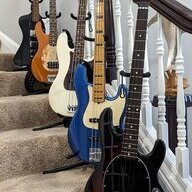
Lots of great, very specific opinions and ideas. Exactly what I was looking for! My mind operates slowly due to processing problems from brain cancer operations, so it will take me a bit to pull the trigger on this. Feel free to post any other thoughts. Thanks again, this is perfect!I have been playing bass for about a year. I have an Ultra Jazz and a 2004 Stingray, both are strung with D'Addario Nickel Wound EXL170 regular light guage 45/100 long scale round wounds (those are what my brother, who sold me the Stingray, always uses). The only other strings I have played are the Fenders that have come on my guitars. I just received an American Professional II P for my 60th. As you can tell, I have limited knowledge about strings, but I would like to try flats on the new bass. Would love your opinions or links to threads on this topic. I am pretty much solely a classic rock player. Thanks ahead for your thoughts. Specifics on brands, gauges, lengths, etc would be great.

It all depends on what goals you have.
In general there are two flavors of flats: traditional (think Motown & Stax), and modern. The traditional sets tend to have a darker sound, while modern sets are a bit brighter.
Looks like we have similar baselines-- my go-to strings for decades have been nickel wrapped rounds. To my ears, many of the modern sets remind me of nickel rounds that have worn in. Flats I find fit that description are:
*Note these are 45-100, and cost roughly $30 - $40
- Fender 9050
- D'Addario Chromes
- Ernie Ball Group III
Tension and feel:
The tension of these strings isn't very perceptible to me. However, the feel is different between the two; frankly I find the flats to be easier to fret.
Then of course there is the feel of the flats under your fingers-- flats are smoother than rounds, but I've never found nickel rounds to feel bad... the flats just feel smoother, and I like that too.
Sound:
Flats can tame a bright/brittle sounding bass.
Flats can be used to rock just like rounds do (think Steve Harris).
Erine Ball Cobalt Flats are among the brightest sounding flats. Super helpful if you have a dark sounding bass and don't want to use stainless steel rounds which have a harsher feel under the fingers than nickel rounds, or flats in general.
Flats tend to have a wider spectrum of tone than that of rounds, at the expense of brighter highs.
For a guy looking to step into the world of flats for the first time, I'd suggest installing them on your P-bass and going with one of the three listed above. Between the three, I'd say the Chromes are a tad brighter than the Fender & Ernie Ball Group IIIs. That said, they sound very close, so I'd go with the least expensive of the three you can find. Availability is also a trick these days
Quick notes:
- Each of the three sets I mentioned can be strung through the body (some companies/sets recommend against it). Stringing through the bridge (not the body) can present some problems with the silk wraps at both ends of the string-- depending on the specific bass you're working with.
- Be sure to bend the end of the string before cutting it to length. This helps avoid various problems with the wraps. It's also good practice when using rounds, as recommended by DR Strings. Doing so works quite nicely with the Fender tuners.
Here's how I treat the strings when installing:
View attachment 4640552
The extra step in the second photo makes removing the string easier when necessary.
Stringing the Fender 9050 through the body results in the silks lining up like this:
View attachment 4640553
If instead you go through the bridge, the silk ends will be closer to the tuning keys (may even begin to wrap around), and you'll likely have to trim some of the silk from the E string to keep the silk away from the bridge saddle.
Best of luck in your search & enjoy the adventure!
+1 to all of this, it's an excellent summary.
One other thing to keep in mind is that flats, like any other type of string, will experience changes in tonal characteristics over time. New flatwounds actually do have some top-end sparkle to them, though not quite the "zing" of fresh roundwounds. When you think of Steve Harris' tone, what you're hearing are very fresh flatwounds, because he (or more likely his bass tech) changes strings for every show he plays. For most of us who aren't sponsored by a string manufacturer and aren't members of one of the top heavy metal bands of all time, this is not really feasible from a financial or effort standpoint.
That said - a lot of folks use flats because they like the way they sound once they age in a bit. While roundwounds go "dead" after a few months, flatwounds age quite nicely, though they will mellow out and lose some definition. You can adjust for that to a certain extent with EQ settings, but they're still going to sound like old flatwounds.
The point here is that if you pick a set and install it, and they don't produce the sound you were hoping for... be patient. Resist the temptation to second-guess your purchase. Plenty of flatwound players keep theirs on for years at a time, or only change if a string breaks. The initial cost of a set of flats is quickly offset by the fact that you won't be buying new strings every few months; it's like having a laser printer instead of an inkjet.
Here's the video that got me interested in trying flats (1:41:0). It's a good illustration of the sound/tone of flats vs rounds-- and a fun video if you have time to watch the entire episode:
Thanks so much Wolfhound, wonderful information, really appreciate you spending time time!It all depends on what goals you have.
In general there are two flavors of flats: traditional (think Motown & Stax), and modern. The traditional sets tend to have a darker sound, while modern sets are a bit brighter.
Looks like we have similar baselines-- my go-to strings for decades have been nickel wrapped rounds. To my ears, many of the modern sets remind me of nickel rounds that have worn in. Flats I find fit that description are:
*Note these are 45-100, and cost roughly $30 - $40
- Fender 9050
- D'Addario Chromes
- Ernie Ball Group III
Tension and feel:
The tension of these strings isn't very perceptible to me. However, the feel is different between the two; frankly I find the flats to be easier to fret.
Then of course there is the feel of the flats under your fingers-- flats are smoother than rounds, but I've never found nickel rounds to feel bad... the flats just feel smoother, and I like that too.
Sound:
Flats can tame a bright/brittle sounding bass.
Flats can be used to rock just like rounds do (think Steve Harris).
Erine Ball Cobalt Flats are among the brightest sounding flats. Super helpful if you have a dark sounding bass and don't want to use stainless steel rounds which have a harsher feel under the fingers than nickel rounds, or flats in general.
Flats tend to have a wider spectrum of tone than that of rounds, at the expense of brighter highs.
For a guy looking to step into the world of flats for the first time, I'd suggest installing them on your P-bass and going with one of the three listed above. Between the three, I'd say the Chromes are a tad brighter than the Fender & Ernie Ball Group IIIs. That said, they sound very close, so I'd go with the least expensive of the three you can find. Availability is also a trick these days
Quick notes:
- Each of the three sets I mentioned can be strung through the body (some companies/sets recommend against it). Stringing through the bridge (not the body) can present some problems with the silk wraps at both ends of the string-- depending on the specific bass you're working with.
- Be sure to bend the end of the string before cutting it to length. This helps avoid various problems with the wraps. It's also good practice when using rounds, as recommended by DR Strings. Doing so works quite nicely with the Fender tuners.
Here's how I treat the strings when installing:
View attachment 4640552
The extra step in the second photo makes removing the string easier when necessary.
Stringing the Fender 9050 through the body results in the silks lining up like this:
View attachment 4640553
If instead you go through the bridge, the silk ends will be closer to the tuning keys (may even begin to wrap around), and you'll likely have to trim some of the silk from the E string to keep the silk away from the bridge saddle.
Best of luck in your search & enjoy the adventure!
Look at YouTube vids comparing them. Rumblin man is a good source on there, as well.
It's a tough call without experimenting with them yourself. As a newer bassist, your tastes will likely evolve, as well. At first, I loved Chromes but they starting sounding a bit dull to me. I also didn't like the D and especially G strings. At first, I loved Thomastik-Infeld Jazz flats. Very distinctive and beautiful in many ways. But they didn't quite give me the tone I was looking for, at least on the bass they were on.
Now, I am using Rotosound Jazz 77 flats. They are very versatile, big bright tone for flats, some overtones, and mids focused. So, even though they've been around since the mid 60s, they do not have a traditional flat tone. Some have referred to them as "rock flats" - and for good reason. For example, they were the string of choice for many famous recordings via Roger Waters, Sting, John Deacon, and Steve Harris. However, they also have unusually high tension that some never get used to. That can be a problem with traditional Labella flats, too. In my case, that's the only "fault" but one I choose to live with since I use them for soft and hard rock.
Short answer? No perfect strings exist. Tone must take your instrument, signal chain, technique, musical styles played, versatility needs, and subjective preferences into account.
I know, thanks for nothing.
It's a tough call without experimenting with them yourself. As a newer bassist, your tastes will likely evolve, as well. At first, I loved Chromes but they starting sounding a bit dull to me. I also didn't like the D and especially G strings. At first, I loved Thomastik-Infeld Jazz flats. Very distinctive and beautiful in many ways. But they didn't quite give me the tone I was looking for, at least on the bass they were on.
Now, I am using Rotosound Jazz 77 flats. They are very versatile, big bright tone for flats, some overtones, and mids focused. So, even though they've been around since the mid 60s, they do not have a traditional flat tone. Some have referred to them as "rock flats" - and for good reason. For example, they were the string of choice for many famous recordings via Roger Waters, Sting, John Deacon, and Steve Harris. However, they also have unusually high tension that some never get used to. That can be a problem with traditional Labella flats, too. In my case, that's the only "fault" but one I choose to live with since I use them for soft and hard rock.
Short answer? No perfect strings exist. Tone must take your instrument, signal chain, technique, musical styles played, versatility needs, and subjective preferences into account.
I know, thanks for nothing.


I've heard so many good things about these strings but I cannot get over the packaging, it looks like a knockoff Mountain Dew label.
Thanks Ricky.My 50-65-85-110 set of Daddario Pro Steel rounds feels remarkably similar in weight and tension and so on to the set of 45-60-80-105 set of Daddario Chromes flats I had. That's my sole data point to offer
I am certainly open to tape wounds, don't know much about them. My interest in flats comes primarily from what I have heard about differences in tone and feel between rounds and flats. I will readily admit that I don't know what I don't know.as long as you're not trying to slap, LaBella Low tension flats are great. Tension wise they feel like rounds under the finger to me, but have that nice smooth exterior. These are what I've currently got on mine. Really woke up that bass when I put them on. low tensions sound a hair more modern than the traditional 760fs that most people buy from LaBella.
Tone is an interesting question. If you find yourself rolling off your highs with the tone knob, You will love LaBella flats. They do have high end, but the players that tend to love high end brightness do not seem to like LaBella. I'm on the other end. I dont like bright, so I dislike EB Cobalt flats. They sound like rounds. To me there is no point in getting flats for a different tone and then buying EB Cobalts.
For classic rock, your two top flats will be LaBella and TI. These two are two flavors of that old signature sound that other brands emulate. P bass with Labella 760fs is pretty much a gold standard.
I do like Labella Tapewounds too. They are in-between flats and rounds. But that's not what you're asking for.

James Jamerson (Motown) & Donald "Duck" Dunn (Volt/Stax), arguably two of the most early influencers of bass players, used these on their Fender Precisions. They also would not change strings until one broke. Then they would change the set. One rarely broke.

Good to know, thank you!Because of their geometry flats will feel stiffer than rounds of the same nominal gauge (outside diameter)
might not be a bad plan to go no heavier than your rounds gauge and consider one gauge lighter than your usual rounds gauge
never done a true apples to apples (eg 100 d’addario XL’s v 100 d’addario Chromes) but I play both flats and rounds and the rounds definitely on average feel stiffer.

I've heard so many good things about these strings but I cannot get over the packaging, it looks like a knockoff Mountain Dew label.
That's why LaBella updated the packaging

You could spend the rest of your life trying different flats. Don’t stress too much about which ones for your first try. Whatever you get, make sure to play them for a month or three until they break in.
I’ll echo that Jamerson and Duck both used LaBella Deep Talkin flats on a P bass and that is the classic 60’s sound. Jamerson used the heaviest gauge and had very high action. I would not go there. My 2 cents would be Labella 360 FL. Not so stiff that they’re hard to press down, but stiff enough to be able to dig into them for that old school percussive thump.
I’ll echo that Jamerson and Duck both used LaBella Deep Talkin flats on a P bass and that is the classic 60’s sound. Jamerson used the heaviest gauge and had very high action. I would not go there. My 2 cents would be Labella 360 FL. Not so stiff that they’re hard to press down, but stiff enough to be able to dig into them for that old school percussive thump.

I have been playing bass for about a year. I have an Ultra Jazz and a 2004 Stingray, both are strung with D'Addario Nickel Wound EXL170 regular light guage 45/100 long scale round wounds (those are what my brother, who sold me the Stingray, always uses). The only other strings I have played are the Fenders that have come on my guitars. I just received an American Professional II P for my 60th. As you can tell, I have limited knowledge about strings, but I would like to try flats on the new bass. Would love your opinions or links to threads on this topic. I am pretty much solely a classic rock player. Thanks ahead for your thoughts. Specifics on brands, gauges, lengths, etc would be great.