• TalkBass has been independent since 1998. Add your voice.
    Create a free account to reply to discussions, view embedded media, and browse with fewer display ads.
    Join freeLog in
    Want zero display ads or expanded classifieds tools? Compare plans.

Double Bass Advice re top repairs

eh_train

Supporting Member
Commercial User
Jan 12, 2004
1,493
1,270
Toronto
www.standupguybasses.com
Disclosures
Owner, Stand Up Guy Basses (Repair/Sell/Buy upright basses)
Hi all,

I have a new project bass, and need some advice. I purchased it yesterday and am keen to start repairs. Probably more importantly though, I am keen to get your thoughts!

A little about it (selected pics below): It's a Romanian solid wood flatback. Probably not too expensive of an instrument when first sold, and definitely not too expensive coming my way. This is a good thing, as my repair experience so far has been completely with ply basses. I've also never owned a flatback before (strange 'cos I've owned 10 basses in the past 20 years).

The reasons it's a project are:

1) There's a good long vertical crack down the centre of the bass, from the saddle to the bridge area. The first pic shows it from the side, where the treble side is about 1/16th of an inch higher than the bass half. Fortunately, there isn't much separation between the two sides of the crack. I had thought it was the centre seam coming apart but looking at it from inside with a mirror and flashlight it's hard to tell! There doesn't seem to be any evidence of cleats that failed, so maybe it is simply a crack in a solid piece of wood???

2) I'm pretty sure the inside part of the treble f hole was broken off, then glued back. It's mostly back in the right spot, save for an inch at the top of the crack. No idea what glue was used, and I don't think they cleated it. Will have to see how close to the sound post position the cracks are (I'm thinking close, but maybe not too close. Or, I may have to do a soundpost patch....).

3) Some misguided soul drilled two holes in the top, roughly between the bridge feet. I don't know if this was some amplification attempt, or some bizarre repair effort, but it will need filling.

My question #1 is SHOULD I TAKE OFF THE TOP OR BACK? I'm leaning toward the back, but only out of convenience: I don't think the top has ever been off, but about 75% of the back is loose around the bottom bout. Another consideration, though, is that the back itself is likely the most stable part of the bass, and the ribs / top assembly might be quite floppy with the back off (I know you can put in some wood supports while repairing, but still...). Also, it seems a little counter intuitive to remove the healthy back (you can see the one spot of road rash in the last pic).

Thoughts on where to start? Any help is greatly appreciated!

Cheers,

Paul (Eh_train)
 

Attachments

  • IMG_0877.jpg
    IMG_0877.jpg
    27.1 KB · Views: 150
  • IMG_0879.jpg
    IMG_0879.jpg
    23.2 KB · Views: 122
That top crack will need some clamping pressure from the sides, probably requiring some of the top seams to be loosened. I'd go ahead and take the top of and glue the back seams. It will also be more convienent to work on the top without the bass attached.
 
Thanks for your replies!

Can't help noticing that it's 1 vote for the top, and 1 for the back. Any chance of some tie-breaking opinions? Anyone have a STRONG opinion about the "right" way to do it, or is this a six-of-one, half-dozen of another situation?

Thanks,

Paul
 
Strong opinion here: glue up the back seams (make sure they are aligned), then remove the top so you can work on that blown-out center seam with the top completely accessible. Back removal is always second choice, because there is the quite real possibility of damaging things at the button area. Good luck!
 
Thanks, all, for your replies. I will take the last post as both a strong and authoritative opinion!

A couple of you mentioned that having the top unencumbered for the repair is important, and it seems like a good point. Will keep TB posted once I have made some progress.

Cheers,

Paul (Eh_train)
 
Hi all,

The good news is the top came off rather agreeably (after regluing the back securely).

The bad news is that there was a bunch of (probably) carpenter's glue in the middle seam.
I have picked most of it out but, inevitably, there are some leftover bits.

Should I: Run a bit of sandpaper in each direction, or, try using heat of some sort? I'm leaning toward sandpaper, as I just want to snag the old glue out.

The other concern re. the centre seam is that it (so far) doesn't seem to want to go together neatly. The problem starts where the crack is near the bridge feet (red circle in pic #2). The top is lined up at one point, and uneven about an inch away. If this persists, should I glue the seam a few inches at a time and "chase" any disagreements down to the saddle? Then, I think, cleating would hold everything once it's reglued.

Note, the green circle indicates where a soundpost patch is needed. I will follow Matthew Tucker's how-to on that one, once the seam is taken care of. I think there will be lots of sweat equity in this bass when it's finished!

Any thoughts on regluing the seam will be most appreciated!

Thanks,

Paul (Eh_train)
 

Attachments

  • IMG_0888.jpg
    IMG_0888.jpg
    34.3 KB · Views: 119
  • topcracks.jpg
    topcracks.jpg
    50.9 KB · Views: 123
Hey,

I have used white vinegar very successfully to remove white glue from bad repairs. Some done by the owners of the basses... :bawl:

I just soak a paper towel in the vinegar, and work in small areas using a dental pick and that and eventually it comes loose and then I clean with water and proceed to the HHG.

Hope that helps,
BG
 
Thanks greatly, Brian and Jake!

One other thing: In post #9, first pic, you can see that the saddle is a "half-blind" type (not sure if that's really what to call it, but...). The top doesn't have a fully notched out space for the saddle, but only a recess. It's the first I've seen like this, and I'm not sure that I like it (both the half-saddle and the top end up seeming flimsy, IMHO).

So, I was thinking of just taking out the bottom half of the recess (ie., fully notching out the space for the saddle). Any thoughts from others who have seen this before?

Thanks,

Paul
 
Thanks greatly, Brian and Jake!

One other thing: In post #9, first pic, you can see that the saddle is a "half-blind" type (not sure if that's really what to call it, but...). The top doesn't have a fully notched out space for the saddle, but only a recess. It's the first I've seen like this, and I'm not sure that I like it (both the half-saddle and the top end up seeming flimsy, IMHO).

So, I was thinking of just taking out the bottom half of the recess (ie., fully notching out the space for the saddle). Any thoughts from others who have seen this before?

Thanks,

Paul

I did the same thing with a Christopher bass that I owned. Just finish the notch and seat it on the block. It is definitely better for the health of the instrument. And, if the saddle is a really tight fit, then I would take a little off each end of the saddle so it doesn't lead to saddle cracks.

BG
 
Hi all,

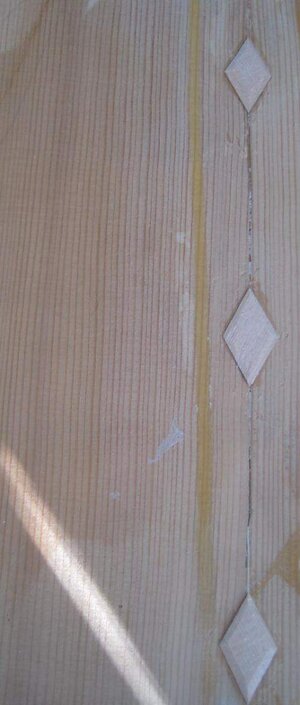
I have made a fair bit of progress on my Romanian flatback project. The top centre seam is now repaired. I've attached a couple of pics of the joined seam and my first attempts at making and installing cleats. Thanks, again, Jake for outfitting me with the dry Spruce I needed.

Along with the update, I need advice on how to do the last repair - the soundpost patch. Pic #3 shows the area. I have glued the crack and now need to consider whether to:

1) just patch around the soundpost, or;
2) Make a large patch that covers the soundpost and the belly area (the seam crack extended right up to the bridge area, though it wasn't neatly down the centre by the time it got that high). This would involve crossing the centre seam, which might lend lots of strength, or might bugger everything up, or:
3) Separately patch the soundpost area and the belly.

THoughts???

Thanks, in advance, for any help!

Paul (Eh_Train)
 

Attachments

  • cleat.jpg
    cleat.jpg
    99.6 KB · Views: 88
  • cleats.jpg
    cleats.jpg
    48.8 KB · Views: 92
Sure, here's the whole sordid mess:

When i got the bass, the centre seam was open from the bottom block to the bridge area. It had the strings on and was near tension!

It took a bit of convincing, and some splining, to get the top halves back together. The cleats are insurance to keep the lower bout together, and the soundpost and/or belly patch should strengthen the midsection.

Did I mention that this is a "project" bass? Patching the midsection will also deal with the two holes that were drilled in the top. You know, the holes you drill into the top so that you can pour the epoxy in.

Cheers,

Paul
 

Attachments

  • IMG_0958.jpg
    IMG_0958.jpg
    97.5 KB · Views: 97
Hey Paul,

Brian's right on with the white vinegar tip. If you'll get a better result by gluing the crack in sections, there's no reason you can't do it that way.

Good luck! ;)

In the restoration of antique furniture it was customary amongst many of us in the business to use cider vinegar on old hide glue. Any particular reason to use white rather than cider? If I remember, the action of acetic acid on the glue was thought to be the key, and therefore the choice to use cider vinegar.
 
In the restoration of antique furniture it was customary amongst many of us in the business to use cider vinegar on old hide glue. Any particular reason to use white rather than cider? If I remember, the action of acetic acid on the glue was thought to be the key, and therefore the choice to use cider vinegar.

I use alcohol on hide glue but we were talking about white/yellow glue, ergo the white vinegar. Cider vinegar might have a slightly higher concentration of acetic acid but it also has colour, which would keep me from using it. That and its more expensive...