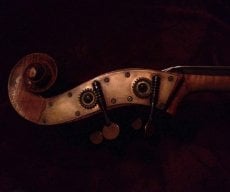
'Just recieved a nice email from my friend Guy Thomson down in Australia who sent a few images of he and his buddies strutting ALCOA #319, circa 1932-33, all polished up and back in action. That is the only one I know of down under but I'd guess there are a few more out in the trenches. I added one to my own quiver recently and am looking forward to it and hoping to be able to hold on to it and take it around to all of the bass nerd and luthier festivals next summer.
j.
www.condino.com
www.kaybassrepair.com


For anyone interested in the details:
"It has taken a while but Number 319 is back in action on a nice sunny Australian Sunday spring morning at the local farmers markets where we have had a gig for the last 17 years. The repair and polish job went OK the neck was badly bent to the right and I wasn’t game to get it dead true bending it cold so the finger board is slightly off set and the bridge not quite on centre. The neck insert timber I replaced. The posts for the screws were sound and Instead of counter sinking the screws I used flat head screws and counter bored the back of the finger board before gluing it down this gave more strength to hold the neck timber which I also glued in.The next person to remove the finger board might be in for a bit of a suprise! The neck has the number 243 stamped in it and the hull has 319 painted in with the blue ink. I found on a Chinese bass web site an aluminium tail piece for $16 powder coated black.Stripped and polished it looks OK the bridge I painted silver the finger board is rosewood waxed.Strings are pure gut. As I expected it has tinny under tones but projects well and the notes at a distance sound good. I have found I only have to slap it about 1/2 as hard as my ply bass to get the same volume..."
So just for a bit more confusion, the blue ink markings inside the body are machinist ink and that was the in house job number for the body guys to stamp and weld up. The neck was made at a different part of the factory and was cast, so they used a different number- usually the one inside the neck under the wooden insert. Then....when they were ready to leave the factory, they got issued a serial number that was stamped into the aluminum, often around the scroll / pegbox and sometimes near the endpin, regularly with a completely different number. Those stamped numbers were reasonably sequential and are the ones that I use for the most definitive of the randomly defined possible serial numbers. They made approx. 500 from 1929-1934 so you can estimate the year, with the catch that after ALCOA and Joseph Maddy's business agreement went sour, whatever remaining basses ALCOA still had were sold off to Conn and it took them until the early 1950s to sell them all, sometimes with their own "serial numbers". Confusing enough????
j.
www.condino.com
www.kaybassrepair.com
For anyone interested in the details:
"It has taken a while but Number 319 is back in action on a nice sunny Australian Sunday spring morning at the local farmers markets where we have had a gig for the last 17 years. The repair and polish job went OK the neck was badly bent to the right and I wasn’t game to get it dead true bending it cold so the finger board is slightly off set and the bridge not quite on centre. The neck insert timber I replaced. The posts for the screws were sound and Instead of counter sinking the screws I used flat head screws and counter bored the back of the finger board before gluing it down this gave more strength to hold the neck timber which I also glued in.The next person to remove the finger board might be in for a bit of a suprise! The neck has the number 243 stamped in it and the hull has 319 painted in with the blue ink. I found on a Chinese bass web site an aluminium tail piece for $16 powder coated black.Stripped and polished it looks OK the bridge I painted silver the finger board is rosewood waxed.Strings are pure gut. As I expected it has tinny under tones but projects well and the notes at a distance sound good. I have found I only have to slap it about 1/2 as hard as my ply bass to get the same volume..."
So just for a bit more confusion, the blue ink markings inside the body are machinist ink and that was the in house job number for the body guys to stamp and weld up. The neck was made at a different part of the factory and was cast, so they used a different number- usually the one inside the neck under the wooden insert. Then....when they were ready to leave the factory, they got issued a serial number that was stamped into the aluminum, often around the scroll / pegbox and sometimes near the endpin, regularly with a completely different number. Those stamped numbers were reasonably sequential and are the ones that I use for the most definitive of the randomly defined possible serial numbers. They made approx. 500 from 1929-1934 so you can estimate the year, with the catch that after ALCOA and Joseph Maddy's business agreement went sour, whatever remaining basses ALCOA still had were sold off to Conn and it took them until the early 1950s to sell them all, sometimes with their own "serial numbers". Confusing enough????
Last edited: