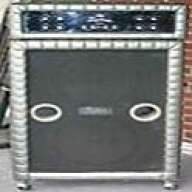
There's just no market for high powered all tube power amps is there?
See Bassmans post:
"There is always the McIntosh MC3500. However, IF you can find one, it will run you 20 to 30 BIG ones"

TalkBass has been independent since 1998. Add your voice.
Create a free account to reply to discussions, view embedded media, and browse with fewer display ads.
Join free Log in
Want zero display ads or expanded classifieds tools? Compare plans.
There's just no market for high powered all tube power amps is there?
Class A power amps are biased so the output stages are always at full current operation. That means an amp like an SVT would be drawing full load current as if it were putting out it's full rated 300 watts RMS all the time. That would make it very expensive to run. Additionally class A amps are more expensive to design than class AB push-pull amps. As a general rule, no bias in the output circuitry runs a set of output tubes harder, produces more gain, and can give an "edgy" or slightly distorted tone at higher volumes. Circuits providing negative bias tend to be cleaner sounding, have less gain, ( though the preamps can get that for you) and drive the output tubes less hard. Last but not least a 6550 and KT88 tube are exactly the same. The 6550 is the "industrial" equivalent of the KT88. Hope this explanation helps.

Interested in what's out there as far as all tube power amplifiers are concerned. My guitarist has a 120 watt peavey classic all tube that just destroys me! Not only do I want to keep up, i've been wanting to send my Sunn Coliseum and Concert Bass through some tubes to get that TONE. Should I just build one? Slave a tube head bypassing the preamp? Any suggestions?

See Bassmans post:
"There is always the McIntosh MC3500. However, IF you can find one, it will run you 20 to 30 BIG ones"

Last but not least a 6550 and KT88 tube are exactly the same. The 6550 is the "industrial" equivalent of the KT88.
Like I said, not much of a market.
McIntosh has been building SS amps since 1964, guess they know their market.

I agree here, why would two identical tubes have different names ? I dont think this would happen.They may be very similar but not exact......imo.This bit isn't really true, they are functionally equivalent in most amps, but the KT88 can be run at higher plate voltages, and has different distortion characteristics. Although I wouldn't be surprised if there are modern valves that are 6550 innards labeled KT88, the difference will be apparent on the data sheets.
http://en.wikipedia.org/wiki/6550
http://en.wikipedia.org/wiki/KT88
Not to disagree with anyone, but I used to be a repair tech working at a warranty station for Ampeg and several other companies. The KT88 and 6550 tubes are identical, though the 6550 is a industrial equivalent of the KT88 and was (at least back then) designed for "rougher" use. 6550s were standard in the SVT for their ability to withstand rough service and vibration. The KT88 was designed for and used more in hi-fi applications (e.g., McIntosh). Biased with the same control gridvoltages and with the same exact plate supply voltages and signal levels, the KT88 and 6550 will be virtually indistinguishable one from the other. The only difference, should any be heard, will be the slightly lower gain the 6550 may have compared with the KT88. BTW, I take some things I read on Wikipedia with a grain of salt - - it is not always the best site for factual information.I agree here, why would two identical tubes have different names ? I dont think this would happen.They may be very similar but not exact......imo.
By your definition, I guess there isn't a market for Picasso's paintings since there are few of them, selling for millions of dollars to very few people.
Economics, like tube amps can be complicated....


There's just no market for high powered all tube power amps is there?

Not to disagree with anyone, but I used to be a repair tech working at a warranty station for Ampeg and several other companies. The KT88 and 6550 tubes are identical, though the 6550 is a industrial equivalent of the KT88 and was (at least back then) designed for "rougher" use. 6550s were standard in the SVT for their ability to withstand rough service and vibration. The KT88 was designed for and used more in hi-fi applications (e.g., McIntosh). Biased with the same control gridvoltages and with the same exact plate supply voltages and signal levels, the KT88 and 6550 will be virtually indistinguishable one from the other. The only difference, should any be heard, will be the slightly lower gain the 6550 may have compared with the KT88. BTW, I take some things I read on Wikipedia with a grain of salt - - it is not always the best site for factual information.
Side note: KT88s used in an SVT will not last long (due to vibration), will sound more distorted, and are twice as likely to short out with the 795 Volt DC plate voltage on an SVT that the 6550s easily endure.
Trying to compare Picasso art to power amps of any kind

Early CD's sounded awful. As they improved the equipment, the sound got better.
Check the data sheets:
Invalid Link Removed
Pick out the fairly modern 6550 and KT88 there:
Invalid Link Removed
Invalid Link Removed
Note absolute maximum plate voltages, among other things.
It is pretty much same deal as 6L6 vs EL34.
On the contrary, I don't believe you are arguing at all. This is what discussion forums are about and hopefully, I am not a purveyor of misinformation myself. I am just basing my comments on my experience as an audio technician and the fact (as I remember it) that Ampeg for one, was pretty adamant about using 6550s instead of KT88s because the 6550s sounded cleaner and would hold up better than the KT88s. And I wholly agree with you - - broken amps also make me sad. Thanks for being willing to toss this information back and forth......It says the KT88 can replace the 65550, but the 6550 doesn't say it can replace the KT88, that is a fairly important difference, and it fits in with the fact the KT88 is more rugged with regards to plate voltages. Which is pretty much what I was saying from the start. It is a really important difference.
As I said, functional equivalent, not identical. Much like 6L6 and EL34, you can put them in amps, and they work in the amp with some variance in sound, but they are different valves, hence the different names. They are not different labels on the same thing.
Edit: Sorry for arguing on the internet, but this sort of misinformation is what makes amps break, and broken amps make me sad.
Though I generally agree with your premise, the biggest reason earlier CD releases often sounded horrible was that people in the industry were not familiarized yet with the differences and potential of the media. They weren't mastering well for it. Practices that worked well for vinyl or tape simply weren't applicable.
So it was user error more than tech.
On the contrary, I don't believe you are arguing at all. This is what discussion forums are about and hopefully, I am not a purveyor of misinformation myself. I am just basing my comments on my experience as an audio technician and the fact (as I remember it) that Ampeg for one, was pretty adamant about using 6550s instead of KT88s because the 6550s sounded cleaner and would hold up better than the KT88s. And I wholly agree with you - - broken amps also make me sad. Thanks for being willing to toss this information back and forth......


