• TalkBass has been independent since 1998. Add your voice.
    Create a free account to reply to discussions, view embedded media, and browse with fewer display ads.
    Join freeLog in
    Want zero display ads or expanded classifieds tools? Compare plans.

Altering Pickup Characteristics

Sep 13, 2018
1,770
2,896
Italy
BuildYourGuitar.com :: The Secrets of Electric Guitar Pickups

Quote from the paragraph "Altering Pickup Characteristics":

3. Change the external load. This method is inexpensive but can be very effective. With only a little expense for electronic components, the sound can be shaped within wide limits. Standard tone controls lower the resonant frequency by connecting a capacitor in parallel with the pickup (usually through a variable resistor to give some control over how much the capacitor affects the pickup). Therefore, one way to change the sound is to replace the standard tone control potentiometer with a rotary switch that connects different capacitors across the pickup (a recommended range is 470 pF to 10 nF). This will give you much more sound variation than a standard tone control (Fig. 8).

Anyone tried this? Does it actually work?
Will lowering the resonant frequency result in heavier punch on the lows?
 
BuildYourGuitar.com :: The Secrets of Electric Guitar Pickups

Quote from the paragraph "Altering Pickup Characteristics":

3. Change the external load. This method is inexpensive but can be very effective. With only a little expense for electronic components, the sound can be shaped within wide limits. Standard tone controls lower the resonant frequency by connecting a capacitor in parallel with the pickup (usually through a variable resistor to give some control over how much the capacitor affects the pickup). Therefore, one way to change the sound is to replace the standard tone control potentiometer with a rotary switch that connects different capacitors across the pickup (a recommended range is 470 pF to 10 nF). This will give you much more sound variation than a standard tone control (Fig. 8).

Anyone tried this? Does it actually work?
Will lowering the resonant frequency result in heavier punch on the lows?
I'm no pickup or electronics expert, but I believe the rotary tone knob on the Epiphone Jack Casady bass does this. Someone with more knowledge on the subject would be able to confirm.
 
  • Like
Reactions: oZZma
The JC is a different setup. It is a low impedance pickup with a transformer to make the output high impedance and the rotary switch is 3 different transformer taps for 3 different impedance levels.

What they are describing is similar to a Varitone but without the inductor. I have one in a bass and a couple in guitars and I like them. I believe @RobbieK has a video about making one.
 
Anyone tried this? Does it actually work?

Yes. In fact, the classic 3-band stingray preamp has just this. It is the main reason the 3-band stingrays sound so different from the classic 2-band 'rays.

A pickup has inductance as everyone knows, but it also has some capacitance. (Known as "stray" or "parasitic" capacitance.) The resonant frequency of a pickup is a product of both its inductance and capacitance. (There is a formula to work out the frequency, the maths is pretty easy actually.) When you put a cap across a pickup, either when the tone pot is all the way down, or if you just wire one as suggested with a switch, then this is simply added to the stray capacitance of the pickup, plus the capacitance of your guitar cable. You can then re-do the maths, and there you go, the resonant frequency has changed. As the capacitance goes up, the frequency goes down.

Above the resonant frequency, the pickup rolls off sharply. 12dB/octave.

But it's not that simple. Just switching through a series of larger and larger caps on its own, doesn't really roll treble off evenly, like sweeping down the freq control on an active LPF circuit. Instead, the cap will create a resonant peak, the height of which depends on impedance. So with a rotary switch and a series of caps, you will get some very honky tones once the resonant frequency gets down into the low treble and high mid-range. The peak will be very, umm... peaky! But a small resistor in series with the cap can tame this.

Here's a video I did a few years ago. (Badly shot I know, but the info is OK.) The idea was to take this concept and tailor and refine it for a specific pickup. This way the treble control works progressively, but with that sharp 12dB/octave roll-off you'd normally get with an active circuit. There's actually a couple of mistakes in this video, and I will revisit it at some stage...


In this video, I use the same idea to tweak the treble response of a pickup I wound that had a very high resonant frequency. I tried to get a similar resonance to a P bass pickup...

 
The old 'inductor based' vari-tone on my '79 B.C. Rich. Honestly, it doesn't work too well. Some of the settings have so much signal loss that it needs the hyperactive preamp with like 40 db of boost.
 
  • Like
Reactions: oZZma
Yes. In fact, the classic 3-band stingray preamp has just this. It is the main reason the 3-band stingrays sound so different from the classic 2-band 'rays.

A pickup has inductance as everyone knows, but it also has some capacitance. (Known as "stray" or "parasitic" capacitance.) The resonant frequency of a pickup is a product of both its inductance and capacitance. (There is a formula to work out the frequency, the maths is pretty easy actually.) When you put a cap across a pickup, either when the tone pot is all the way down, or if you just wire one as suggested with a switch, then this is simply added to the stray capacitance of the pickup, plus the capacitance of your guitar cable. You can then re-do the maths, and there you go, the resonant frequency has changed. As the capacitance goes up, the frequency goes down.

Above the resonant frequency, the pickup rolls off sharply. 12dB/octave.

But it's not that simple. Just switching through a series of larger and larger caps on its own, doesn't really roll treble off evenly, like sweeping down the freq control on an active LPF circuit. Instead, the cap will create a resonant peak, the height of which depends on impedance. So with a rotary switch and a series of caps, you will get some very honky tones once the resonant frequency gets down into the low treble and high mid-range.
I haven't even watched the video yet and I already have two stupid questions :D:D:D:D
1.What happens BELOW the resonant frequency? Same 12 db/octave roll off?
2. What of I don't want to roll off trebles, but only have stronger lows? Is there some trick? :D
 
The capacitor trick works well to shape mids and highs, not so much lows. For lows, a bunch of things (or a combination) might help: EQ, strings, setup (pickup height), technique, gain/volume. Not necessarily in that order.

A pickup swap might do, but it would change more than just lows probably...

That said, if lows are inherently lacking (instrument design/construction), all else is futile.
 
  • Like
Reactions: oZZma
The capacitor trick works well to shape mids and highs, not so much lows. For lows, a bunch of things (or a combination) might help: EQ, strings, setup (pickup height), technique, gain/volume. Not necessarily in that order.

A pickup swap might do, but it would change more than just lows probably...

That said, if lows are inherently lacking (instrument design/construction), all else is futile.
Thanks.
As a matter of fact, I think this bass' character is inherently trebley, so maybe I should just deal with it and stop being obsessed by that open E (because except for this the bass sounds fantastic). Or change tuning.
 
The best way to get more LOWs in a two-pickup bass is to wire them in Series. Two *Inductors in Series has a lower resonant frequency than two Inductors in Parallel.
However, if you want your highs back, you just roll back the volume on the neck pickup.

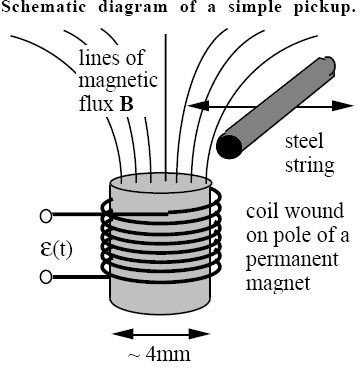
*Inductors are named such, because of Induction, which is how the electrical signal is extracted from the strings.
Pickups are really large inductors.
c0564657f21bfd46dc63b9304d5ba17311779749_large.jpg

Here you can see why an Inductor is often called a Coil.
 
  • Like
Reactions: oZZma
The best way to get more LOWs in a two-pickup bass is to wire them in Series. Two *Inductors in Series has a lower resonant frequency than two Inductors in Parallel.
However, if you want your highs back, you just roll back the volume on the neck pickup.

*Inductors are named such, because of Induction, which is how the electrical signal is extracted from the strings.
Pickups are really large inductors.
c0564657f21bfd46dc63b9304d5ba17311779749_large.jpg

Here you can see why an Inductor is often called a Coil.
Thanks a lot!!
 
  • Like
Reactions: Killed_by_Death