• TalkBass has been independent since 1998. Add your voice.
    Create a free account to reply to discussions, view embedded media, and browse with fewer display ads.
    Join freeLog in
    Want zero display ads or expanded classifieds tools? Compare plans.

Double Bass Alternatives to ebony, for fingerboards

The benefit as I see it is bamboo grows like a weed as opposed to ebony trees which take - a long time to grow and require specific growing regions, environmental conditions etc. So I vote that bamboo is "greenish" on the basis of quick growing (renewable), easy to process etc.

If the adhesive is making up 40% of the finished product, surely you need to consider the environmental impact of the adhesive and its production? Kind of like the GreenSheep who think a Prius is Eco-friendly without giving any consideration to the manufacture and disposal of the ****ing batteries... :(

Not arguing per se, just keeping it real. ;)
 
The benefit as I see it is bamboo grows like a weed as opposed to ebony trees which take - a long time to grow and require specific growing regions, environmental conditions etc. So I vote that bamboo is "greenish" on the basis of quick growing (renewable), easy to process etc.

And the urea-formaldehyde or epoxy glue used to laminate it? How green is that? How green are the cut-offs that get burned or sent to landfill? (regular wood shavings can be composted.) And how will luthiers deal with that material when it destroys their sharp tools? And what about the shavings and dust, what will these do to the health of those working with these materials? My former assistant got sarcoidosis in his respiratory tract from working with a type of laminated hardwood used in guitar fingerboards. I think it was probably from the glue used to process the material.
 
For a long term solution, instead of alternative woods, how about be planting more ebony species trees in various other countries around the world? (A la Apple tree, not native to N.A. but now plentiful here) Could you grow ebony species in North or Central America?

What is "texas ebony"? Is it a real ebony? If a new chosen wood is not as stiff as the old style ebony, could it not just be thicker and not hollowed out as much to compensate?
 
I'm really intrigued by eucalyptus, still, as a laminate. But also, bamboo in large pieces with little glue sounds good too. I agree with much of what has been said about adhesives and the problems associated with them. I considered diamond wood a while ago, and decided that it's production was no less detrimental than ebony deforestation. I started this thread because I've done little research, and know little about alternatives. So far, what my little mind has come away with is this:

Bamboo: good in large pieces, without adhesive (what about wood glues or hide glues? Are the resins they use necessary for gap filling?).
If the bamboo is from China, fine. Ebony isn't much closer.

Eucalyptus: Many varieties of different hardness. Stability problems easily resolved with laminations?)

Both of these present a problem that hasn't been brought up: Staining them black. I use epoxy paint on maple. It's very nasty stuff. I've tried dies, and oils, and shellac... nothing holds up long, or doesn't get the players fingers black.

One last wee point. Should we also be talking about standards? Can we lower our standards for performance (yes, I'm a luthier) ? Do we need FBs to be black? I guess it's on a case by case basis. There's hard resistance in the realm of the orchestra, at least.
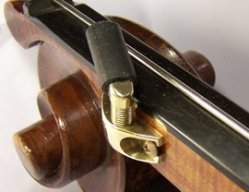
 
One wood that one wouldn't normally think of for fingerboards is walnut, but Ovation has been using an impregnated walnut for the fingerboards on most of it's top of the line Adamas guitars for decades, and it seems to hold up quite well. Looks great and is available as a domestic product.
Anyone ever tried it for bass?
I'm really intrigued by eucalyptus, still, as a laminate. But also, bamboo in large pieces with little glue sounds good too. I agree with much of what has been said about adhesives and the problems associated with them. I considered diamond wood a while ago, and decided that it's production was no less detrimental than ebony deforestation. I started this thread because I've done little research, and know little about alternatives. So far, what my little mind has come away with is this:

Bamboo: good in large pieces, without adhesive (what about wood glues or hide glues? Are the resins they use necessary for gap filling?).
If the bamboo is from China, fine. Ebony isn't much closer.

Eucalyptus: Many varieties of different hardness. Stability problems easily resolved with laminations?)

Both of these present a problem that hasn't been brought up: Staining them black. I use epoxy paint on maple. It's very nasty stuff. I've tried dies, and oils, and shellac... nothing holds up long, or doesn't get the players fingers black.

One last wee point. Should we also be talking about standards? Can we lower our standards for performance (yes, I'm a luthier) ? Do we need FBs to be black? I guess it's on a case by case basis. There's hard resistance in the realm of the orchestra, at least.
If you're not already familiar with the walnut fingerboards on the Adamas it shouldn't be too hard to find one so that you could see what you think of it. Plenty of walnut in this country, but also, if walnut can be made usable then there should be any number of other usable woods to be found. One of the main problems would probably be with people wanting the blackness of ebony, but most fully black fingerboards being stained would allow the staining of other woods as well.

Bamboo is available all around the world and without doing any research, I'd be surprised if you couldn't get it from Central America. Also, aren't there a few exotic hardwood possibilities from Hawaii, not to mention bamboo?
 
I don't know how viable it would be for a fingerboard but some guitar makers stain woods black by dissolving steel wool in vinegar and then soaking the wood in it for a while. Reports are that it penetrates well for guitar size fretboards. Note the wood must have a high natural tannic acid content for this to work.
 
And the urea-formaldehyde or epoxy glue used to laminate it? How green is that? How green are the cut-offs that get burned or sent to landfill? (regular wood shavings can be composted.) And how will luthiers deal with that material when it destroys their sharp tools? And what about the shavings and dust, what will these do to the health of those working with these materials? My former assistant got sarcoidosis in his respiratory tract from working with a type of laminated hardwood used in guitar fingerboards. I think it was probably from the glue used to process the material.

Its really hard to know the bottom line here. There is certainly a huge downside to using synthetic and hybrid materials in luthiery. The luthier now has to have a respirator and deal with hasmat disposal, and I suppose sometimes set down his beloved planes and pick up noisy power tools. Not to mention the environmental harm done by producing the materials in the first place. On the other side is the degradation of tropical forests done by sticking with traditional woods. The huge carbon footprint and threat to biodiversity of cutting roads and transporting the logs, and harm done to indigeneous populations. The industries on both sides are naturally reticent to divulge the real effects of their operations, and even if they were totally transparent the amount of number crunching that scientists would need to do to be able to make a statement such as "epoxy impregnated eucalyptus for bass fingerboards is overall more environmentally friendly than using legally harvested african ebony" would be an incredible challenge. At this point I think there just isn't enough information out there to make an informed decision. Also, though the idea of growing ebony and other tropical hardwoods in the US sounds neat on the surface, I think you wouldn't have to scratch very hard to shoot it down.
 
I don't know how viable it would be for a fingerboard but some guitar makers stain woods black by dissolving steel wool in vinegar and then soaking the wood in it for a while. Reports are that it penetrates well for guitar size fretboards. Note the wood must have a high natural tannic acid content for this to work.

The tanin+vinegar+metal combination works incredibly well, but only on high-tannin woods, like you mentioned. Red oak + walnut are such example. I turned both pitch black using vinegar and steel wool. But I wouldn't use either one for a fingerboard.

You'd still need top coat, because even using the above method, you're fingers would turn black.

If I could find a piece of bamboo that large, I would make a fingerboard out of it in a second.

Dressing a bamboo fingerboard probably presents a few issues, however, due to the long grain and its tendency to split along it. It is grass, after all.

George
 
I've been using a scraper plane for fingerboard dressing for years. It allows very precise control over the shape of the board, and deals well with burls and wavy grain. I assume it would handle bamboo well to. It just takes a bit longer to get where you want to. I've gotten used to that, though. I keep my plane blades shallow, and make lots of passes. I find that in the end, it saves as much time as it costs, as the forms are more averaged out, and there are less peaks and valleys, and tear out..
 
With regards to walnut, I can't believe it's hard enough. On a guitar, with frets that wear instead of board, and a truss rod, and a maple neck much thicker than the board, I understand. But the fingerboard on a bass is the most important part of the resistance against string tension. It's sometimes as thick as the neck, and it's played upon directly. Granted, a chemical hardener can be applied, but most people wont like that, and it's not very clean. Do they use it for fretless basses?
 
I know you can torch bamboo into darker hues, with reds and browns. Could this method approach black without damage?
I think you'd be very close to making it brittle if you wanted to approach black. I know this from experience. There is a point beyond which you don't want to go with temperature+time, at which the structure of the material is altered. You can read about this on fishing rod making forums, flute forums, and various ethnic drum forums.

I got bamboo to a very nice dark brown before, without damaging it. Baking is another alternative to torching.

Now I'm really interested in this. I know in the U.S. we have "golden bamboo", but I don't think it approaches the 1/2 ft diameter. At such diameters though, the walls should be thick enough for a single piece fingerboard.

George
 
I would play a bass that didn't have a black fingerboard. just saying. Very baroque-stylin'. I am curious about the use of local woods for intruments and fingerboards and think it's an awesome idea. I would be interested to see what someone could do with them.
 
With regards to walnut, I can't believe it's hard enough. On a guitar, with frets that wear instead of board, and a truss rod, and a maple neck much thicker than the board, I understand. But the fingerboard on a bass is the most important part of the resistance against string tension. It's sometimes as thick as the neck, and it's played upon directly. Granted, a chemical hardener can be applied, but most people wont like that, and it's not very clean. Do they use it for fretless basses?

I've never seen it used on anything other than the standard fretted Adamas line of acoustic guitars, but thought that since it did so well on them, that it might be worth consideration.
 
I posted a link for bamboo boards that would work for FBs. I don't think a scraper plane would work on bamboo. I have bent and chipped chisels cleaning up mortice ends in bubinga. The Dymondwood I used was only workable with very coarse sandpaper. I think once you get above the hardness of ebony or lignam vitae you need carbide cutting tools or grinders. I go back to my earlier post - you can use a native North American wood like maple or hickory and just dress it 1-2 times a year. This is just like a good tune up on a car. As for staining walnut you can use black leather dye which penetrates into the pores nicely or some finish suppliers have stuff called ebonizing stain, same dif as dye
 
Stewart MacDonald sells a "fingerboard dye", but all it is is Fiebing's Professional Oil Leather Dye, which you can get at Tandy's or the like. I've used it many times for guitar fingerboards, with good results. Not sure how deep it would penetrate or how well it would last on the kinds of woods under discussion here, but it would definitely be worth a try.
 

Attachments

  • oil_dye.JPG
    oil_dye.JPG
    16.8 KB · Views: 70
One point of concern with a softer wood is that even if the surface were hardened someway, it does not change the fact that only about half the fingerboard is supported by the neck. The fingerboard has to be sufficiently stiff to support the player's hand in the upper register without flexing. There might be a way to engineer it to work, but I doubt most players would be willing to use a floppy fingerboard. I think at least some people would be okay with a fingerboard that isn't black however.

One idea I've had to is use a generic stable wood. You shape it to the appropriate dimensions and the desired amount of scoop, and then laminate a sheet of carbon fiber cloth over it. With some sanding, this should yield a smooth and hard playing surface that will lend some stiffness to the whole board. Of course, you can't make any adjustments to the scoop once the board is done. It seems like nature has already provided the perfect solution. Maybe our attention should be more focused on making ebony be around in the future.