
Enjoy the benefits of a premium membership!
Upgrade Account
-
TalkBass has been independent since 1998. Add your voice.
Create a free account to reply to discussions, view embedded media, and browse with fewer display ads.
Join free Log in
Want zero display ads or expanded classifieds tools? Compare plans.
You are using an out of date browser. It may not display this or other websites correctly.
You should upgrade or use an alternative browser.
You should upgrade or use an alternative browser.
amp head to identify
- Thread starter Claudy Mountain
- Start date
More options
Who Replied?
- Feb 12, 2006
- 61,086
- 5
- 221,205
- Disclosures
- Development Engineer-Mesa Boogie, Development Engineer-Genzler (pedals), Product Support-Genz Benz
The PCB numbers aren't going to help, even for me and I serviced Yamaha back in the day.
There should be a model number screen printed on the chassis, probably B-xxx or such. It's usually on both the front and back.
There should be a model number screen printed on the chassis, probably B-xxx or such. It's usually on both the front and back.

I originally read this as "Amp Head and Identity," thinking "sounds existential."
I clearly need to step away from... something.
A Google search of images for "Yamaha LC15694" turned up this thread: Yamaha B100 Amp Question, about a Yamaha B-100.
Image of both visible circuit boards (in the first post) match the numbers you give:

I clearly need to step away from... something.
A Google search of images for "Yamaha LC15694" turned up this thread: Yamaha B100 Amp Question, about a Yamaha B-100.
Image of both visible circuit boards (in the first post) match the numbers you give:
got this amp head from a combo to identify
Yamaha circuitboard LC 80123 and LC15964
J 115 BThe PCB numbers aren't going to help, even for me and I serviced Yamaha back in the day.
There should be a model number screen printed on the chassis, probably B-xxx or such. It's usually on both the front and back.
- Feb 12, 2006
- 61,086
- 5
- 221,205
- Disclosures
- Development Engineer-Mesa Boogie, Development Engineer-Genzler (pedals), Product Support-Genz Benz
With Yamaha (and others), it's common for bare board numbers to be used in multiple related models, especially power supply boards.I originally read this as "Amp Head and Identity," thinking "sounds existential."
I clearly need to step away from... something.
A Google search of images for "Yamaha LC15694" turned up this thread: Yamaha B100 Amp Question, about a Yamaha B-100.
Image of both visible circuit boards (in the first post) match the numbers you give:
If you notice, many components are not stuffed. I believe that this bare PCB set was used for multiple models, including the B-100, G-100, a keyboard version, head and combo versions, the 50 watt versions and other country variants of these amps. It may also have been used in some PA products.
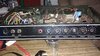
Can you post pictures of the front, back and internals?
Last edited:
Makes sense -- thank you for pointing that out. I wasn't sure that what I found would be the amp in question, but thought it might offer the OP a lead.With Yamaha (and others), it's common for bare board numbers to be used in multiple related models.
Are the boards sometimes populated with different components (or component values -- say if you were setting up otherwise similar tonestacks, one for guitar and one for bass)?
- Feb 12, 2006
- 61,086
- 5
- 221,205
- Disclosures
- Development Engineer-Mesa Boogie, Development Engineer-Genzler (pedals), Product Support-Genz Benz
Yes, very common for the era.Makes sense -- thank you for pointing that out. I wasn't sure that what I found would be the amp in question, but thought it might offer the OP a lead.
Are the boards sometimes populated with different components (or component values -- say if you were setting up otherwise similar tonestacks, one for guitar and one for bass)?
Sorry -- looks like the J-115B might have been a distinct model (at least I found a photo that implies such) among a few in a line. Don't know to what extent the head portion/circuitry might overlap with those in the manual I linked (though the description of the inputs and controls seems similar).Does this manual correspond with what you have?
Yamaha B 100-115 Bass Amplifier | SynthXL - FREE Service Manual
https://www.synthxl.com/wp-content/uploads/2021/10/Yamaha-B100-115-Bass-Amp-Service-Manual.pdf
I didn't turn up a manual (if you're looking for one) for the J-115B, but that doesn't mean that it's not out there. If you don't find one with a search, you might try contacting Yamaha to see what they can tell you.
- Feb 12, 2006
- 61,086
- 5
- 221,205
- Disclosures
- Development Engineer-Mesa Boogie, Development Engineer-Genzler (pedals), Product Support-Genz Benz
I'm about 95% certain that this PCB set was used in the G-50 guitar amps, the 7th control (reverb) and associated components would have been stuffed for this model.
As you can see, it's not as easy as it looks.
Different markets also had different models, the full model may have been J-50 115B or a variant of this. There was a B-50 115 but that model had only 4 controls but could have used the same PCB dropping the distortion circuit and mid control.
a different market could have married the 50 watt output to the 100 watt populated preamp as well.
As you can see, it's not as easy as it looks.
Different markets also had different models, the full model may have been J-50 115B or a variant of this. There was a B-50 115 but that model had only 4 controls but could have used the same PCB dropping the distortion circuit and mid control.
a different market could have married the 50 watt output to the 100 watt populated preamp as well.
Last edited:
I am ready to believe this....As you can see, it's not as easy as it looks...
- Feb 12, 2006
- 61,086
- 5
- 221,205
- Disclosures
- Development Engineer-Mesa Boogie, Development Engineer-Genzler (pedals), Product Support-Genz Benz
I serviced Yamaha during this era, lots of models and variants used the same parts. The Yamaha parts book was a valuable asset when cross-referencing parts between models, even models coming from Japan via the armed forces PX.I am ready to believe this.

Had that amp in one of the Yamaha combos I played through in high school jazz band in '94-'98. Was a fairly tall 115 combo on casters.


