• TalkBass has been independent since 1998. Add your voice.
    Create a free account to reply to discussions, view embedded media, and browse with fewer display ads.
    Join freeLog in
    Want zero display ads or expanded classifieds tools? Compare plans.

Ampeg/Avatar problem driving me nuts

ITS THE CAB.

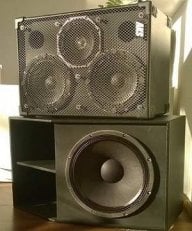
I finally was able to reproduce the issue at my home. Used all known working cables, played through my 410HLF, no problems at all. Swapped the speaker cable into the Avatar and it started cutting out. Went back to the HLF, no problem.

Plugged in my old PF500 and it seems to work fine through the HLF. I'm still within the 45 day GC return policy so I'm gonna return the head and look for a used cab to use in the downtime that I have the Avater checked out.

Contact Avatar, they likely have an updated crossover available for the cab. Fairly simple and quick to swap in. It is not only Avatar that has had this happen by the way. Other operating class amps are not immune to troubles these crossover designs can cause, but they don't manifest in as obvious a way.
 
I thought that at first since I couldn't replicate it at my home, but the issue appeared again last night at band practice at the drummer's home. The power there seems clean as the PA, two other guitar amps and the back up bass amp function in the room without issue

Does a power conditioner fix your problem? Maybe when everything your band plugs in (at practice or at gigs) there is just too much draw for the Ampeg to get enough ...
 
Just got off the phone with Trevor at Avatar and they'll be sending me an updated crossover. Awesome customer service and I'm glad I don't have to give up on this cab because it has killer tone and is a total back saver.

Thanks for the help here too guys! Will bump after I install the new crossover and give er a test run.
 
Just got off the phone with Trevor at Avatar and they'll be sending me an updated crossover. Awesome customer service and I'm glad I don't have to give up on this cab because it has killer tone and is a total back saver.

Thanks for the help here too guys! Will bump after I install the new crossover and give er a test run.

They are a great bunch over at Avatar, glad you took the advice.
 
Just got off the phone with Trevor at Avatar and they'll be sending me an updated crossover. Awesome customer service and I'm glad I don't have to give up on this cab because it has killer tone and is a total back saver.

Thanks for the help here too guys! Will bump after I install the new crossover and give er a test run.


Let us know how this turns out.

My Avatar's are going onto 7 years in use, maybe I'll check into some updated x-overs also.
 
Let us know how this turns out.

My Avatar's are going onto 7 years in use, maybe I'll check into some updated x-overs also.
Will do! It should be here Saturday and I'll pop it in and try it out at practice Sunday. I love how this cab sounds with the head I use so I don't wanna give up on it.

I bought the thing on Craigslist for super cheap so I have a feeling I got swindled a little :/
 
UPDATE.

New crossover is installed. Still cuts out with my PF500. Can't get it to cut out with my SVT but I don't know if that because I'm afraid to crank it and blow the driver apart.

Why does this problem only exist with the portaflex through this cab? 4ohm driver rated at 500 watts with a 4ohm amp that puts out 500w. It's not cranked to the moon. Now I'm really in the dark.
 
Dang!
Have you got back in touch with Trevor, @Avatar- about this?

Since the cab functions fine with your SVT, but still acts up with your PF500 it would seem like the PF, is the culprit after all?
The PF-500 have has a history of this happening

Does the Avatar, have an attenuator for the tweet? if so, does having it full on, or full off -have any effect on the cab cutting out while paired with the PF?
 
I've encountered the same sort of problem with my 210 cab (three way system). Two years ago I took that cab to a guy who's also importer of Prolude (Class-D) bassamps. We hooked up my cab, sounded fine but on slightly louder then moderate volume the amp started to give these "spikes" and then it cut out.
I never encountered this problem with SS amps (even my cheap Bugera BVP5500 :roflmao:) and I've build the same cab for another bassplayer who has a TC Electronic RH450 (or 750) Class-D amp and it works perfectly fine with that cab. I also hooked up that 210 to an amp build up out of class-D Hypex (designed by class-D wizzard Bruno Putzey) modules, no problem either. I know that the three-way crossover of my 210 cab is a bit more complex but there aren't any "weird" component values in there, nothing out of the ordinary. The only "trick" in this crossover is a series LCR to smooth out the impedance peak of the 8" mid driver, this is needed for the HPF to work properly. I could do a redesign of the crossover without the LCR, after doing some simulations I see that it will only have a slight impact on the frequency response, slightly less linear.

Maybe @agedhorse can shine some light on this matter, he's the amp expert :). My main question would be how will I know that the crossover doesn't cause a class-D amp to oscillate since I don't own such an amp myself. I've dropped the same question on a Dutch DIY-audio forum.

Also read this thread Preference For Sealed Cabs? Why?
 
Last edited:
I've encountered the same sort of problem with my 210 cab (three way system). Two years ago I took that cab to a guy who's also importer of Prolude (Class-D) bassamps. We hooked up my cab, sounded fine but on slightly louder then moderate volume the amp started to give these "spikes" and then it cut out.
I never encountered this problem with SS amps (even my cheap Bugera BVP5500 :roflmao:) and I've build the same cab for another bassplayer who has a TC Electronic RH450 (or 750) Class-D amp and it works perfectly fine with that cab. I also hooked up that 210 to an amp build up out of class-D Hypex (designed by class-D wizzard Bruno Putzey) modules, no problem either. I know that the three-way crossover of my 210 cab is a bit more complex but there aren't any "weird" component values in there, nothing out of the ordinary. The only "trick" in this crossover is a series LCR to smooth out the impedance peak of the 8" mid driver, this is needed for the HPF to work properly. I could do a redesign of the crossover without the LCR, after doing some simulations I see that it will only have a slight impact on the frequency response, slightly less linear.

Maybe @agedhorse can shine some light on this matter, he's the amp expert :). My main question would be how will I know that the crossover doesn't cause a class-D amp to oscillate since I don't own such an amp myself. I've dropped the same question on a Dutch DIY-audio forum.
Also read this thread Preference For Sealed Cabs? Why?

I got reply back from the Dutch audio forum from a guy who knows a lot about the Hypex stuff and class-D amps in general. He did a good explanation (in Dutch). Here's my (ahum) translation: Hypex class-D amps have a sort of feedback-loop which incorporates the LC filter and loudspeaker load, budget amps have the feedback before the LC filter, in this case the amp itself doesn't "see" the loudspeaker load directly since the LC filter is in front of it. When the load is a bit more complex (not only the impedance) then strange things start to happen because the amp doesn't get enough loop-gain, it just can't run the complex load (LC + loudspeaker) without running into self-excited oscillation.
But in short the problem occurs very often with budget class-D amps, Hypex and probably TC Electronic class-D amps don't have such issues :cool:
 
Last edited:
This is a well known problem and it can affect all class D amps. In fact amps that take all of their feedback after the reconstruction filter tend to be more prone due to the reduction in phase margin. The problem is that the residual PWM carrier's stored energy in a defectively designed crossover interacts with the amp resulting in the stability margin slipping past zero.

In quality class D designs, the amp will protect itself, as designers of amps are aware that there are a lot of non-engineering types designing speakers without the slightest knowledge or understanding of power filter (crossover) designs, folks with good intentions but without the skill set to design and analyze their designs in the face of what an amplifier sees. I have helped several speaker manufacturers sort this out recently.

Incidentally, poor crossover designs create problems for class AB amps as well, and can cause spectacular failures as amps burst into rail to rail oscillations.

The most common cause is capacitive elements being used for inductive impedance linearization without a suitable damping term. If the designer was to do a phase or power factor analysis, it would be obvious (if they understand the subject) that under some conditions, like a driver failing open, that the resulting circuit presents an illegal load to the amp. Amp designers refer to such speaker products as amp killers, and we try hard to design in protection for such instances, but protection is not always 100% effective.
 
  • Like
Reactions: B-string
This is a well known problem and it can affect all class D amps. In fact amps that take all of their feedback after the reconstruction filter tend to be more prone due to the reduction in phase margin. The problem is that the residual PWM carrier's stored energy in a defectively designed crossover interacts with the amp resulting in the stability margin slipping past zero.

The amp guru from the Dutch audio forum told me that feedback after the LC filter is no guarantee that it will work when the ampdesigner hasn't done his home work....Bruno Putzey (Hypex) definitely did his homework.

In quality class D designs, the amp will protect itself, as designers of amps are aware that there are a lot of non-engineering types designing speakers without the slightest knowledge or understanding of power filter (crossover) designs, folks with good intentions but without the skill set to design and analyze their designs in the face of what an amplifier sees. I have helped several speaker manufacturers sort this out recently.

Incidentally, poor crossover designs create problems for class AB amps as well, and can cause spectacular failures as amps burst into rail to rail oscillations.


You can say what you want but impedance correction netwroks are COMMON PRACTICE and not only among "amateurs" these are common "tools" for crossovers. I understand that some "exotic" crossovers can cause problems but I've never ever encountered any problems in 25 years with my own designs except when I hooked up my 210 cab to that particular class-D amp.
Duke Lejeune is a professional and uses these "tricks" too.
There are two German Loudspeaker magazines that have build hundreds of loudspeakers almost all of those include elements to smooth out impedance peaks, I've never ever heard them talk about these issues and they probably never encountered them.

With my cabinet there are zero problems with Hypex class-D amps (which you say are more prone to that problem, in practice that's not the case with my cab!), TC Electronic class-D amps, my own SS Bugera, my SS Denon, my SS JVC, my SS Bell 9024 PCX poweramp, my SS Advance acoustic (Class AB). In my case it's definitely a problem with the design of a crappy class-D amp.
 
Last edited:
UPDATE.

New crossover is installed. Still cuts out with my PF500. Can't get it to cut out with my SVT but I don't know if that because I'm afraid to crank it and blow the driver apart.

The PF500 is probably an ol'/budget class-D design that can't handle a slightly more "complex" load of the Avatar cab. If you stick with that PF500 and you try other cabs it's very likely that you'll encounter that problem again. If you google you'll find a lot of people who had these kind of troubles with the PF-500.
If you read my posts in this thread you see that I did have trouble with one particular class-D amp and no problems with other amps (including two class-D amps).
 
Last edited:
You can say what you want but impedance correction netwroks are COMMON PRACTICE and not only among "amateurs" these are common "tools" for crossovers. I understand that some "exotic" crossovers can cause problems but I've never ever encountered any problems in 25 years with my own designs except when I hooked up my 210 cab to that particular class-D amp.
Duke Lejeune is a professional and uses these "tricks" too.
There are two German Loudspeaker magazines that have build hundreds of loudspeakers almost all of those include elements to smooth out impedance peaks, I've never ever heard them talk about these issues and they probably never encountered them.

With my cabinet there are zero problems with Hypex class-D amps (which you say are more prone to that problem, in practice that's not the case with my cab!), TC Electronic class-D amps, my own SS Bugera, my SS Denon, my SS JVC, my SS Bell 9024 PCX poweramp, my SS Advance acoustic (Class AB). In my case it's definitely a problem with the design of a crappy class-D amp.
Please don't put words in my mouth or misrepresent what I said.

When designing impedance correction networks, the designers must consider the phase angle/power factor and damping terms as part of the design in order to prevent an illegal load to amplifiers. Amplifiers are designed to be stable into a range of loads, and there are folks who call themselves speaker designers who do not understand the first thing about this topic. This is what I was addressing.

Also, I did NOT say that Hypex were more prone to "that problem". I said that post filter feedback topologies are generally more prone. This means that additional effort during the design phase must be placed on the analysis of stability margins into reactive (especially leading PF) loads.

As a designer of BOTH amplifiers AND speakers, this is a topic I have studied in great depth over many years. I suggest you study the math behind reactive loop stability, it might prove enlightening. It's really a fascinating subject if you can get over the dryness of the math itself.
 
Amplifiers are designed to be stable into a range of loads, and there are folks who call themselves speaker designers who do not understand the first thing about this topic. This is what I was addressing.

I understand what you mean, but I think a large portion of loudspeaker manufacturers (not only amateurs) delve into these things. You may look at me as an amateur since I don't make money with my "hobby", that doesn't mean my knowledge is below that of most manufacturers.
As you state, it takes a great amount of knowledge about amplifiers to adress these things.

Also, I did NOT say that Hypex were more prone to "that problem". I said that post filter feedback topologies are generally more prone. This means that additional effort during the design phase must be placed on the analysis of stability margins into reactive (especially leading PF) loads.

You didn't say that, but to me it implied that (english is not my native language so I might interpret things differently)

As a designer of BOTH amplifiers AND speakers, this is a topic I have studied in great depth over many years. I suggest you study the math behind reactive loop stability, it might prove enlightening. It's really a fascinating subject if you can get over the dryness of the math itself.

I'm already on to that and it's a great subject :)

The thing is, I'm still wondering about that particular class-D amp that gives problems with my 210 cab, all the other amps I've listed have zero problems with that.
What I'm trying to say is that you can't design a loudspeaker (that will reach the design goals) that will run effortlessly on all available amps if some of these amps are very prone to loads that are a bit more complex. In this case a crossoverless design would be the way to go....
 
Or a crossover that does not present an illegal leading reactive load to the degree that some designs appear to do.

Often, increasing the damping term a bit is all that is necessary, so that stored carrier residual energy is dissipated rather than accumulated.
 
Or a crossover that does not present an illegal leading reactive load to the degree that some designs appear to do.

Often, increasing the damping term a bit is all that is necessary, so that stored carrier residual energy is dissipated rather than accumulated.

But what if this particular amp I'm talking about is just a badly designed amp? and that the crossover is just fine (for 99.9% of the available amps)
Can I measure such an "anomaly" at the crossover? If it's measurable I need to get my "tools" up to the standard that I can measure that :)
 
It's certainly possible that you got a defective amp as well. If all of the amps using the same power module exhibit this problem, then I would recommend looking at a reactive impedance plot considering all values of a variable tweeter pad. Another thing to check is for saturation of inductors, especially if iron core inductors are used (I don't recommend them because of this reason amongst others)

Troubleshooting this sort of thing requires being objective, analytical, methodical and not being defensive.
 
  • Like
Reactions: B-string
It's certainly possible that you got a defective amp as well. If all of the amps using the same power module exhibit this problem,
At the importer of the Prolude amps we tried three models, all three models showed this problem.

then I would recommend looking at a reactive impedance plot considering all values of a variable tweeter pad.

You mean the L-pad in the crossover? I don't use a variable tweeter pad, it's fixed.

Another thing to check is for saturation of inductors, especially if iron core inductors are used (I don't recommend them because of this reason amongst others)

There's only one iron core inductor in the crossover (lowpass for the two 10's), the type I choose is a Corrobar which is especially made for high power applications and has low saturation (see CO 92 in the graph below, this graph shows when saturation starts to happen with different inductor types, this study is done by a German engineer who also designed loudspeakers for JBL and Quadral). Before this type of inductor starts to saturate the drivers will already be fried.

saturation_inductors_.jpg


Troubleshooting this sort of thing requires being objective, analytical, methodical and not being defensive.
Of course, I wanna know what's causing this and if it's indeed an anomaly in the crossover or just a not so well designed amp, it's probably going to be a long quest, thnx for your time @agedhorse :)
 
Last edited: