• TalkBass has been independent since 1998. Add your voice.
    Create a free account to reply to discussions, view embedded media, and browse with fewer display ads.
    Join freeLog in
    Want zero display ads or expanded classifieds tools? Compare plans.

Ampeg PF20T volume for apartment living

I know there are quite a few members here that own the Ampeg PF20T Tube amp. I'm thinking of buying one. I can't play too loud in my apartment and I have a few amps but would like to practice with that Ampeg tone/sound. Can someone tell me if these sound good at a low volume or do you have to crank up the volume to get the desired sound? Thanks for any info.
 
Honestly, it should be perfect for you for two reasons.

1) It'll sound fantastic at any volume.

2) There is an XLR out on these amps that allows you to take a tap off of the output transformer with no speaker load (which is rare for a tube amp). So if you decide that even this amp gets too loud for certain times if day, you can get all that tubey goodness into your headphones if you have a method for headphone use (either a headphone amp or even a computer interface for recording).

In other words, I think this would be the perfect amp for apartment playing.

Also, isolate your speaker cab from the floor. That will certainly help with apartment volume levels. If you don't want to buy the expensive foam isolator, use a couple of folded towels. The less connected that cab is to the structure of the building, the less you'll aggravate the neighbors.
 
Honestly, it should be perfect for you for two reasons.

1) It'll sound fantastic at any volume.

2) There is an XLR out on these amps that allows you to take a tap off of the output transformer with no speaker load (which is rare for a tube amp). So if you decide that even this amp gets too loud for certain times if day, you can get all that tubey goodness into your headphones if you have a method for headphone use (either a headphone amp or even a computer interface for recording).

In other words, I think this would be the perfect amp for apartment playing.

Also, isolate your speaker cab from the floor. That will certainly help with apartment volume levels. If you don't want to buy the expensive foam isolator, use a couple of folded towels. The less connected that cab is to the structure of the building, the less you'll aggravate the neighbors.

Thanks for the info TWO FINGERS. Just the fact that you say it will sound fantastic at any volume is all I need to hear. I have a foam isolator made by Gramma and it does help with my solid state amps. I've always wanted that tubed Ampeg sound so this amp is looking very good!
 
  • Like
Reactions: two fingers
Thanks for the info TWO FINGERS. Just the fact that you say it will sound fantastic at any volume is all I need to hear. I have a foam isolator made by Gramma and it does help with my solid state amps. I've always wanted that tubed Ampeg sound so this amp is looking very good!

Glad to help. Yeah it sounded so good when I got to play through one, I'm thinking seriously about building a modern fliptop around a 215 cab and getting a PF50T.
 
Another really excellent small amp for apartment dwellers is the Fender Rumble 15. I actually use my Rumble 15 a lot more frequently than I use my Ampeg PF20T. Mostly due to the convenience of the 'combo' format. But it also sounds pretty darn good.
 
Bass and an apartment is a difficult mix. Low end carries through walls and you really have to be careful or they’ll be banging on your door. Placing the amp at ear level helps a lot.

Does a PF-20T have the Ampeg sound? You bet. The output can be fed into a small mixer and headphones out if you wish. At least some of the time.
 
  • Like
Reactions: Guitalia
Bass and an apartment is a difficult mix. Low end carries through walls and you really have to be careful or they’ll be banging on your door. Placing the amp at ear level helps a lot.

Does a PF-20T have the Ampeg sound? You bet. The output can be fed into a small mixer and headphones out if you wish. At least some of the time.

You're right, especially the building I'm in. I've been playing my Carvin MB10 and MB15 combos with the volume around 2 which is quite low but at least I can hear it and no complaints. Believe me I don't like the sound level limitations but it's what it is for now. That's why I've asked how the PF20T sounds at a low level.
 
  • Like
Reactions: beans-on-toast
Wouldn't 2 cabs (one on each side of the couch, with you in the middle) be better for that? ;-)
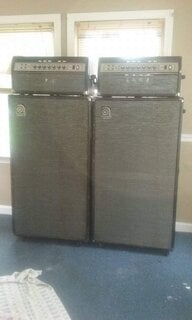
Somethin' like dis???
HVbpqr9.jpg
 
I know there are quite a few members here that own the Ampeg PF20T Tube amp. I'm thinking of buying one. I can't play too loud in my apartment and I have a few amps but would like to practice with that Ampeg tone/sound. Can someone tell me if these sound good at a low volume or do you have to crank up the volume to get the desired sound? Thanks for any info.

The answer to your question is that provided an amplifier, any amplifier is reasonably flat in its frequency response, how bass notes or music sounds playing through it loud or soft has nothing to do with the amplifier itself. It actually has everything to do with how our ears work.

There is a scientific reason why music including bass notes sound fuller and more pleasing to the ear at higher volume levels. The reason is because our ears become less sensitive to bass frequencies at low volume. So when you play or listen to music at low volume, you have to compensate for this loss of sensitivity in the bass region, or the music will sound sterile, with no bottom end. Two very smart guys named Fletcher and Munson studied this effect scientifically and came up with a graph showing how the ear progressively looses its sensitivity to bass frequencies as the volume level (SPL) diminishes. This is known as the Fletcher Munson curve.

The following is a great little article that will explain this effect, and has everything you need to know in it. The article is oriented toward recording but the information will be critical in your situation as well for you to achieve your goals no matter what bass head or amplifier you end up using.

Fletcher Munson Curve: A Must-Know for Audio Recording

If you desire to go into more scientific detail regarding this phenomenon, the following Wikipedia article is pretty comprehensive.

Equal-loudness contour - Wikipedia

Bottom line: At low practice volume levels in an apartment you must seriously boost your bass (and sometimes your treble) on your bass head tone settings or your instrument will sound thin and unsatisfying to the ear. This is going to be the case with any bass head you employ to practice with, including the Ampeg PF20T.

I live in a condo and practice with a loudspeaker at all hours of the night. I don't bother anybody because I play at low volume. My practice rig is an Acme Low B112FR which I power with an Ampeg SVT 7Pro (I know, it's overkill, but it's a long story!). The cab lives on a stool next to my practice stool, so it's practically right next to my ear. This works out real well and I don't have to turn the volume up very high at all to hear everything I need to hear. I play a Fender American Standard Precision 5 string with La Bella 760fl's. On the Ampeg bass head I use both the Ultra Lo and Ultra Hi with the bass around 1:30. That fattens up the tone real good for low volume, and I roll the bass in and out on the instrument itself as desired. My mids and highs are straight up. For practice, a similar EQ scheme would work with a PF20T keeping in mind the PF20T has no Ultra Lo or Ultra Hi. [Note: If I tried that EQ scheme live with a full rig, I would blow all the mic stands off the front of the stage! It only works for practice at low volume!].

For the last week I've been experimenting with headphones and IEM's for practice purposes with surprising results. Headphones / IEM's never worked very well for me for practicing using the headphone output on my SVT 7Pro. It just never sounded very good, for some reason. But I have found that using an Apogee Jam + interface and my iPad with Garage Band I can acquire a bass amp sim, and doing that makes my bass sound amazingly good in my IEM's / headphones. It's premature to say at this point, but it sounds so good I am strongly considering changing up and just using the Apogee / iPad set up through IEM's / headphones for practice purposes. You might consider that as an option, as well. iPhones, iPads Mac's and PC's are supposed to work with the Apogee. [Note: I originally purchased an iRig Pro interface but had to return it when the headphone jack stopped working after three days]. I am not associated in any way with Apogee. Good luck.
 
Last edited:
I recently bought a PF20t and PF112HLF for a lower volume amp. It sounds great and can be used as a headphone practice or recording amp with a mixer or audio interface. Also if you need more volume you can take a direct line out to a power amp or as a DI to a P/A system. It really is a very versatile amp. I would highly recommend it.
Edited to say that with the PF210HE it can get plenty loud by itself.
 
  • Like
Reactions: friend33 and klaatu

Latest posts