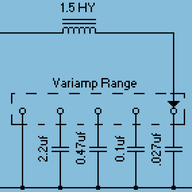
For ported cabs there is probably a "pumping time" delay, and therefore phase change, closely related to some other spec.

TalkBass has been independent since 1998. Add your voice.
Create a free account to reply to discussions, view embedded media, and browse with fewer display ads.
Join free Log in
Want zero display ads or expanded classifieds tools? Compare plans.

Always wanted to try a CA9. I heard that they kick like a mule!Head & shoulders above all else, Glockenklang Blue Rock & Reeves C225. With a HPF &
a sealed speaker cab. Look for slew rates & high Damping Factor. I haven't tried one
but I have read that the Crest CA9 is good, very high damping factor.



Huh, no recommendations for Hartke. I feel my HA amp and Hydrive cabs are pretty punchy. A sealed cab pretty much has that in it's DNA.
I'm seeing a lot of different amps/cabs being favored for their tight/punchy response. Maybe it should have been asked as to which amps are slow and sloppy?

The D-800/800+ are defined as high dampingI'm pretty sure that @agedhorse stated that the other Subway amps without the damping control were default to the 'high' setting but I could be misremembering.
What kind of transient test are you talking about?When running frequency response tests, the transient response of both the Glockenklang & the
Reeves Custom 225 showed considerably faster rise time & quicker damping than any other amps
that I tried. Transient response directly correlates with what you hear, like tight & punchy or
muddy & boomy. TR is not just the amps ability but also that of the speakers.
My apologies, I meant Impulse Response, when testing amps & speakers in systems. Swapping out componentsThe D-800/800+ are defined as high damping
The WD-800 is variable damping (low-medium-high)
The TT-800 is low damping (not quite as low as the WD in low position) and it remains constant through 8, 4 and 2 ohm loads just like the output transformer would on the Bass-400.
What kind of transient test are you talking about?
I think there is a misunderstanding or mis-correlation of what you are saying versus what you are actually testing or describing.
When running frequency response tests, the transient response of both the Glockenklang & the
Reeves Custom 225 showed considerably faster rise time & quicker damping than any other amps
that I tried. Transient response directly correlates with what you hear, like tight & punchy or
muddy & boomy. TR is not just the amps ability but also that of the speakers.

Characterizing an amplifier's response via an impulse response convolution is a way to express a lot of data in a single package. That's very difficult than transient response which involves propagation delays, amplitude versus phase data, bandwidth data, etc.

Agreed!My non-expert 2¢ is that I doubt any (normal) tube power amp belongs in *this* thread, except as a comparatively negative example.
Very interesting thought!!If you are willing to chase "tight" all the way down the rabbit hole... and are willing to trade away SPL...
There are a number of car subs that will do this for you.
Note: nearly all of these are "subs" so biamping around 100 Hz is necessary.
The absolute tightest of these are EBP=50-ish and housed in a sealed D2 alignment.
The Eminence LAB12 isn't a car sub (box is too big), but meets the requirements.
F3 around 43 Hz in D2, with a box volume around 3.75 cubic feet.
D2 rolls off a wee bit higher than the smaller B2 box.
If you are OCD about the tightest possible speaker configuration, D2 is it.
Huh, no recommendations for Hartke. I feel my HA amp and Hydrive cabs are pretty punchy. A sealed cab pretty much has that in it's DNA.
I'm seeing a lot of different amps/cabs being favored for their tight/punchy response. Maybe it should have been asked as to which amps are slow and sloppy?
Another vote for an adjustable HPF. I finally hopped on the bandwagon and was amazed at how much mud it removed from two different rigs in two different locations: just a little tweak was all it took. Bandmates in both groups commented on how much "punchier" my sound was. For $75 you can get the always-on version from Boughton (the one I bought), which is a lot less expensive than replacing a head. And even if you do wind up getting a new head or cabs, you'll find it useful for those too.

The frequencies that are causing the mud are well below 80hz, so I suspect you are actually cutting some of the "good" lows -- the thump you want -- but not touching the "bad" lows that are mucking things up. The Broughton ("Always-On") HPF I recently bought cuts everything below 25hz at the minimal setting, and then you can adjust the cutoff upwards from there. In my case I didn't have to move it very far: I'd guess that I have it set somewhere around 35-40hz. (This particular model doesn't have the frequencies labeled around the adjustment knob, so I can only estimate.) I was really wowed by the difference: I didn't even realize how much mud was in my tone until it was gone. And as I said in my previous post it wasn't just me: My bandmates (in two different bands) commented on how much "punchier" the bass was in the mix.I'm curious how the HPF applies? I have a 4 band semi parametric eq which shelves lows I set it around 80hz and cut until it starts to sound thin, then dial in just a touch. I then try to rely on the bump in low mids, but it doesn't quite get me the punch I need. How would an HPF work any differently than this?


