I have been asked many times how I have my basses set up. I usually avoid directly answering the question because my setup, though perfect for me, may be totally unplayable for someone else. I advised that my numbers were practically meaningless for anyone else - we all play differently.
However, I have softened my view a bit - it must be old age creeping in. I now feel that it's still true that my numbers might not work for you, but that a reference point might be useful for someone who has not had the benefit of a good setup and is struggling with their machine. So I am going to post the actual measurements of one of my basses.
A few caveats:
1. As stated, this setup works for me and may be totally useless to you
2. Not all my basses are set up the same. That's not an accident - I play them all differently and usually for different styles fo music (rock, country, fusion, trad jazz, etc). Even when played the same, some basses require a different setup to play equally well.
3. I like my action quite low, but not extremely low.
4. I have a moderately light touch
5. I sometimes change the setup on a bass from its usual settings. This often occurs when I have been playing a lot of standup then do a gig on one of my bass guitars. After days on the standup I find I am plucking too hard on the bass guitar and need a higher setup. After a day or two I end up lowering the BG again.
6. All measurements taken with the bass held in playing position.
The bass guitar I am using for this purpose is the one that gets the most use these days - a 2000-something 4-string MIM Fender Jazz. The body and neck are original but everything else has been changed. I levelled the frets. Here's the setup ...
1. Relief E string side .008" (0.2mm) G string side - .006" (0.15mm)
This measurement was taken with dial gauge mounted on an accurate straightedge spanning frets 1 to 15. Measurement is taken at the point of maximum deviation, in this case the 7th fret. The relief differs side to side, and this is common to many basses. The amount of relief I chose gives the best performance across all strings on this bass.
2. String Height at the 12th fret, open strings, measured with feeler gauges, fret top to bottom of string
G:.062" (1.57mm) D: .065" (1.65mm) A: .070" (1.78mm) E: .077" (1.96mm)
3. Pickup Height - note that this is an almost useless measurement for comparison purposes since the necessary pickup height is very much determined by the pickups themselves and vary from brand to brand, model to model. The measurement is taken with the string held down at the last fret and a feeler is used to measure between the pole pieces and the underside of the string
Neck Pickup: E: .090" (2.29mm) G: .090" (2.29mm)
Bridge Pickup: E: .090" (2.29mm) G: .080" (2.03mm)
4. Nut Height measured with a feeler gauge open string, top of first fret to underside of the string
E: .010" (0.25mm) G: .010" (0.25mm) (A dand D strings same)
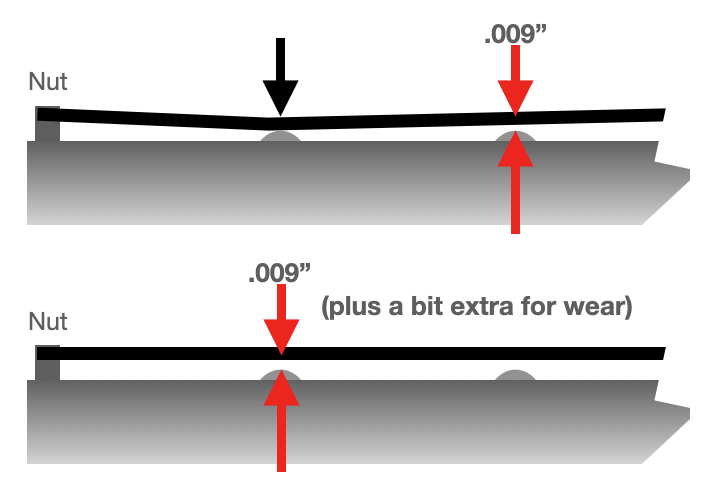
This nut height is much lower than recommended by most techs and luthiers. Here's how I arrived at this height. I held down the string at the first fret and measured the gap between the string and the second fret. In my case that measured .009". I then fretted at the second fret and measured the gap at the third fret. It too measured .009". I figure that if a clearance of .009" when fretting is good for the second and third frets it should be good open at the first fret, but I added an extra .001" to allow for a bit of nut wear. I probably didn't need to add that extra bit because after more than 10 years playing this bass the nut hasn't worn (it's bone BTW). Having the nut cut lower than .009" makes no sense since it would only allow more buzzing on the open string than a fretted one. Perhaps this will make it clear:
There are two significant benefits to having the nut cut so low - it makes fretting at the first fret easier and it allows for better intonation at the first and second frets. The string stretches less when fretting there since you don't need to press it as far down. The more stretching there is, the more the note becomes sharp. Some makers use a compensated nut to help with intonation at the first couple of frets, but with the nut cut as I have it's totally unnecessary. On my bass both E and G strings are less than 1/2 cent flat at the first fret with a straight nut, no compensation. One downside of having the nut cut so low is that you may experience more "back buzz". This is the string rattling against the frets between the nut and where you are fretting, a sympathetic vibration. Additional nut height will help alleviate this problem though I find it not to be a problem with a well setup bass, especially if the player has a light touch and/or damps properly.
I emphasize that this setup works for me on this bass given the way I play it. Chances are it will not be so good for you. It is different from the "standard" setup I use for new clientele. I start them with more relief and more string height and adjust from there as I gain understanding of the player's style and preferences. But I do not deviate from my method for determining nut height since I find the typical recommendation excessively high.
Having said that these measurements will likely not work for you, it is an illustration that a modest instrument such as this MIM Jazz can be made to play well with a low setup. To arrive at what works best for you, you will need to do a lot of trial and error. Normally you should only change one variable at a time, but it's a complex process. Each element of the setup has an effect on all other elements. Change the amount of relief and you will probably need to change the string height to compensate. That may throw off the intonation. If you set the nut height using the method I suggest, then change the string height - you may need to change the nut height to compensate. Same is true if you change the amount of relief - you may need to adjust the nut. My last peice of advice - beware of simplistic answers. At least one setup guided I have seen says that if the notes closer to the nut buzz you need more relief, but it they buzz in the upper register you need less relief. It's not that simple - in fact you can well end up with a far less than optimum setup as a result.
However, I have softened my view a bit - it must be old age creeping in. I now feel that it's still true that my numbers might not work for you, but that a reference point might be useful for someone who has not had the benefit of a good setup and is struggling with their machine. So I am going to post the actual measurements of one of my basses.
A few caveats:
1. As stated, this setup works for me and may be totally useless to you
2. Not all my basses are set up the same. That's not an accident - I play them all differently and usually for different styles fo music (rock, country, fusion, trad jazz, etc). Even when played the same, some basses require a different setup to play equally well.
3. I like my action quite low, but not extremely low.
4. I have a moderately light touch
5. I sometimes change the setup on a bass from its usual settings. This often occurs when I have been playing a lot of standup then do a gig on one of my bass guitars. After days on the standup I find I am plucking too hard on the bass guitar and need a higher setup. After a day or two I end up lowering the BG again.
6. All measurements taken with the bass held in playing position.
The bass guitar I am using for this purpose is the one that gets the most use these days - a 2000-something 4-string MIM Fender Jazz. The body and neck are original but everything else has been changed. I levelled the frets. Here's the setup ...
1. Relief E string side .008" (0.2mm) G string side - .006" (0.15mm)
This measurement was taken with dial gauge mounted on an accurate straightedge spanning frets 1 to 15. Measurement is taken at the point of maximum deviation, in this case the 7th fret. The relief differs side to side, and this is common to many basses. The amount of relief I chose gives the best performance across all strings on this bass.
2. String Height at the 12th fret, open strings, measured with feeler gauges, fret top to bottom of string
G:.062" (1.57mm) D: .065" (1.65mm) A: .070" (1.78mm) E: .077" (1.96mm)
3. Pickup Height - note that this is an almost useless measurement for comparison purposes since the necessary pickup height is very much determined by the pickups themselves and vary from brand to brand, model to model. The measurement is taken with the string held down at the last fret and a feeler is used to measure between the pole pieces and the underside of the string
Neck Pickup: E: .090" (2.29mm) G: .090" (2.29mm)
Bridge Pickup: E: .090" (2.29mm) G: .080" (2.03mm)
4. Nut Height measured with a feeler gauge open string, top of first fret to underside of the string
E: .010" (0.25mm) G: .010" (0.25mm) (A dand D strings same)
This nut height is much lower than recommended by most techs and luthiers. Here's how I arrived at this height. I held down the string at the first fret and measured the gap between the string and the second fret. In my case that measured .009". I then fretted at the second fret and measured the gap at the third fret. It too measured .009". I figure that if a clearance of .009" when fretting is good for the second and third frets it should be good open at the first fret, but I added an extra .001" to allow for a bit of nut wear. I probably didn't need to add that extra bit because after more than 10 years playing this bass the nut hasn't worn (it's bone BTW). Having the nut cut lower than .009" makes no sense since it would only allow more buzzing on the open string than a fretted one. Perhaps this will make it clear:
There are two significant benefits to having the nut cut so low - it makes fretting at the first fret easier and it allows for better intonation at the first and second frets. The string stretches less when fretting there since you don't need to press it as far down. The more stretching there is, the more the note becomes sharp. Some makers use a compensated nut to help with intonation at the first couple of frets, but with the nut cut as I have it's totally unnecessary. On my bass both E and G strings are less than 1/2 cent flat at the first fret with a straight nut, no compensation. One downside of having the nut cut so low is that you may experience more "back buzz". This is the string rattling against the frets between the nut and where you are fretting, a sympathetic vibration. Additional nut height will help alleviate this problem though I find it not to be a problem with a well setup bass, especially if the player has a light touch and/or damps properly.
I emphasize that this setup works for me on this bass given the way I play it. Chances are it will not be so good for you. It is different from the "standard" setup I use for new clientele. I start them with more relief and more string height and adjust from there as I gain understanding of the player's style and preferences. But I do not deviate from my method for determining nut height since I find the typical recommendation excessively high.
Having said that these measurements will likely not work for you, it is an illustration that a modest instrument such as this MIM Jazz can be made to play well with a low setup. To arrive at what works best for you, you will need to do a lot of trial and error. Normally you should only change one variable at a time, but it's a complex process. Each element of the setup has an effect on all other elements. Change the amount of relief and you will probably need to change the string height to compensate. That may throw off the intonation. If you set the nut height using the method I suggest, then change the string height - you may need to change the nut height to compensate. Same is true if you change the amount of relief - you may need to adjust the nut. My last peice of advice - beware of simplistic answers. At least one setup guided I have seen says that if the notes closer to the nut buzz you need more relief, but it they buzz in the upper register you need less relief. It's not that simple - in fact you can well end up with a far less than optimum setup as a result.
Attachments

Last edited: