• TalkBass has been independent since 1998. Add your voice.
    Create a free account to reply to discussions, view embedded media, and browse with fewer display ads.
    Join freeLog in
    Want zero display ads or expanded classifieds tools? Compare plans.

Double Bass Annotation in the Messiah

Hi folks,
I have been invited to join a chamber orchestra for a performance of Handle's Messiah in December and I was just intrigued by the annotation on the IMSLP version that I have downloaded in advance of receiving the Part (its the numbers under the dots as below). Forgive my ignorance but I havent a clue what the numbers and annotation refers to?
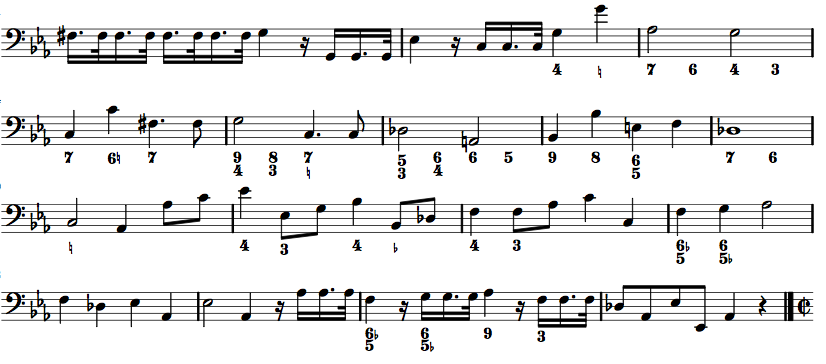

Handel.png
 
That's the kind of notation that I use for harmony when analysing something like a 4 voice Bach Coral. For example a 6/4 is the second inversion of a triad chord, a 7 means a chord with the fundamental on the bass and the seventh present but it's not the V of the tonality,...etc.

I can't think of a use for these numbers from a bassist point of view, unless you want to sit at the piano and build the chords youself.
 
Last edited:
It's figured bass, and only useful for the cembalo/harpsichord player. Don't worry your pretty little head over it.

That made me smile because I inevitably started reading up on implied triads, baroque inversion annotation, and SATB improv etc (worrying my 'not so pretty head' over it!) ...and came to the same conclusion that educational and interesting though it was, it probably isn't going to be relevant for the job that I need to do. Thanks Paul
 
It's figured bass, and only useful for the cembalo/harpsichord player. Don't worry your pretty little head over it.
+1. I suppose that an incorrigible academic might claim that it's important to know what part of the chord each written note is, and that you must do a complete harmonic analysis to be able to play the part properly, but I think most good bassists can do this perfectly well with their ears:)