• TalkBass has been independent since 1998. Add your voice.
    Create a free account to reply to discussions, view embedded media, and browse with fewer display ads.
    Join freeLog in
    Want zero display ads or expanded classifieds tools? Compare plans.

Announcing The Ray Ross™ Saddle-Less Bass Bridge

Hey jim c,
Thanks for the thoughtful insight and well reasoned questions.
One at a time,
Rembo will not be back. He was completely flabbergasted by the negative hostility that arrived upon his posting.
You are correct in that you dont adjust this ALL the time. You want high? Great!.. You want low? Great! Now go play bass. Pretty simple really. As for the wrench, all my original designs used one. The distributor thought it looked a little "industrial" this is another example of "form/function".
There is maybe a tiny,tiny bit of deflection of the pins but almost unnoticeable. Nothing "bends".
In regards to "running out of room" do you mean action or intonation? There was once a mexican fender that needed a shim in the neck...that sounds like the start of a joke... But both action and intonation have been great on everybodys instrument so far. Unfortunately I just cannot buy one of every bass ever, just to check.
If there is no "kink" in your strings, leading to a crushed core, your strings will last forever. Aside from grime build up. I will also reiterate my take on strings, as there has been much discourse...
Any bass string will work. I mostly prefer daddario, because they have very clean windings, right up to the ball. Exposed core strings are gross and pointless with this design. Also, silk windings are just fine, they just get a little "hairy" after playing for a while. I have silk flatwounds on my 5 string bridge (comes out in a couple weeks) they are magnificent.
Despite the many comments about the windings being part of the "speaking length"
It is completely moot. Makes no negative difference, whatsoever. If it did, I would not have made it past my first namm. The irony is that I have been using this "tech" for ten years now, and people are just now saying "holy poopie that works!" Please bear in mind, this has been a reeeeally hard, long road that got me here, but at the end of the day I am just another bass player that came up with something new and wanted to share with other bass players. Financing has helped, along with very thick skin. And yes, my balls are huge.
 
Hey jim c,
Thanks for the thoughtful insight and well reasoned questions.
One at a time,
Rembo will not be back. He was completely flabbergasted by the negative hostility that arrived upon his posting.
You are correct in that you dont adjust this ALL the time. You want high? Great!.. You want low? Great! Now go play bass. Pretty simple really. As for the wrench, all my original designs used one. The distributor thought it looked a little "industrial" this is another example of "form/function".
There is maybe a tiny,tiny bit of deflection of the pins but almost unnoticeable. Nothing "bends".
In regards to "running out of room" do you mean action or intonation? There was once a mexican fender that needed a shim in the neck...that sounds like the start of a joke... But both action and intonation have been great on everybodys instrument so far. Unfortunately I just cannot buy one of every bass ever, just to check.
If there is no "kink" in your strings, leading to a crushed core, your strings will last forever. Aside from grime build up. I will also reiterate my take on strings, as there has been much discourse...
Any bass string will work. I mostly prefer daddario, because they have very clean windings, right up to the ball. Exposed core strings are gross and pointless with this design. Also, silk windings are just fine, they just get a little "hairy" after playing for a while. I have silk flatwounds on my 5 string bridge (comes out in a couple weeks) they are magnificent.
Despite the many comments about the windings being part of the "speaking length"
It is completely moot. Makes no negative difference, whatsoever. If it did, I would not have made it past my first namm. The irony is that I have been using this "tech" for ten years now, and people are just now saying "holy poopie that works!" Please bear in mind, this has been a reeeeally hard, long road that got me here, but at the end of the day I am just another bass player that came up with something new and wanted to share with other bass players. Financing has helped, along with very thick skin. And yes, my balls are huge.
Hey jim c,
Thanks for the thoughtful insight and well reasoned questions.
One at a time,
Rembo will not be back. He was completely flabbergasted by the negative hostility that arrived upon his posting.
You are correct in that you dont adjust this ALL the time. You want high? Great!.. You want low? Great! Now go play bass. Pretty simple really. As for the wrench, all my original designs used one. The distributor thought it looked a little "industrial" this is another example of "form/function".
There is maybe a tiny,tiny bit of deflection of the pins but almost unnoticeable. Nothing "bends".
In regards to "running out of room" do you mean action or intonation? There was once a mexican fender that needed a shim in the neck...that sounds like the start of a joke... But both action and intonation have been great on everybodys instrument so far. Unfortunately I just cannot buy one of every bass ever, just to check.
If there is no "kink" in your strings, leading to a crushed core, your strings will last forever. Aside from grime build up. I will also reiterate my take on strings, as there has been much discourse...
Any bass string will work. I mostly prefer daddario, because they have very clean windings, right up to the ball. Exposed core strings are gross and pointless with this design. Also, silk windings are just fine, they just get a little "hairy" after playing for a while. I have silk flatwounds on my 5 string bridge (comes out in a couple weeks) they are magnificent.
Despite the many comments about the windings being part of the "speaking length"
It is completely moot. Makes no negative difference, whatsoever. If it did, I would not have made it past my first namm. The irony is that I have been using this "tech" for ten years now, and people are just now saying "holy poopie that works!" Please bear in mind, this has been a reeeeally hard, long road that got me here, but at the end of the day I am just another bass player that came up with something new and wanted to share with other bass players. Financing has helped, along with very thick skin. And yes, my balls are huge.


In the meantime, here is some fresh meat for the dogpile brigade..,
I have not posted this because it represents testing in conditions that will remain arguable til judgement day. Testing in a fancy studio takes money,(which I dont have). What I do have is a good friend who happens to be an acoustic scientist (and a bassist) who did some preliminary tests in his home lab. I will post his findings and sit back and watch the highjinks ensue..
Two jazz basses tested, one with my bridge, one with standard fender bridge on anybodys bass.
1. (Blue and yellow graph)Spectragraph reading (measures bandwith ie frequency response)
Standard fender bridge:700hz
Ray ross: 2700hz.. Not only that but the graph indicates "dead spots" that your saddles are introducing.
2. When viewed in a waveform (orange and green) you can see and immediate decay in the waveform on a fender bridge, Rayross actually GROWS after the initial bloom.
3. 13 seconds longer sustain

Now I know some of you highly educated folks will have SOMETHING to say about this, I am guessing negative. Which is why I did not post this earlier, but go ahead and tear it to pieces. Like I said, I do have very thick skin. I think this info is worth passing on anyway. You folks enjoy this and let me know what you think!

TheRayross
 

Attachments

  • IMG952019031095231106.jpg
    IMG952019031095231106.jpg
    273 KB · Views: 104
  • IMG952019031095211524.jpg
    IMG952019031095211524.jpg
    414.4 KB · Views: 130
In the meantime, here is some fresh meat for the dogpile brigade..,
I have not posted this because it represents testing in conditions that will remain arguable til judgement day. Testing in a fancy studio takes money,(which I dont have). What I do have is a good friend who happens to be an acoustic scientist (and a bassist) who did some preliminary tests in his home lab. I will post his findings and sit back and watch the highjinks ensue..
Two jazz basses tested, one with my bridge, one with standard fender bridge on anybodys bass.
1. (Blue and yellow graph)Spectragraph reading (measures bandwith ie frequency response)
Standard fender bridge:700hz
Ray ross: 2700hz.. Not only that but the graph indicates "dead spots" that your saddles are introducing.
2. When viewed in a waveform (orange and green) you can see and immediate decay in the waveform on a fender bridge, Rayross actually GROWS after the initial bloom.
3. 13 seconds longer sustain

Now I know some of you highly educated folks will have SOMETHING to say about this, I am guessing negative. Which is why I did not post this earlier, but go ahead and tear it to pieces. Like I said, I do have very thick skin. I think this info is worth passing on anyway. You folks enjoy this and let me know what you think!

TheRayross
Thanks for this.
I wonder if you could help me undertsand the Spectragraph chart.
What is represented by the X and Y axis?
Is the Y axis frequency?

In regards to all the mean spirited remarks:
I always think of musicians, artists, dancers, etc. as a creative and open minded group of people in search of an original idea.
This bridge is a very original idea IMO with the potential to make a bass sound better (or just different) as well as the potential for longer lasting strings.

OTOH, I have never heard any difference with an orignal style solid brass bridge or brass nut. I think that a ton of money has been wasted on these products without any gains other than weight. But maybe I just don't hear the difference and they are really there. Maybe it makes people happy even if there is no measurable audible difference.
No reason to throw stones just because you don't hear the difference whether it's real or perceived.
.02
 
Last edited:
Thanks for this.
I wonder if you could help me undertsand the Spectragraph chart.
What is represented by the X and Y axis?
Is the Y axis frequency?

In regards to all the mean spirited remarks:
I always think of musicians, artists, dancers, etc. as a creative and open minded group of people in search of an original idea.
This bridge is a very original idea IMO with the potential to make a bass sound better (or just different) as well as the potential for longer lasting strings.

OTOH, I have never heard any difference with an orignal style solid brass bridge or brass nut. I think that a ton of money has been wasted on these products without any gains other than weight. But maybe I just don't hear the difference and they are really there. Maybe it makes people happy even if there is no measurable audible difference.
No reason to throw stones just because you don't hear the difference whether it's real or perceived.
.02
I hear what you are saying about the stones. I texted my friend and asked him what the x and y were. I should hear back shortly. In the meantime, if anybody on the forum knows stuff about spectragraphs feel free to weigh in here. Computers and liney/graphy stuff is not my cup of tea.
In regard to brass. I am a fan. From the very first instrument I made, I always made a brass nut to go with it. It is a splendid material to work with, polishes very nicely, and smells way better than bone (kind of smells like dead, wet, dog). Tonally speaking I definitley hear a difference in the character of the OPEN strings. Can you make nuts from other stuff? Yep. Do they sound ok? Yep. Brass is similar to scarf jointed headstocks, in that they are both very difficult to mass produce for a low price. Which is why most companies dont do that.
 
As someone who has always believed that the bent metal bridge was an engineering afterthought, I am intrigued by new bridge designs. When I saw the pictures in the opening post, I instantly thought of a question -- I just read the entire thread, watched two videos, and looked through the Ray Ross website, looking for the answer, but I haven't found it.

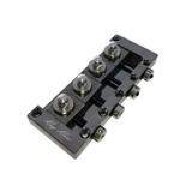
What, if anything, is holding the pin assemblies down against the baseplate of the bridge? The reason I ask, it seems like plucking a string with upward force would lift the end of the string if nothing is anchoring the pin to the base of the bridge. It's not a technique anyone uses all the time, but there are occasions. It's not a problem with saddles, because plucking would never raise a string above the angle on the backside of the saddle, so the saddle still has the downforce applied and it stays where it is. With the Ray Ross bridge, there doesn't seem to be anything holding it down, so how would it stay in place when someone is aggressively plucking the strings?

(edit) OK, I think I figured it out. If the point where the ball-end meets the pin was the same elevation as the point where the intonation screw meets the back end of the bridge base, then it would be susceptible to lift with only a minimal amount of force. But the string end is higher, and that height sort of mimics the angle and effect that a saddle provides. Which means, if I'm right, that I wouldn't be able to pluck a string hard enough to lift the pin from the bridge base.
 
Last edited:
As someone who has always believed that the bent metal bridge was an engineering afterthought, I am intrigued by new bridge designs. When I saw the pictures in the opening post, I instantly thought of a question -- I just read the entire thread, watched two videos, and looked through the Ray Ross website, looking for the answer, but I haven't found it.

What, if anything, is holding the pin assemblies down against the baseplate of the bridge? The reason I ask, it seems like plucking a string with upward force would lift the end of the string if nothing is anchoring the pin to the base of the bridge. It's not a technique anyone uses all the time, but there are occasions. It's not a problem with saddles, because plucking would never raise a string above the angle on the backside of the saddle, so the saddle still has the downforce applied and it stays where it is. With the Ray Ross bridge, there doesn't seem to be anything holding it down, so how would it stay in place when someone is aggressively plucking the strings?

(edit) OK, I think I figured it out. If the point where the ball-end meets the pin was the same elevation as the point where the intonation screw meets the back end of the bridge base, then it would be susceptible to lift with only a minimal amount of force. But the string end is higher, and that height sort of mimics the angle and effect that a saddle provides. Which means, if I'm right, that I wouldn't be able to pluck a string hard enough to lift the pin from the bridge base.
You are correct! All of the forces at work here are kind of upside down and backwards. The important thing is leverage and torque. They are still doing their job here, just in a different way. If you read all of this post, you might have caught that downforce on a typical saddle is only 10-12 lbs in the first place. Because of the upside down/backwards thing, the downforce is alot higher.

Thanks for a great question falcon, let me know if that helps.
 
You are correct! All of the forces at work here are kind of upside down and backwards. The important thing is leverage and torque. They are still doing their job here, just in a different way. If you read all of this post, you might have caught that downforce on a typical saddle is only 10-12 lbs in the first place. Because of the upside down/backwards thing, the downforce is alot higher.

Thanks for a great question falcon, let me know if that helps.

Sorry, that was talon, not falcon..duh
 
You are correct! All of the forces at work here are kind of upside down and backwards. The important thing is leverage and torque. They are still doing their job here, just in a different way. If you read all of this post, you might have caught that downforce on a typical saddle is only 10-12 lbs in the first place. Because of the upside down/backwards thing, the downforce is alot higher.

Thanks for a great question falcon, let me know if that helps.
So the thing that makes it work is the fact that the intonation screw attaches to the bridge at a lower point. If it was at the same elevation, alongside the pin instead of below, then there wouldn't be any downforce and therefore nothing holding the pin down if a string was plucked upward. Correct?
 
  • Like
Reactions: MattZilla
So the thing that makes it work is the fact that the intonation screw attaches to the bridge at a lower point. If it was at the same elevation, alongside the pin instead of below, then there wouldn't be any downforce and therefore nothing holding the pin down if a string was plucked upward. Correct?
Not necessarily, remember that you have approximately 40 lbs per string worth of tension on any bass string (depending on string diameter) Even if everything was on the same plane, you would have to be playing some kind of absurd, string exploding staccato to get any kind of negative feedback.

As the baby's daddy, I really learn something new everytime i pick up a bass.
The response, the nuiance, a harmonic i did not know was there yesterday, etc...it has been very difficult to articulate what is actually happening. It is however thrilling to physically "rearrange" some things and have the results be this far off the charts!

Contrary to popular belief, stuff just doesnt happen in real life like it does on shark tank. Real products take years to be developed and accepted en masse. If you read this entire thread, you immediately witnessed the throng of nay-sayers come out of the woodwork to decry this hardware's merits, even though some at least admitted they did not understand. This is precisely why i showed up here. Example: how many posts were related to the "fat portion of the string being part of the speaking length is down right terrible and will never work"? 50? 100? Geez i lost count. The fact is that it is completely moot, doesn't make one bit of difference, at least in a negative light. This hardware doesnt go anywhere but waaay better than anything else out there. It is not a gimmick, it is not snakeoil. It is truly revolutionary in its approach and its results.

I did an interview with music trades mag a couple months ago in that interview, i stated that an 8 year old can hear the difference between two basses. One with my bridge, one without. I will stand by that statement til judgement day, because it is true. It is THAT painfully obvious to any bassplayer.

I will also add that rayross has begun to make some serious waves in the industry. Japan was the first...and those guys LOVE innovation. Just because you dont see rayross on your buddy's bass (yet) doesnt mean that it is "not going well"

You guys keep the real questions coming, and i will always come back to answer them! Thanks for the interest.
 
In the meantime, here is some fresh meat for the dogpile brigade..,
I have not posted this because it represents testing in conditions that will remain arguable til judgement day. Testing in a fancy studio takes money,(which I dont have). What I do have is a good friend who happens to be an acoustic scientist (and a bassist) who did some preliminary tests in his home lab. I will post his findings and sit back and watch the highjinks ensue..
Two jazz basses tested, one with my bridge, one with standard fender bridge on anybodys bass.
1. (Blue and yellow graph)Spectragraph reading (measures bandwith ie frequency response)
Standard fender bridge:700hz
Ray ross: 2700hz.. Not only that but the graph indicates "dead spots" that your saddles are introducing.
2. When viewed in a waveform (orange and green) you can see and immediate decay in the waveform on a fender bridge, Rayross actually GROWS after the initial bloom.
3. 13 seconds longer sustain

Now I know some of you highly educated folks will have SOMETHING to say about this, I am guessing negative. Which is why I did not post this earlier, but go ahead and tear it to pieces. Like I said, I do have very thick skin. I think this info is worth passing on anyway. You folks enjoy this and let me know what you think!

TheRayross
I think that by using two different basses you have skunked your test.
 
I just found about that bridge on Youtube by accident and got interested in the design. Then I read the company's/builder's replies to criticism in the comment section and got shocked:

Ross Ray Cult.jpg


Then I read this thread and found so many interesting questions and was glad to see the builder of the bridge jump in and clarify. And again - I was shocked: People who are interested in finding out about possible flaws of the design because they want to be sure it works are referred to as "dogpile brigade", serious questions are attributed to the "highjinks" and curiosity and constructive interest in the product are being dissmissed as coming from people that have no clue what they're talking about. Finally, graphs are presented in a boastful manner and it turns out that the self-assured constructor cannot even read his own evidence.
Maybe it's a cultural difference I am not able to deal with or it is a sort of USP to act the offensive hillbilly guy on purpose... Whatever it is, the product could be perfect but I wouldn't want to buy it from someone who behaves like this.
Greetz from Greece
 
I just found about that bridge on Youtube by accident and got interested in the design. Then I read the company's/builder's replies to criticism in the comment section and got shocked:

View attachment 3524128

Then I read this thread and found so many interesting questions and was glad to see the builder of the bridge jump in and clarify. And again - I was shocked: People who are interested in finding out about possible flaws of the design because they want to be sure it works are referred to as "dogpile brigade", serious questions are attributed to the "highjinks" and curiosity and constructive interest in the product are being dissmissed as coming from people that have no clue what they're talking about. Finally, graphs are presented in a boastful manner and it turns out that the self-assured constructor cannot even read his own evidence.
Maybe it's a cultural difference I am not able to deal with or it is a sort of USP to act the offensive hillbilly guy on purpose... Whatever it is, the product could be perfect but I wouldn't want to buy it from someone who behaves like this.
Greetz from Greece
If the damn bridge works he could be an ogre for all I care. Get over yourself and stop politicking and let the man make a living. If you want to contribute buy a bridge and review it. For shock there is ice water. It'll provide a nice counter shock and reset your priorities.
 
OK, I think I figured it out. If the point where the ball-end meets the pin was the same elevation as the point where the intonation screw meets the back end of the bridge base, then it would be susceptible to lift with only a minimal amount of force. But the string end is higher, and that height sort of mimics the angle and effect that a saddle provides.
As a qualified physicist, i can confirm you are correct. The string tension being non-aligned with the intonation screw anchor point creates a torque (rotational force) that results in a downforce on the bridge of similar magnitude.
People who are interested in finding out about possible flaws of the design because they want to be sure it works are referred to as "dogpile brigade", serious questions are attributed to the "highjinks" and curiosity and constructive interest in the product are being dissmissed as coming from people that have no clue what they're talking about.
No, these responses from Ray Ross are directed at the less pleasant and less informed critics, his responses to more reasonable criticism have been good.
I wouldn't want to buy it from someone who behaves like this.
The responses in the Youtube comments seem reasonable to me. Ray Ross has behaved better than many of the critics, and i can certainly forgive him sometimes losing patience or being fatigued by the volume of negativity that tends to occur on the Web. I respect people who stand up for themselves and fight back a little in a civil way.

As for the lock-windings being part of the speaking length, it is only a tiny increase in unit mass and a small increase in stiffness, much less of a mass change than a taperwound string would create, and people accept those even for EADG. I can imagine the benefits of the design outweighing any negative effect.
 
Thank you ixlramp!
That about sums it up, very clearly, conciseley and fairly. Referencing "fatigue" is also well put. This IS a very unusual design, i expect skepticism, even criticism. That's just fine. If i didnt have anything better to do, i would go back to the beginning and count how many people mentioned the "windings being part of the speaking length" causing this system to "not work". No matter how many times that was addressed, there was always another one.

That makes for a very tiresome conversation, i think we can all agree. If anyone has valid questions, or observations, i will always come back and discuss. Otherwise, you sir are correct. I have no interest in arguing the validity of a completely valid piece of hardware.

If anyone is interested, the japanese are doing very thorough testing and will post their findings to youtube shortly. They have way better cameras, sound, resources than i do. The folks on this forum who love to argue needlessly can go argue with them. (Good luck)

In the meantime, i am going to go practice, maybe we all should.

Best regards
 
  • Like
Reactions: BlueTalon
In the meantime, i am going to go practice, maybe we all should.
You are a good man Ray Ross, I wish you all the best with your innovation and your life in general. Everyone who breaks the mold, who does something different, who creates something new, can expect howls from the sheeple who will never really do anything except complain. But you already know that. :cool: Well done! Now, back to my bass practice...
 
  • Like
Reactions: BlueTalon