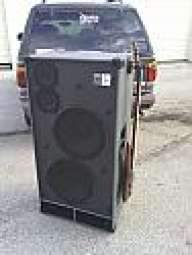
... But, I guess I'll ask the favorite TB question concerning 18" drivers....What do you feel you need a driver of that size for?
One big driver (for low end only) has a large surface area and also as drivers get bigger in diameter, the X-max also tends to increase. If you work out the volume displacement at X-max, it can be seen that a good 18 (such as Precision devices 1851) will outperform most pairs of 15's and would probably work in a cabinet smaller than a pair of 15's.
There is a misconception regarding directivity with speakers which says that larger speakers tend to beam the sound forward (so you hear less "off-axis"). This is true when you compare a single 18" to a 10" for example where the 10 will have better dispersion above a given frequency (based on 1/4wavelength of that frequency). Bear in mind that at very low frequencies (sub 200 Hz or lower) then it does not really matter as the sound is still omni-directional.
The main part of the misconception which people often do not take in to account is that when you group speakers together (eg 4 x10") you are effectively making a larger speaker with less dispersion. This works well for stadium PA speakers as it tends to throw the sound further forward). Two speakers placed horizontally next to each other will beam the sound at 90 degrees (vertical plane) and vice versa up to the new speakers size. Therefore a group of 4 in traditional 410 format will probably have just as bad a dispersion as an 18.
On the plus side, for smaller speakers, the physical depth of the driver cone tends to be less creating a flatter surface wherease the 18 will be deeper. There are also multiple motor units and typically less moving mass per speaker increasing higher frequency efficiency. However, multiple dustcaps emitting higher frequencies creates a world of problems with the sound field with peaks and nulls in various positions.
Use an 18 for what it is good for and cross it over below 250 Hz and use a big efficient mid (6 minimum, I tend to go for an 8 or a 10 for pro audio and add a quality tweeter for above 3 kHz).