• TalkBass has been independent since 1998. Add your voice.
    Create a free account to reply to discussions, view embedded media, and browse with fewer display ads.
    Join freeLog in
    Want zero display ads or expanded classifieds tools? Compare plans.

Any amateur builders using their own CNC?

I am currently in the process of building my first neck-through-body bass, which will also be my first fretted neck build.

Among the things I need to solve is how to build a compound radius fretboard, and how to slot fanned frets into it. Unfortunately, someone posted a video here recently of the Spector factory, showing their CNC machine cutting blind fret slots, and that put ideas in my head.

So, I am foolishly considering building a customized CNC to do those things for me. My ideal budget is not much more than just the savings from not having to purchase the other tools required to do things without a CNC: a fretting saw, maybe some kind of miter box jig with a depth stop, and a router sled jig to make a compound radius board.

Realistically I am willing to invest somewhat more to achieve the blind slots, and some other cool things a CNC will allow. It looks like I should be able to do this for about $250 US.

My initial plan is to start with a CNC3018 and mod the Y-axis and chassis with 1200 mm rails. It will also require rigging up some kind of table(s) with the guides 500 mm apart, allowing a 700 mm working distance for the Y-axis, effectively giving me a CNC3070. That will allow me to do 27" fretboards and probably fit a body in there if needed. Of course, things like nuts and custom router templates should be easy too.

To be clear, I have no plans to cut or shape whole necks or body perimeters, though I could maybe consider using this for pickups and other small routes. Also, I have no illusions of this being a quick process and fully anticipate jobs taking days, not minutes, but because I am making one-off things the speed of the routing is really not a concern.

So, my question is whether any other amateur builders have attempted to do something like this and, if so, what was your experience?
 
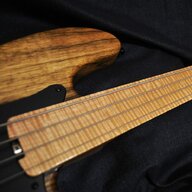
I actually considered an entry-level CNC router based setup for my Ric clone builds, but came to the conclusion it wasn't cost effective for a couple of builds. For that matter, buying or building a fret slot jig probably isn't either, given the relatively cheap cost of having a fingerboard custom-cut by LMI. That does generally limit you to whatever fretboard blanks they have, though I was able to have a Bubinga fretboard blank shipped to them directly for fret slotting. I don't know if they do fanned-fret, but there are other companies that do, and its pretty much guaranteed to be perfect. I read a lot of reviews on the router based systems, a common complaint seemed to be the rigidity of the frame system, or accumulated "slop" in the connections that made them accurate enough for some things, but not necessarily fret slotting. Unless you already know how to Code for CNC (I don't!), factor in a pretty steep learning curve, set up time, etc, and I'm guessing Old-School traditional MDF or plywood templates with flush trim bits is just easier. If you are planning on lots of builds, or have other work in mind where it would be useful, CNC might be a huge time saver, just not sure a lower end system is good enough. The technology changes so fast my previous research is probably hopelessly outdated though. Curious to hear from our resident Pros and Advanced Amateurs as to how they have evaluated CNC into their projects. If you go for it, please post photos so the Luddites (me) can get all Tool-Geeky on it.
 
The one thing I really would love a machine to do for me is fingerboard radiusing. It’s tedious and surprisingly hard to do right, I’ve effed up a couple trying. That can be done with a home-built jig too, I may do that if I keep building long enough.
 
i use a ZTW 12x12, clearly not big enough for fretboards unless i make a fixture where i can shift them to the left or right to deal with the entire length. but i already have a fretboard mitre box and the necessary tools for this. i use the ZTW mostly for segmented acoustic guitar rosettes and bridges, jewelry, engraving, etc..

a lot of people don't factor in the control software and the CAD/CAM software and the effort required to be proficient with it.
 
When I did my multiscale bassVI I had a friend with a CNC machine do the blind fret slots on a Richlite fingerboard. It came out really nice. He did the math to calculate the paths, but also checked them against FretFind. I think about getting a CNC machine often, but I don't want to spend the time to learn to program it. It would be cool for some operations (fretboard radiusing) for sure. At this point I see that as a retirement project, when I have a lot more time.

If you want to blind slots without a CNC you can always put binding on the fretboard - if you use the same wood as the fretboard it will be practically invisible (depending on the type of wood you use). I had a Steinberger with a synthetic (I think) fingerboard that was done that way and you really had to look close to see the joint.
 
ability to radius and do true compound radii is cool though. someday i'm going to get into this. currently most of my guitar work is on flat fingerboards, classical style. the ability to do the back side of a neck would be awesome as well but is going to require a much beefier and louder machine with the capacity to handle a 1/2" diameter carbide ball endmill.

at one point we did some calcs on the power requirements and discovered our humble little condo doesn't easily have the juice to deal with 4 motors getting worked during roughing of the back of a acoustic guitar neck which generally has more wood to remove and more features if you count a slotted headstock as well. double trouble for a hard-ass rock maple bass neck.
 
Last edited:
  • Like
Reactions: pcake
I don't think you will get satisfactory results with that machine or your budget for what you want. The tooling alone for the operations you want to do will be closer to $100 once you factor in breaking a few .023 end mills at $25 each.

The learning curve on 3d machining is steep, and modeling a compound radius is tough.

You can build a simple router jig that will do compound radii and straight radii. Blind slots can't be done manually, but you can slice off some fretboard material for matched binding.

Sorry to seem like a downer, but cnc machining is never cheap. Never.
 
@scottyd posted this up a few years back. He is still active here

My "on the cheap" CNC router build


Edit: I should have tagged @MrJones. He is the real brains of the operation.

I use mine quite a bit. Fret slots, cavities, templates, pickup bobbins, pup covers, surfacing stock, sizing stock. I machine my own bridges with it...I even use it as a make shift overhead router for many tasks. It's become a priceless tool in my shop. Mr Jones and I wouldn't dare go back to when I didn't have one. Oddly enough I don't do many bodies or necks with it. The thing is unforgiving to operator error and can make nice lumber into scrap in the blink of an eye!
 
@scottyd posted this up a few years back. He is still active here

My "on the cheap" CNC router build


Edit: I should have tagged @MrJones. He is the real brains of the operation.


The only thing smarter than the CNC and software that runs it.....is indeed Mr. Jones.
IMG_20191120_171649401.jpg
 
Expect to break/go through a lot of .023” end mills I’d think. Solid carbide would last much longer than hss, but look at them sideways and they’ll break. I think this is a job for an outside specialist if you can find one, or go with a regular slotted board if you can do without the fanned frets.

Thanks, I appreciate the thoughts. Fanned frets are a must for this project so that does limit options. I agree about only looking at carbide bits, and yes, I will go through several on the way I am sure. Despite the pitfalls of doing this myself I don't see many better options as commercial CNC operation costs add up real fast too.

I don't think you will get satisfactory results with that machine or your budget for what you want. The tooling alone for the operations you want to do will be closer to $100 once you factor in breaking a few .023 end mills at $25 each.

The learning curve on 3d machining is steep, and modeling a compound radius is tough.

You can build a simple router jig that will do compound radii and straight radii. Blind slots can't be done manually, but you can slice off some fretboard material for matched binding.

Sorry to seem like a downer, but cnc machining is never cheap. Never.

No worries. I don't think of your comments as being a downer, more like being realistic. I agree, this won't be simple, but perhaps I should have made it clear that my interest in a CNC isn't just for this one project. This is just the first good reason I have had to try. The technology isn't new to me, and I am familiar with Arduinos, stepper motors, programming etc, so the biggest learning I have is FreeCAD. I already looked at some tutorials and honestly it doesn't seem too bad.

Also, there is a macro for compound fretboards, plus FretFind, so a significant amount of the heavy lifting for those parts are done:
Macro Guitar fretboard - FreeCAD Documentation

Regarding costs, I do expect to go through several 0.6 mm bits, but I will source cheaper ones than $25. I can find factory second bits, where the ends are re-ground, for a few dollars each. Since I am not in a rush I can take the time to re-zero each bit. Also, since I am not paying by the hour, I can slow the cut speed and depth down to help with bit survival.

If it all goes wrong and doesn't work out, I can always build router jigs and use a binding a mentioned, as a plan B.
 
CNC user here. I fortunately have access to a monster commercial CNC, but I have looked into buying/building my own as well for convenience one day. Here are my thoughts (sorry if this is wordy)

Buying a CNC
As far as buying a budget CNC (non-commercial), the Shapeoko gets good marks for rigidity in that category and seems to be the one to go with over the X-Carve. The XXL version should be large enough for bass building as well.

Building a CNC
Chris Monck at Highline guitars used to use a X-Carve, but ended up building his own to get around the rigidity issues. He has plans for the build here:


CNC in general
(Aka things I have learned the hard way)

- As mentioned earlier by Ripthorn, one of the trickiest parts to going the CNC route is learning the software. It's not impossible, just be prepared to put a lot of hours into learning the software. A lot of people think of CNC as "push button, get guitar", but it's not that easy. The CAD/CAM side is a skill just like using a chisel or draw knife, it takes time and repetition to learn and hone.
- Prototype. I have used foam and MDF for prototyping, or cheaper wood. Anytime you create a new model and toolpath, assume you missed something and prototype to verify. Small mistakes can destroy a beautiful hunk of exotic wood, and damage your tooling, both of which can get expensive.
- Secure your workpiece - Man this one has bit me a few times. If your workpiece isn't secured (well!), prepare for disaster. Things get ugly fast when something breaks loose near a spindle spinning at 16,000 RPM.
- Speeds & feeds:. Read up on speeds and feeds. There are a number of good websites/tools out there like CNCcookbook & GWizard that will help you understand what these are. Sometimes it is tricky finding info about wood speeds & feeds since a lot of CNC users use metal. Getting this right will reduce your chances of breaking tools, ruining wood and wear & tear.

Sorry for being so wordy, but these were the main things that came to mind when going down the CNC path. It's hard work, but definitely doable with patience and attention to detail.
 
What you are considering could work. If you aren’t familiar with cnc machining, it’s going to take some time to get where you want to be. Apart from learning the programming, you are going to want a machine that works. If you have to spend a ton of time to get your machine running, you are kinda just throwing money away. Not saying what you are looking at is a bad choice but you could end up being happier with what you get if you save up a bit more dough.
I bought a shapeoko machine and I’ve been happy with it, haven’t used it enough but I plan on trying some guitar work at some point. It’s only 12x12 travel but it’s expandable. Was about a grand I believe and I built it in a day.
 
  • Like
Reactions: Jeff Siddall
Expect to break/go through a lot of .023” end mills I’d think. Solid carbide would last much longer than hss, but look at them sideways and they’ll break. I think this is a job for an outside specialist if you can find one, or go with a regular slotted board if you can do without the fanned frets.
My friend used a mill that was thinner than .023, he had to make two passes to get to the proper width. He did break one while cutting my fret slots, but it was due to a bad path, once he corrected that he cut the whole thing with one mill.