
Enjoy the benefits of a premium membership!
Upgrade Account
-
TalkBass has been independent since 1998. Add your voice.
Create a free account to reply to discussions, view embedded media, and browse with fewer display ads.
Join free Log in
Want zero display ads or expanded classifieds tools? Compare plans.
You are using an out of date browser. It may not display this or other websites correctly.
You should upgrade or use an alternative browser.
You should upgrade or use an alternative browser.
Double Bass Anyone changing up their setup for this year?
- Thread starter neddyrow
- Start date
More options
Who Replied?

Well, I've had the ToneDexter II for a couple of weeks now and have had a chance to generate a small set of wavemaps to characterize my two New Standard basses: a LaScala hybrid and a Cleveland ply. While the Audio Sprockets folks recommend using a cheaper small diaphragm condenser mic, I've started with a nice Royer R-10 ribbon mic and an SE-DM1 Dynamite Preamplifier beween the Royer and the TDII. (This is important, both because the ribbon mic needs a clean level boost when sensing the modest audio levels of the uprights—but more importantly since the ToneDexter by default sends out phantom power—you can disable it—and that would damage the ribbon mic. The Dynamite pre uses the phantom power but does not pass it along to the attached mic.) I've also tried a couple of simple dynamic mics I had on hand: a Sennheiser e609 and an AKG D5. Audio Sprockets strongly recommends that upright bass players train the TDII with arco playing, so I did that with a bit of pizz thrown in for good measure. I'd note that I was using a Full Circle pickup, run into my F-Deck HPF, with the cut-off frequency as low as possible and just enough clean gain to give the ToneDexter what it was looking for in terms of level.
The ToneDexter II is a very sophisticated piece of (high quality feeling) gear with many, many menus to be called up using the various knobs. Training is relatively simple but you have to do it this way: (i) Hit the Mute/Tuner pedal button and tune the instrument, *then* hit the Boost button and between you and the box set the levels for the mic signal and the piezo transducer. The ToneDexter then begins to acquire its sample of your playing, using the mic and the transducer, and giving you a percentage feedback as to how far it's progressed. After a few minutes of playing, it's done and straight away you can A/B the tranducer signal, the tone map-processed signal, and any blend you choose. There's a wealth of EQ options (LPF, HPF, bands, notches) with some explicit feedback prevention options and an interesting control to adjust the "spatial" character of the ToneDexter output. This reels back some of the "air" in the samples, tightening the sound. At big band rehearsal, I found that taking this down to about 70% was a nice setting. You can save all of the various EQ/space settings with the saved tone map and give the map a fairly complex name (yellow text in the display image above). You can also edit the names and save/backup the maps by connecting the ToneDexter to a computer using the supplied USB3 jack.
The results have been interesting. It's no surprise that the quality/character of the "tone map" produced depends strongly on mic placement—although hardly at all on the sort of room where you're doing the training. Various positions around the f-holes produced a rather too-fat sound for my taste, and I got best results with the mics in front of the bridge, about 25-50 cm in front of the instruments. The ribbon gave better results than the two dynamics—and when I return the rental ribbon to L&M, I'm going to bring home a suitable condenser to have a go with that. Prior to getting this beastie, my go-to preamp (after the HPF) had been a Tech21 SansAmp ParaDriver DI. I was pretty happy with that set-up, running it into the Effects Return on my AI Clarus SL amp. The ToneDexter II is a striking improvement, though: more "acoustic" and detailed-sounding, free of piezo quacking—particularly the always-annoying thud of an open A string—and the closest thing to MBOL that I've experienced. I really got a sense of the wood of the instrument, the character of the strings, and the details of my playing/bumbling. This was true with both basses which have very different voices/strings. I've got a feeling that I've still got a lot of learning curve to crawl up to make best use of this box, but it's going to be worth my time. The one thing which I'd mention is that the complex menuing system makes it awkward to do much on-the-spot fiddling with the sound while performing. Better to set up before starting, then save the sound *for that room* into an empty tone map slot—and there's plenty of them. (There's no apparent problem with varying the volume, phase, or HPF cut-off from the F-Deck on the fly during playing, though.)
[One last note...on a lark I got one of my Yamaha electrics and ran it into the ToneDexter and tried processing its signal with the various tone maps I'd saved with the uprights. The result? A pleasant, slightly fat sound but nothing any more interesting that tweaking some EQ knobs would yield. No surprise I guess.]
Last edited:


Earl
Supporting Member
Well, one major change is I have switched from the Yamahiko pickup to the Bassbalsereit (passive version). It has solved at least one thing I have struggled with on my bassy 7/8th Juzek - too much bass response resulting in boominess and unnatural sound (yes, I tried different soundpost placements, strings etc. to no avail, the Yama just picks up a lot). I no longer need to turn down the bass knob and mids to almost nothing, and rarely need an HPF. So now I can just plug straight in to any amp with at least 1M impedance and it sounds great. Yes, I had to have a hole drilled in my bridge (not such a big deal). You can find the ideal sound by rotating the pickup in the hole and how tight the fit is. I was surprised at the different sounds and volumes possible. I may keep the Yamahiko on as a backup, or maybe I might sell it (it is the M8 dual sensor if interested).

No pickup/preamp plans but I am looking into amps to see if I can lighten my load, my Bergantinos are almost 40 lbs. each.
I just tried out a Fender Rumble 500 today and it’s noticeably lighter, but the speakers don't hold up against the Bergs in terms of clarity which is what I expected for $650. Going to try out a 23 pound GR 1-12 combo on Wednesday. Almost $1700, so I’ll only be buying that if it’s 99% perfect
I just tried out a Fender Rumble 500 today and it’s noticeably lighter, but the speakers don't hold up against the Bergs in terms of clarity which is what I expected for $650. Going to try out a 23 pound GR 1-12 combo on Wednesday. Almost $1700, so I’ll only be buying that if it’s 99% perfect

Not intending to tell anyone else what they should or shouldn’t do, my plan for the year is to practice more and mess with my setup/gear less. Wish me luck
Well, guess who just bought a Yamahiko pickup and some Kolstein Heritage strings? So much for not messing with my setup
 Dohhhh!
Just played two diametrically opposed gigs yesterday: a background gig in a crowded cavernous concrete room where we could barely hear each other (that gig was all about the $$$, obv.), and a trio concert in a sold out listening room later that evening. The regular rig (FC-->Noble--->RedEye---> PJB) handled both situations perfectly and I ended the day with more bread in the pantry and the knowledge that I don't need to change my setup in any way. Win-win!

Well, I've gone ahead and changed my speaker modeling program.
Basic modeling of sealed and ported speakers
Basic modeling of sealed and ported speakers
Nice work! The definition "...the voltage across the speaker is what it is" took me *right* back to ~90% of my 3rd/4th year profs. It's been a while since since I've read anything written in TeX... Would have loved this as a project in a vibrations course.Well, I've gone ahead and changed my speaker modeling program.
Basic modeling of sealed and ported speakers
I don't think you could have simplified it any further, and those without stem backgrounds have to trust us nerds with the math anyway. Just a great write up.
Thanks. I have to confess that I cheated on TeX. It's actually authored in a Jupyter notebook, where I can run the Python code, then converted into HTML using a utility that runs it through TeX. It's pretty much the case that if a document has not been authored in a word processor, then TeX is lurking somewhere in the workflow.Nice work! The definition "...the voltage across the speaker is what it is" took me *right* back to ~90% of my 3rd/4th year profs. It's been a while since since I've read anything written in TeX... Would have loved this as a project in a vibrations course.
I don't think you could have simplified it any further, and those without stem backgrounds have to trust us nerds with the math anyway. Just a great write up.


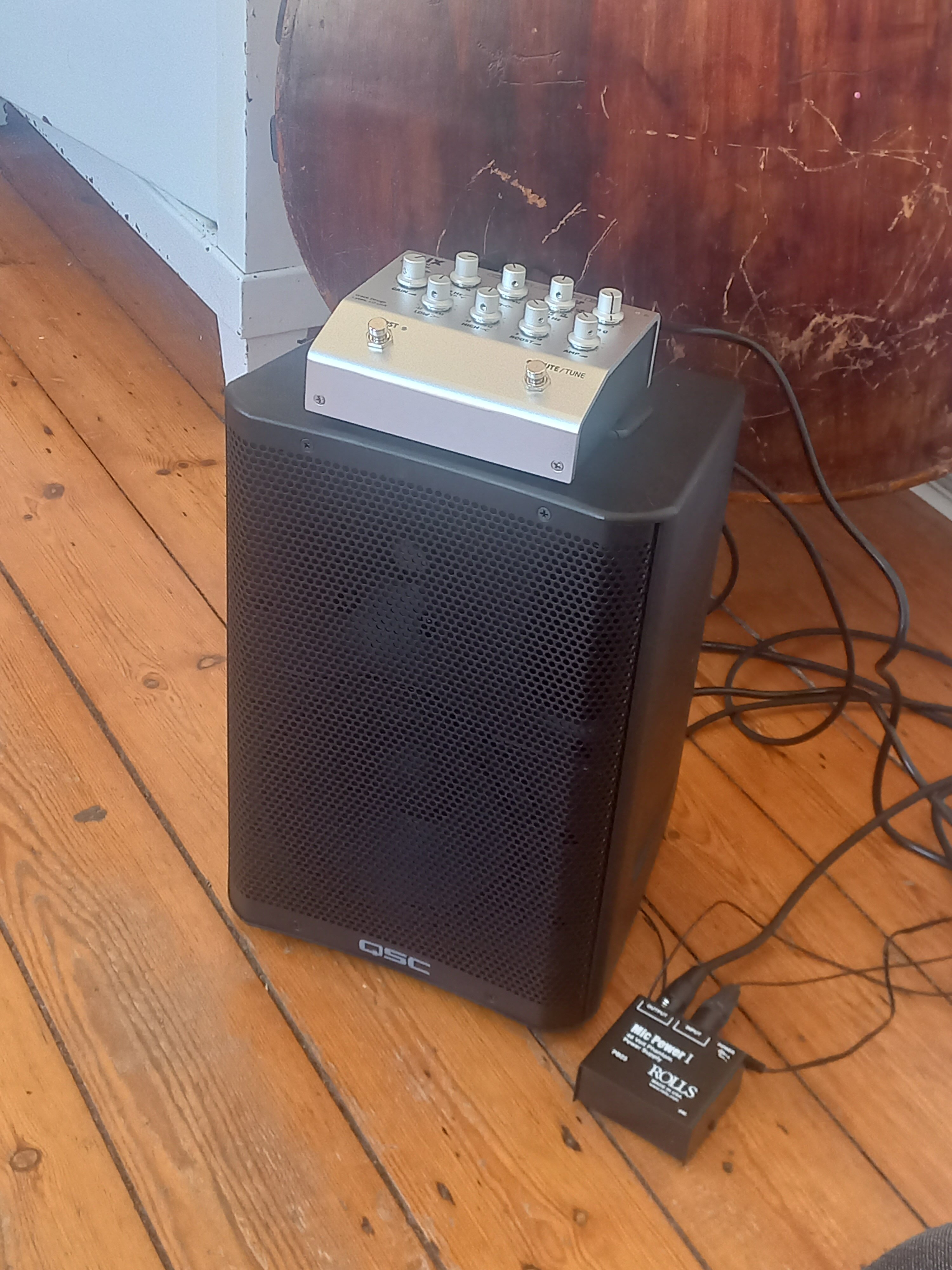
Ischell -> Rolls 48V supply -> Grace Alix -> QSC CP8. Hoping it will end my woes.

I have added the Red-Eye to my setup.
At the last concert I bypassed Tonedexter, I don't know why, but the sound was better.
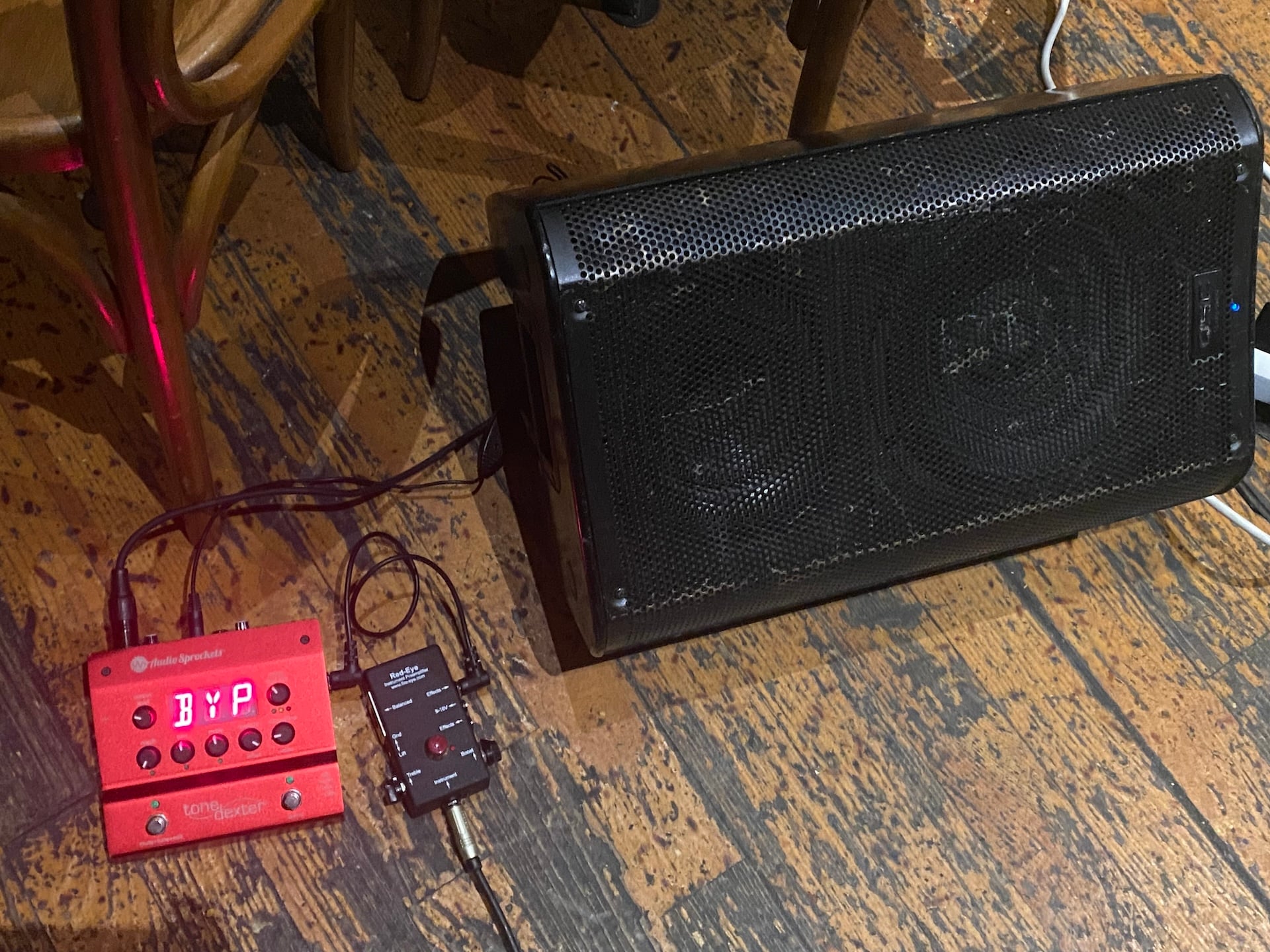
At the last concert I bypassed Tonedexter, I don't know why, but the sound was better.

While my DB is pretty well setup for amp or FOH sound, that part of my DB only gets used on stage, and really most of my playing is in jams where neither amp or FOH exist. So my electric equipment isn't changing.
Last week I did lower my action though. Trying to keep my hands working as long as possible.
As a corollary to this, a couple of weeks ago I finally replaced my terminally cracked original wooden endpin assembly with a new fully adjustable resin/CF endpin assembly. Of course everything related to setup is affected in at least a minor way when the endpin plug and tailpiece are loosened, so setup had to be at least reviewed for everything...
I played an acoustic gig last weekend, have another today. Things are going great in the endpin/setup arena.
Related to my setup in regard to my hands, I'm changing up my left hand posture due to fingers that don't bend so well at this time; it's been about 8 months now with a number of trigger fingers and while the more severe joint pain has pretty much subsided, I'm guessing the joint flexibility and recovery is going to take years instead of months...
So I'm basically bringing the neck closer to my face and moving the thumb more behind the neck instead of cradling the neck. Combined with my action being lower now, I like the new hand posture a lot. It provides really good reach, good access to notes across all 4 strings in the lower positions, with quick flexibility for the higher positions, and the fingers that don't bend well don't have to bend much. Plus it's more intuitive for me, from playing with the thumb on the back of the neck with my other smaller instruments.
I think my old hand position was the "baseball" grip people refer to, this new grip is probably closer to Simandl, not that the name it gets matters that much for me or in the musical environments that I play. But as a note to others who might want to try this change, lowering the action to between 5mm and 6mm was a requirement for this, I couldn't execute it when the action was closer to 10mm, even with fat low tension strings; fortunately my fingerboard has plenty of relief and I don't get buzzing.
All and all the lower action and this new posture may keep me playing for a decade or so longer, and I really like the reach, so I'm happy about it.

I reinstalled the Spiro mitt E, weich A, D, and G that were on the bass when I bought it.
I removed the Shadow SH965 NFX and installed a Krivo magnetic pickup. Nice!
Also installed an adjustable bridge.
I removed the Shadow SH965 NFX and installed a Krivo magnetic pickup. Nice!
Also installed an adjustable bridge.
I recently installed a Krivo, that along with Spirocores is a big "any gig worthy" jump forward for me.
Thanks to @TroyK and @james condino for inspiration.
My Krivo has a little hiss, mostly noticeable with in ears. Not really an issue but any thoughts or advice?
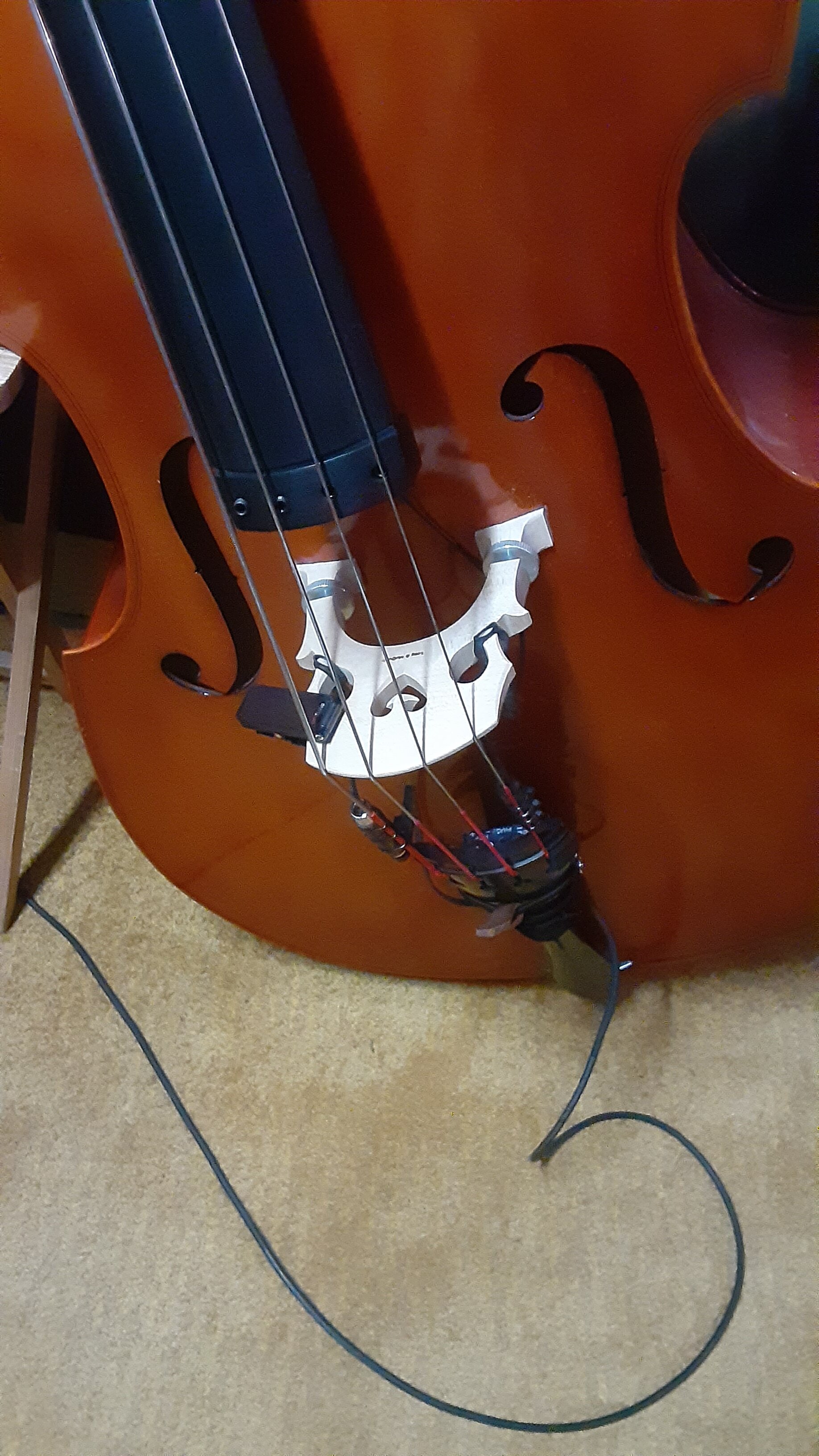
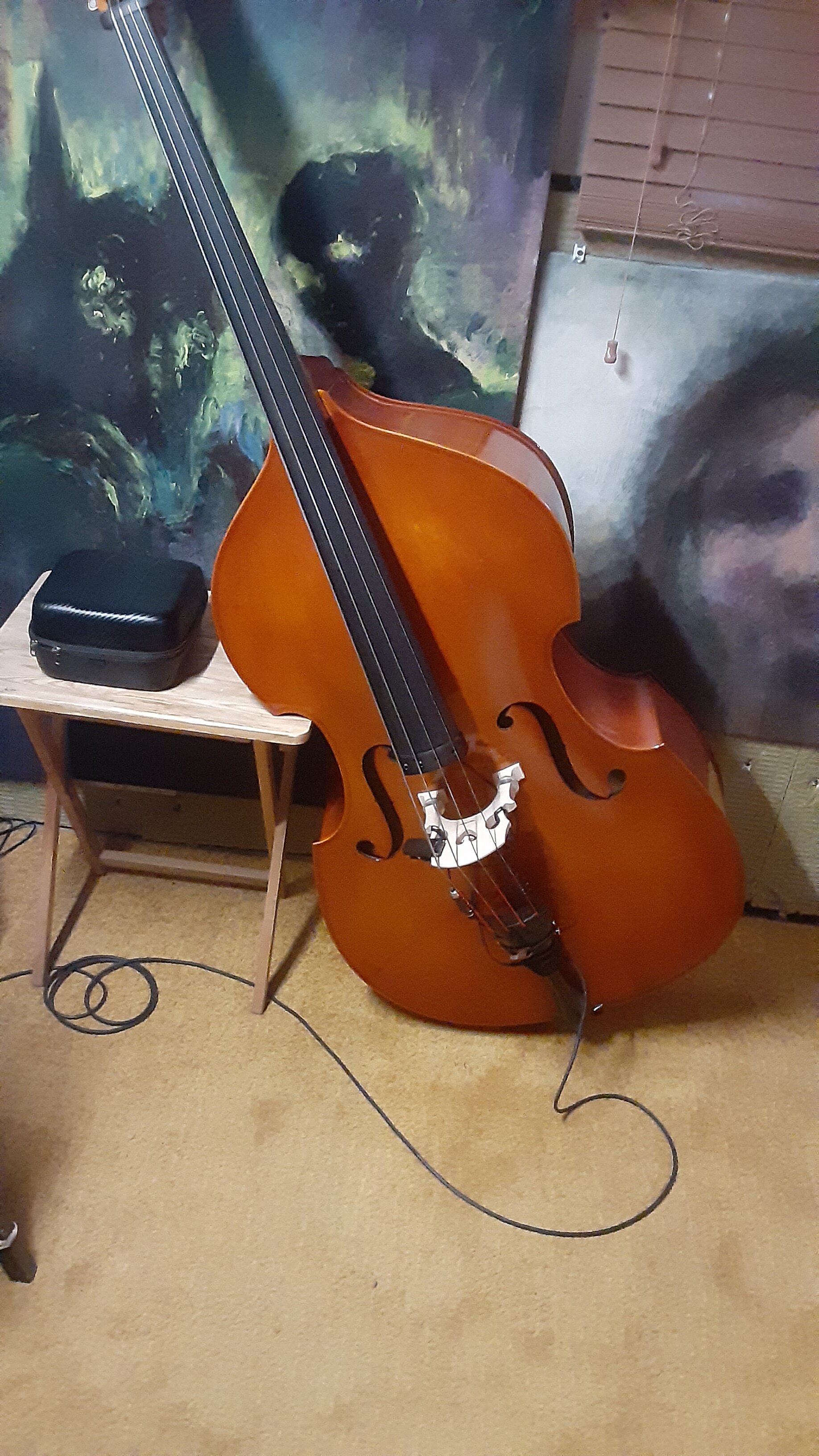
Thanks to @TroyK and @james condino for inspiration.
My Krivo has a little hiss, mostly noticeable with in ears. Not really an issue but any thoughts or advice?
Last edited:
My setup for the last 10+ years has been Kay Bass or New Standard Cleveland (both with medium Zyex and Lifeline pickup) into an AI 2-channel Coda and mostly my 4 ohm Schroeder 12”. If not, it’s the Coda combo for smaller gigs, or a 15” Celestion in an Anvil cab for bigger gigs. My AI is starting to have problems, and repair is unlikely given that Rick mostly replaced parts instead of repairing (or so I am told). Very disappointing. Especially because I sometimes double and need 2 channels. Not a ton of options.
So the new rig is Kay or Cleveland with Zyex and Lifeline>Headway EDB-2 H.E.>Aguilar AG 700. Nothing particularly new in bassland but an affordable way to meet all my needs. I play my first gigs with the new rig this coming weekend. Last week I played my Headway into the venue’s Tone Hammer 700 with an SL410. That was super fun. Gave me a good example of how good the Headway can be in keeping a natural acoustic tone with a decently sizable rig. I think my AG 700 and 12” will actually be better at creating a punchy bluegrass bass tone.
So the new rig is Kay or Cleveland with Zyex and Lifeline>Headway EDB-2 H.E.>Aguilar AG 700. Nothing particularly new in bassland but an affordable way to meet all my needs. I play my first gigs with the new rig this coming weekend. Last week I played my Headway into the venue’s Tone Hammer 700 with an SL410. That was super fun. Gave me a good example of how good the Headway can be in keeping a natural acoustic tone with a decently sizable rig. I think my AG 700 and 12” will actually be better at creating a punchy bluegrass bass tone.

I'm learning a lot by reading all this !
I picked up a late 40s German bass in January. New Spiro light gauge and a
Lifeline.
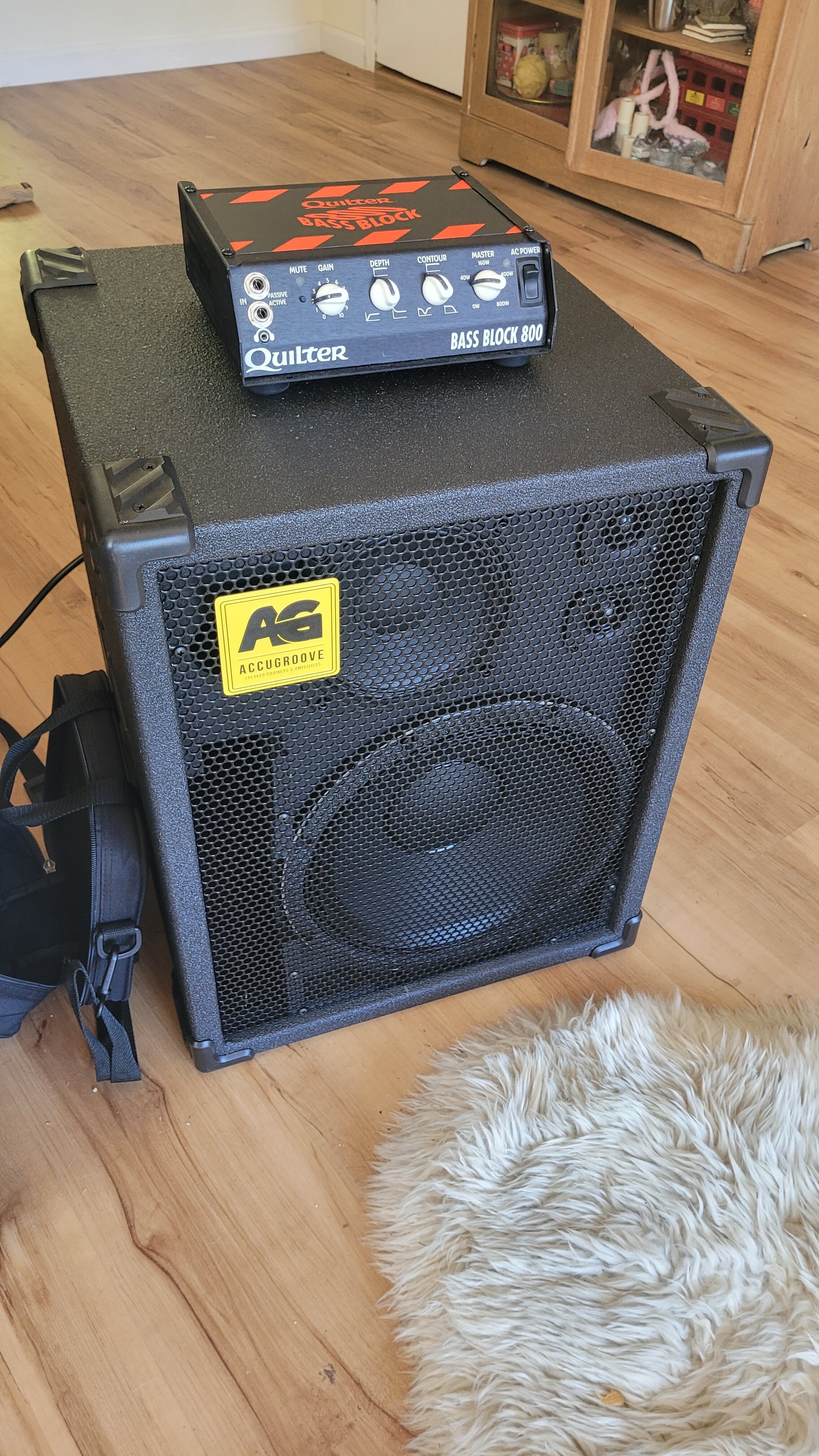
I just picked up a used radial tonebone OD for $150. What a great bit of gear for doubling! I can run it into my jbl 110 powered monitor or my accugroove rig.
And, it has good D.I.
I picked up a late 40s German bass in January. New Spiro light gauge and a
Lifeline.
I just picked up a used radial tonebone OD for $150. What a great bit of gear for doubling! I can run it into my jbl 110 powered monitor or my accugroove rig.
And, it has good D.I.
My Krivo has a little hiss, mostly noticeable with in ears. Not really an issue but any thoughts or advice?
Just realized
 ... most of the hiss comes from my eq pedal (depending on the setting).
I used the D4 again last night, this time without the pickup. Last minute sub gig, with a trumpet and two [sic] banjos, outdoors, no FOH. This time I went straight into my K10 powered speaker on the ground, which I liked better firing into the brick wall directly behind us.Used something different tonight. 8 piece jazz combo in a college theater/auditorium.
View attachment 5385126
Audix D4 --> FOH
Full circle --> fdeck --> backline amp
Backline amp was the unfortunate fender rumble combo, and was all I had to listen to on stage, so the fdeck earned its keep as usual. Sound guy was ecstatic to have literally anything other than the di from the amp, so I can only assume it sounded okay. I used the bow a little, and hopefully this setup spared the audience the experience of Arco alla Piezo.
Quick 'n easy, low fuss, no feedback, and it sounded okay. I would have used more eq (hpf, midrange) if I'd had it, or put the speaker on a stand. We got paid and asked back, and the BL wants me on the next one, so I guess it was objectively good enough.


