Enjoy the benefits of a premium membership!
Upgrade Account
-
TalkBass has been independent since 1998. Add your voice.
Create a free account to reply to discussions, view embedded media, and browse with fewer display ads.
Join free Log in
Want zero display ads or expanded classifieds tools? Compare plans.
You are using an out of date browser. It may not display this or other websites correctly.
You should upgrade or use an alternative browser.
You should upgrade or use an alternative browser.
Anyone play or own a Carruthers bass?
- Thread starter Thir13teen
- Start date
More options
Who Replied?
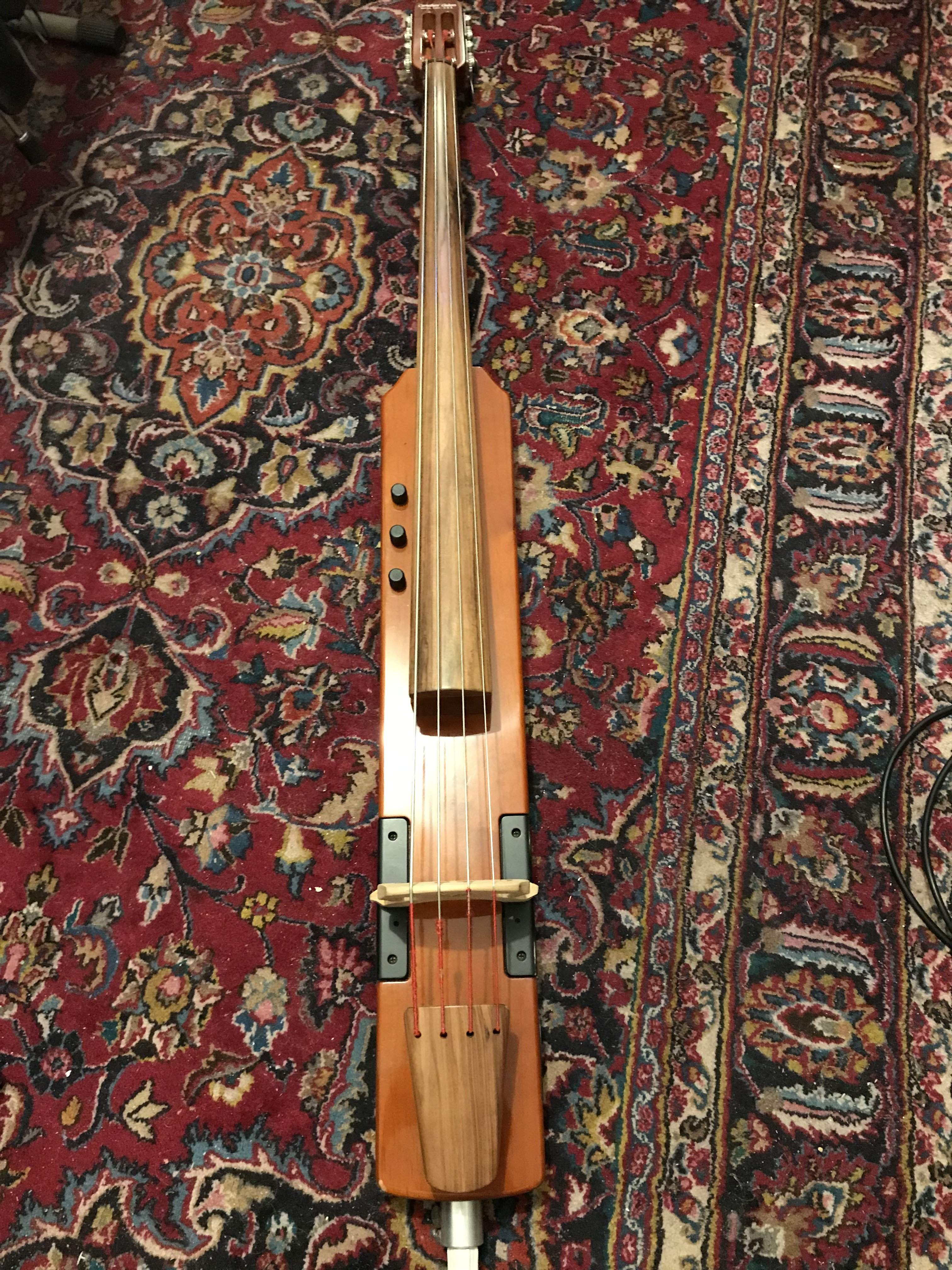
Most (if not all) EUB's have pre amps that need a battery or batteries.I have one, also, and was looking forward to playing it next Sunday: the gig will be outdoors in 90-degree heat, and this bass wouldn't break a sweat (unlike its more fragile German 3/4 cousins).
When I fired it up just now, it wouldn't send a signal to the amp! I switched cords and even switched basses, but the Carruthers retained 'the right to remain silent.' If anyone knows how to breathe life back into a suddenly-silent Carruthers (or similar) skinny upright, I'm all ears. It has a plastic plate on the back of its skinny body, so there might be a battery in there that has expired.
When it's working, it is sometimes fun to play. There's a body-simulator so you can lean into the side as if you were playing your upright, and it even has a thumb groove alongside the right side of the fingerboard. I say 'sometimes fun' because it has way more Sustain than most uprights, so you have to exercise lots of control over resonance. With judicious EQ'ing, I made it work through a jazz cruise in Tahiti with an extraordinary singer - a gig Isle not soon forget.
Again: any clues as to how to get the bass singing again?
Or: anyone want to buy it, as-is? Tomastik Spirocore Orchestra strings, soft AND hard case.
That being said, how much...….

Change the battery. I’m looking for a gig bag or case for mine. Would you sell one of the cases?I have one, also, and was looking forward to playing it next Sunday: the gig will be outdoors in 90-degree heat, and this bass wouldn't break a sweat (unlike its more fragile German 3/4 cousins).
When I fired it up just now, it wouldn't send a signal to the amp! I switched cords and even switched basses, but the Carruthers retained 'the right to remain silent.' If anyone knows how to breathe life back into a suddenly-silent Carruthers (or similar) skinny upright, I'm all ears. It has a plastic plate on the back of its skinny body, so there might be a battery in there that has expired.
When it's working, it is sometimes fun to play. There's a body-simulator so you can lean into the side as if you were playing your upright, and it even has a thumb groove alongside the right side of the fingerboard. I say 'sometimes fun' because it has way more Sustain than most uprights, so you have to exercise lots of control over resonance. With judicious EQ'ing, I made it work through a jazz cruise in Tahiti with an extraordinary singer - a gig Isle not soon forget.
Again: any clues as to how to get the bass singing again?
Or: anyone want to buy it, as-is? Tomastik Spirocore Orchestra strings, soft AND hard case.
Thanks, folks.
(1), Verily, "underwhelmed" is apt -if one is looking to be overwhelmed. For me, "whelmed" is enough: it is what it is, and does not pretend to be otherwise. Over the years, owners have customized their Carruthers with better pick-ups; I replaced the stock bridge (in western MA) with an old one from a 3/4 bass. I see it as a "utility" bass for an upright-only player, tolerable for tight spaces and hot weather.
(2) So, there IS a battery in the back? There are set screws at top and bottom of the plastic plate - but also a tiny Allen-wrench-type hole in the middle - beyond my pay grade. Might have to take it to a guitar shop.
(3), Sorry, but cannot sell the gig bag separately.
Just to get reacquainted with the feel of it, I popped in an Underwood pick-up and plugged into a Genz-Benz Shuttle 6. Quite honestly, the lows are warm and on par with many an amplified upright; the highs are a but thin. That said, the strings are well-worn Tomastik Spirocores.
Based on prices on the Reverb website, and without the Underwood, I'd ask $1,000 for this puppy.
(1), Verily, "underwhelmed" is apt -if one is looking to be overwhelmed. For me, "whelmed" is enough: it is what it is, and does not pretend to be otherwise. Over the years, owners have customized their Carruthers with better pick-ups; I replaced the stock bridge (in western MA) with an old one from a 3/4 bass. I see it as a "utility" bass for an upright-only player, tolerable for tight spaces and hot weather.
(2) So, there IS a battery in the back? There are set screws at top and bottom of the plastic plate - but also a tiny Allen-wrench-type hole in the middle - beyond my pay grade. Might have to take it to a guitar shop.
(3), Sorry, but cannot sell the gig bag separately.
Just to get reacquainted with the feel of it, I popped in an Underwood pick-up and plugged into a Genz-Benz Shuttle 6. Quite honestly, the lows are warm and on par with many an amplified upright; the highs are a but thin. That said, the strings are well-worn Tomastik Spirocores.
Based on prices on the Reverb website, and without the Underwood, I'd ask $1,000 for this puppy.
OK, The battery casket is open, revealing a very conventional 9V battery. It never occurred to me that there would be a pre-amp built into this device. Now the bigger challenge: convincing the singer on this Sunday's gig to accept the Carruthers - that playing outdoors in 90-degree heat, canopy or no canopy overhead, poses a significant risk to the health of a conventional upright.


I first met John in 1978 when Alembic referred me to him to fix an issue with my Series I circuit. James Demeter was his electronics guy at that point, and he took care of the issue. John did some touch up and patch work on my bass, and it was perfect. That started a lifelong relationship between me and John, and has lead to me owning multiple basses of his over the years. John's innovations and influence are far reaching in the guitar industry, and virtually any modern instrument owes something to Carruthers. He has been employed as a consultant to virtually every major manufacturer from Fender and Gretsch to Yamaha. Modern manufacturing methods in many cases are a direct result of John's designs. Needless to say, John has "been there and done that", and you will never meet a more knowledgeable luthier/machinist.
I currently own two Carruthers basses, a four and a five string of the modern era. They follow John's philosophy of what works best for the working musician. Light weight, sustain, tonal complexity and variability, and simple road worthy construction. John does not use the typical EMG pickups and circuit. They are stacked single coils that can be split, and have a three band EQ. Everything John does has a lot of forethought and experience behind it. He has his opinions, and sometimes he can seem stubborn about them, but the bottom line is he puts out a fine product that is made in house (unlike a Sadowsky), and has a lifetime of knowledge involved with the design. That knowledge comes from having worked on or built a guitar for virtually every major artist over the past 50 years. Both of my basses are fantastic for recording as well as live performance.
I currently own two Carruthers basses, a four and a five string of the modern era. They follow John's philosophy of what works best for the working musician. Light weight, sustain, tonal complexity and variability, and simple road worthy construction. John does not use the typical EMG pickups and circuit. They are stacked single coils that can be split, and have a three band EQ. Everything John does has a lot of forethought and experience behind it. He has his opinions, and sometimes he can seem stubborn about them, but the bottom line is he puts out a fine product that is made in house (unlike a Sadowsky), and has a lifetime of knowledge involved with the design. That knowledge comes from having worked on or built a guitar for virtually every major artist over the past 50 years. Both of my basses are fantastic for recording as well as live performance.
TLJ,
Thank you for the stout and articulate defense of Mr. Carruthers. Far be it from me to question his experience or reputation. My reservations about his electric upright have to do with me, not him.
Whatever upright bass I play, I look for sound and physical compatibility. To my ears, the Carruthers EUB has a sort of "orange" tone; it won't respond beyond a low threshold when I try to "dig in; and the angle of the belly bumper isn't ergonomic.
Having said all that, I still couldn't part with it when a prospective buyer offered me my asking price.
Limitations aside, it's still a handy tool to keep in the shed, and the transaction would enter a file called Yet Another Bass Sale I Regret.
Thank you for the stout and articulate defense of Mr. Carruthers. Far be it from me to question his experience or reputation. My reservations about his electric upright have to do with me, not him.
Whatever upright bass I play, I look for sound and physical compatibility. To my ears, the Carruthers EUB has a sort of "orange" tone; it won't respond beyond a low threshold when I try to "dig in; and the angle of the belly bumper isn't ergonomic.
Having said all that, I still couldn't part with it when a prospective buyer offered me my asking price.
Limitations aside, it's still a handy tool to keep in the shed, and the transaction would enter a file called Yet Another Bass Sale I Regret.

I visited his shop in Venice back in 1994. A buddy of mine was getting one of his EUBs.
I played a few of his electrics. I found them to be kind of big and clunky, not to my taste anyway.
The B string on the fiver that I played was not very good at all. Very floppy and hollow sounding, with a significant drop off in volume compared to the other strings.
I played a few of his electrics. I found them to be kind of big and clunky, not to my taste anyway.
The B string on the fiver that I played was not very good at all. Very floppy and hollow sounding, with a significant drop off in volume compared to the other strings.
I visited his shop in Venice back in 1994. A buddy of mine was getting one of his EUBs.
I played a few of his electrics. I found them to be kind of big and clunky, not to my taste anyway.
The B string on the fiver that I played was not very good at all. Very floppy and hollow sounding, with a significant drop off in volume compared to the other strings.
Had a 5 of his for a few years in the early/mid 90's.
Had a crappy B even with the 35" scale.
Truss rod wasn't broke, but didn't easily straighten the neck enough.
The bridge spacing was wide 19mm/.75 inch. At that width, its funny he was such a big fan
of the EMG's (JJ setup) because at that point in time EMG's magnetic field wasn't wide enough
for a wide 5. The B and G strings were about 25% lower in volume than the other strings.
To his credit, I don't remember him charging me for the replacements when wider field EMG J's
became available, even though I bought the bass used from Guitar Center.
The body was big with not a lot of body contouring.
It wasn't terrible, but was one of my least fave "experiments".

Great information. Thank you for sharingI first met John in 1978 when Alembic referred me to him to fix an issue with my Series I circuit. James Demeter was his electronics guy at that point, and he took care of the issue. John did some touch up and patch work on my bass, and it was perfect. That started a lifelong relationship between me and John, and has lead to me owning multiple basses of his over the years. John's innovations and influence are far reaching in the guitar industry, and virtually any modern instrument owes something to Carruthers. He has been employed as a consultant to virtually every major manufacturer from Fender and Gretsch to Yamaha. Modern manufacturing methods in many cases are a direct result of John's designs. Needless to say, John has "been there and done that", and you will never meet a more knowledgeable luthier/machinist.
I currently own two Carruthers basses, a four and a five string of the modern era. They follow John's philosophy of what works best for the working musician. Light weight, sustain, tonal complexity and variability, and simple road worthy construction. John does not use the typical EMG pickups and circuit. They are stacked single coils that can be split, and have a three band EQ. Everything John does has a lot of forethought and experience behind it. He has his opinions, and sometimes he can seem stubborn about them, but the bottom line is he puts out a fine product that is made in house (unlike a Sadowsky), and has a lifetime of knowledge involved with the design. That knowledge comes from having worked on or built a guitar for virtually every major artist over the past 50 years. Both of my basses are fantastic for recording as well as live performance.

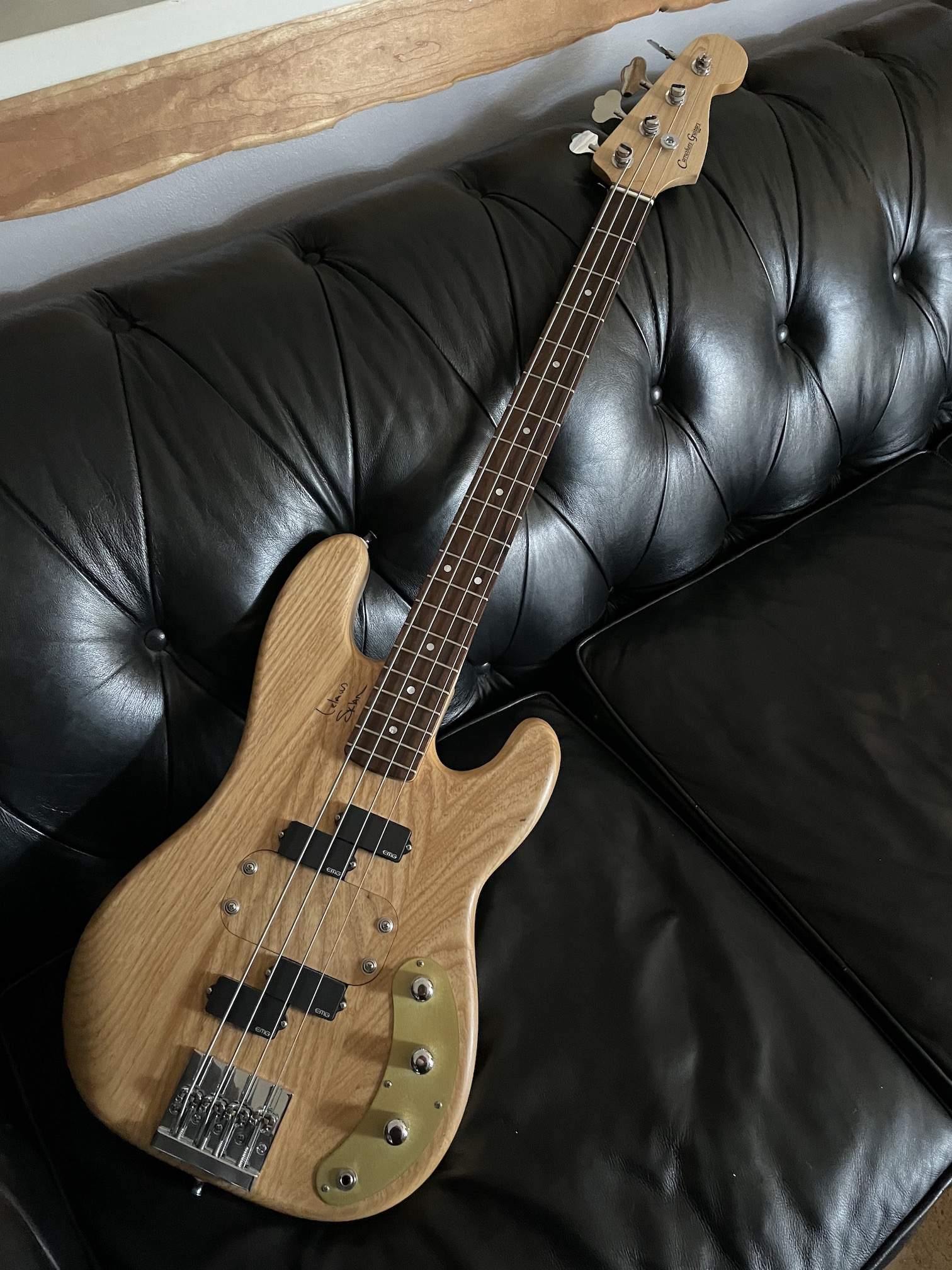
I have relied on John Carruthers since I was 17 years old...and I am old as heck now. I have three of his basses currently, and they span from the 70's to today. All are great, and John has been one of the most influential people in instrument design and construction in the past five decades. Check out this video where I play my oldest Carruthers with the reverse P pickups John pioneered with Lee Sklar. I am playing through a Fender rumble combo that happened to be sitting next to the sofa at Norm's.
Carruthers basses are among the best. John is one of the top bass builders in the world. I have five and been playing them for some 30+ years. The note quality is exceptional and practically everywhere I've played, in and outside the country, people want to know what bass is that you're playing.What is it?
I recently got one of John's new Lee Sklar replica basses, and it is mind blowing! I have one for stock here at the shop too.