• TalkBass has been independent since 1998. Add your voice.
    Create a free account to reply to discussions, view embedded media, and browse with fewer display ads.
    Join freeLog in
    Want zero display ads or expanded classifieds tools? Compare plans.

Anyone Prefer Dead Roundwounds to Flats?

For decades, I went for the bright sound of roundwound strings that I would replace quite frequently. I probably was trying to emulate my rock bass heroes: John Entwhistle, Geddy Lee and Chris Squire.

I really wanted to like flatwound strings due to the playing comfort, plus all the love they receive on TB. I just couldn't get on with the sound, however.

I have been influenced to leave my roundwounds on without changing them for months at a time. My current set may last a year. The darker sound seems to fit the music nicely. Anyone else?
 
Last edited:
Yes, I use "dead" roundwounds a lot. They sit much better in the mix than clanky/zingy/bright roundwounds. It's either "dead" roundwounds or flats for me.

Not all roundwounds are suitable for this though. Some just go REALLY dead.

My favourite "dead" rounds are Pyramid Pure Nickels. They age gracefully like flats and will last for YEARS. I love a "dead" set of Roto66s too, very unique mids.

GHS are the worst for this in my experience, they tend to go DEAD rather than "dead".
 
Try lighter gauge and/or hex core flats. Dead rounds are corroded and foul, won't intonate properly, and by the time they get good and dead, the windings will get flattened and worn through by the frets in fairly short order anyhow.

That thing you're calling the "sound" has to do with the mass of the strings more than anything. It isn't really an e.q. issue (amps and basses have knobs). It's the difference in attack and decay. A lighter string is easier to get going, lighter on the attack, and longer on the decay. A heavier string takes more force to get moving, provides a great burst of energy, and dies off more quickly. That is the classic flatwound thing – not whether or not the strings sound bright or dark (again, amps and basses have knobs). It's a "pluunk" more than a "ka-raaaang." There are several modern flats that are designed specifically to provide the flatwound surface feel, and some of the inherently treble-attenuated tone, while having the attack and decay characteristics of rounds.
 
Last edited:
I tend to prefer older rounds. Not dead, but settled in. I had a set of D’Addario XLs on one bass for over twenty years. I only changed them because they started to feel grody and truly were dead.

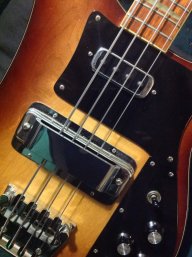
When I was deciding on strings for my Ric fretless, I went through several sets before I settled. The bass came to me with an ancient set of grey tapewounds from back when Ric offered such a thing. They were aurally uncomfortable to me, as if my ears were congested. I tried the Optima reproduction of the old Maxima flats that used to be stock Ric strings, and they weren’t much of an improvement. I might have tried LaBella Copper Whites, too, since I have a set around. I finally settled on some NOS now-discontinued strings that Ric used to make, light-gauge nickel rounds, .040-.095. Much much better, even with the tone dialed back, there is still a presence that was lacking with other strings. That was a few years ago; they’ve mellowed nicely and I feel no need to change them anytime soon.
 
For decades, I went for the bright sound of roundwound strings that I would replace quite frequently. I probably was trying to emulate my rock bass heroes: John Entwhistle, Geddy Lee and Chris Squire.
^^^ Same.
I really wanted to like flatwound strings due to the playing comfort, plus all the love they receive on TB. I just couldn't get on with the sound, however.[/QUOTE]
^^^^ Me 10 years ago

NOW: Ernie Ball Cobalt Flats
 
Last edited:
I don't prefer them over flats, but I use them just as much. I keep a P w old flats and a P w well-worn rounds for this specific reason. I've never felt that old/dead rounds equate flats. It's really two different sounds. For example I'll even use one with old nickel rounds with a foam mute over flats for certain things. The difference between the two is even more evident when playing pickstyle. Live maybe it's a toss up, but for recording . . . totally different, and both useful and yummy.
 
Last edited:
Anyone else?
not exactly...

i don't like the sound of "dead" rounds. although i expect an early/new "zing" version of every set (doesn't last long IMO), they all mellow or adjust for the long haul, and for me, in general: most sets are playable from ~6-18 months (depending on several variables) or thereabouts, and then i'm likely to be tired of the response and i'll change the strings.

i'd make a distinction between "dead round wounds" and "broken-in rounds." i mostly play broken-in rounds --- i try to avoid dead strings.