
Enjoy the benefits of a premium membership!
Upgrade Account
-
TalkBass has been independent since 1998. Add your voice.
Create a free account to reply to discussions, view embedded media, and browse with fewer display ads.
Join free Log in
Want zero display ads or expanded classifieds tools? Compare plans.
You are using an out of date browser. It may not display this or other websites correctly.
You should upgrade or use an alternative browser.
You should upgrade or use an alternative browser.
Anyone try anything like this before?
- Thread starter _Some Dude
- Start date
More options
Who Replied?
Sounds like the problem is the LG's rig / setup. He's gotta be aware that single guitar bands do this all the time....?

I'm in a new band. Mostly two guitars, however the lead singer wants to be able to put his guitar down and focus on singing certain songs.
The other guitarist doesn't like how the band thins out. His tone is pretty bright. It works well in context (two guitars), but with just him it is thin.
I'm thinking about suggesting an A/B box or something that lets him play through both his and the lead singers amp when the lead singer isn't playing.
I don't think I've seen this before, but I can't be the first person that's thought about it?
Thoughts?
The main guitarist should have the full sound while the less important guitarist has the thin sound.
In my band, the lead guitarist plays with the full sound while the rhythm guitarist has a somewhat neutered low end.
However, I think that especially in parts where the lead guitar plays leads or solos, the thinned out guitar and bass work pretty well to fill out the spectrum.
Embrace the different sound. I don’t get why some people are so afraid of space in music. We don’t need every song to be a wall of sound.

FullumMusic
Commercial User
- Oct 13, 2022
- 2,008
- 5,683
- Disclosures
- Audio/Music software developer, contracted with a company you've heard of and deving my own stuff.
It will add volume, but It won't work as well as you think for filling out the "bigness" or "fullness" of two guitars..I'm in a new band. Mostly two guitars, however the lead singer wants to be able to put his guitar down and focus on singing certain songs.
The other guitarist doesn't like how the band thins out. His tone is pretty bright. It works well in context (two guitars), but with just him it is thin.
I'm thinking about suggesting an A/B box or something that lets him play through both his and the lead singers amp when the lead singer isn't playing.
I don't think I've seen this before, but I can't be the first person that's thought about it?
Thoughts?
When two guitars play at the same time, there are slight variations. No matter how locked-in everyone's timing is, each guitarist is hitting the notes and chords a fraction of a second off from each other. The note envelopes are maturing slightly differently over time. The pitches and phases of the two instruments will be ever so slightly off. The tone is slightly different. All these variations between the two guitars are what makes two guitars sound full.
When you run one guitar through two amps, all it's doing is amplifying the exact same signal twice. None of those variations are there. So all it's really doing is making it louder. You might get a little variation if you set the two amps to have completely different tones. But it probably won't work well enough to do what you want, and it will also mess with the mix, because now the guitar is way louder than the other instruments.
-----
Same thing happens when you're recording vocals and you want to fill out the vocal track with duplicate tracks. If you just duplicate the vocal track, you're just doubling the volume (+3dB). It's not doing anything tonally or making anything fuller. It's just louder.
What you need to do is make multiple copies of the vocal track, and nudge them a few milliseconds off from each other. And then pitch shift them ever so lightly out of tune with each other. (And if you really wanted to replicate actual multiple vocal tracks, you'd also automate a 100% wet delay and pitch shifter to have each copy of the vox always changing exactly how many ms early/late and sharp/flat they are. And i'm talking less than 1 millisecond and less than +/-10cents of pitch.
So you'd probably need an FX chain after the AB, going to only one of the amps, that does some kind of extremely fine grained time & pitch modulation, on top of tone differences to really emulate 2 guitars. And you'd probably have to figure out how to lower the volume on both amps whenever both are being used. But it might be a lot of effort and money spent only to find it doesn't really do what you want anyway.
Last edited:

s0c9
Supporting Member
I’ve got a simple solution.
Tell the singer he can’t do that because it won’t work. QED
Tell the singer he can’t do that because it won’t work. QED
It feels like you are spending a lot of energy on something that is very basic, and simple to fix - but working it from the wrong end.
1 - You seem settled into a place where one brand of amp isn't cutting it, so you need a different amp. Incorrect. Any competent guitarist playing any decent guitar will be able to get tones from across the spectrum out of either of these amps. The amp brand is not the issue here, stop chasing it.
2 - You refer to the guitarist as "fantastic." Incorrect. It doesn't matter what finger noodling he can pull off - if he is incapable of managing something as basic as his tone then he's simply not ready for stage work. There are many well-known ways to solve this problem. Maybe he needs to find a more experienced guitarist to talk him through the basics of tone management.
It's great that you are so concerned about your final product, that's an important part of being in a band. But this issue isn't yours to fix - the guitarist needs to step up and learn the basics of being a guitarist.
1 - You seem settled into a place where one brand of amp isn't cutting it, so you need a different amp. Incorrect. Any competent guitarist playing any decent guitar will be able to get tones from across the spectrum out of either of these amps. The amp brand is not the issue here, stop chasing it.
2 - You refer to the guitarist as "fantastic." Incorrect. It doesn't matter what finger noodling he can pull off - if he is incapable of managing something as basic as his tone then he's simply not ready for stage work. There are many well-known ways to solve this problem. Maybe he needs to find a more experienced guitarist to talk him through the basics of tone management.
It's great that you are so concerned about your final product, that's an important part of being in a band. But this issue isn't yours to fix - the guitarist needs to step up and learn the basics of being a guitarist.

The real answer is to have the remaining guitarist fill up the space. Not everyone can do this, it's a different skill playing with another guitar and being the sole guitar. I'd also make my bass parts cover more real estate.
I'd be completely surprised is the guy who stopped playing, if his amp settings will work with the 2nd guy. If you could add only the 1st guy's cabinet only is the only way this might work, but I'm not crazy about the idea. Gonna need a different player to carry everything if No. 2 can't.
I'd be completely surprised is the guy who stopped playing, if his amp settings will work with the 2nd guy. If you could add only the 1st guy's cabinet only is the only way this might work, but I'm not crazy about the idea. Gonna need a different player to carry everything if No. 2 can't.
FullumMusic
Commercial User
- Oct 13, 2022
- 2,008
- 5,683
- Disclosures
- Audio/Music software developer, contracted with a company you've heard of and deving my own stuff.
It seems like if the singer wants to focus on singing and not play guitar, and the guitarist wants a 2-guitar sound, let the singer sing, and get a second guitarist.
It solves both issues and everyone gets what they want and not some overly complicated pseudo-approximation of it.
It solves both issues and everyone gets what they want and not some overly complicated pseudo-approximation of it.
IMO this is why although not for me, what The Edge can do with U2 is so impressive.It seems like if the singer wants to focus on singing and not play guitar, and the guitarist wants a 2-guitar sound, let the singer sing, and get a second guitarist.
It solves both issues and everyone gets what they want and not some overly complicated pseudo-approximation of it.

Not much to add, but I'd definitely +1 on the comments of getting video/audio of the tone and playing it back, and pushing the LG to find a warmer/phatter tone for the trio stuff. And let's be honest, the LG probably has 17 pedals on a board, surely one or two of them can phatten up the sound, right?
I play in a trio, and our guitarist isn't a shredder, but focuses a lot on tone, and it's refreshing. But we still deal with volume/mix issues ocassionally, and I just played him video of our last outdoor gig where the guitar was way too loud out front, so things happen, but we discuss and adjust.
This formula (guitar/bass/drums/vocals) has been done - VH, Cream, Rush, SRV, Mr. Big, Zeppelin, Big Head Todd, Extreme, Living Colour, the list goes on. He should know that Great Lead Tone does not equal Great Rhythm Tone...
I play in a trio, and our guitarist isn't a shredder, but focuses a lot on tone, and it's refreshing. But we still deal with volume/mix issues ocassionally, and I just played him video of our last outdoor gig where the guitar was way too loud out front, so things happen, but we discuss and adjust.
This formula (guitar/bass/drums/vocals) has been done - VH, Cream, Rush, SRV, Mr. Big, Zeppelin, Big Head Todd, Extreme, Living Colour, the list goes on. He should know that Great Lead Tone does not equal Great Rhythm Tone...
Last edited:
I'd say NO on this. I'm not aware of guitar amps or "solution boxes" that will easily allow one person to plug into a guitar amp and play it, and also allows another person somewhere else to easily and seamlessly send signal to that same amp from another amp. Or whatever to accomplish your idea. Why? You potentially get into two issues: Phase cancellation of amps/sounds, and ground loops from power supply issues. There are boxes that are designed to address the phase cancellation and ground loop issues, but I'm not aware of one that does those two things and also addresses two players playing the same amp or two players sending two different signals to the same amp. It may "absolutely" be able to be accomplished but it's going to take a lot of work and opens up more cans of worms and contingencies than are easily solved.I'm in a new band. Mostly two guitars, however the lead singer wants to be able to put his guitar down and focus on singing certain songs.
The other guitarist doesn't like how the band thins out. His tone is pretty bright. It works well in context (two guitars), but with just him it is thin.
I'm thinking about suggesting an A/B box or something that lets him play through both his and the lead singers amp when the lead singer isn't playing.
I don't think I've seen this before, but I can't be the first person that's thought about it?
Thoughts?
My suggestion is leave it in the guitarist's hand's to thicken their tone if they have to- a world of pedals can do that, and/or the lead singer needs to stay playing guitar and get better/more comfortable at it- a very valuable skill set.

Now that the thread has slowed down a bit, I'm going to thank you guys. You gave me a bunch to think about it, and I'll bring some ideas to the rest of the band to discuss how we want to move forward. One thing I like about this sub-forum is that you're more practical than other places, so I tend to get better advice.
All our rehearsals are recorded (audio and video), and we usually review them afterwards. Problem is it's a really dry mix straight off the soundboard, so it was interesting to hear cellphone footage of what FOH sounded like. We're also only 3 or 4 rehearsals in, so there's a lot of development that still needs to happen.
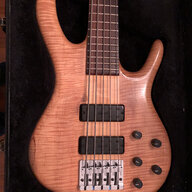
We did get cellphone footage of a few songs from the first gig, which I've just listened to again after re-reading this thread, and it confirms what the soundman told me... the guitar is thin and there's an empty spot in the mix. It's particularly pronounced when I use my 5 string (with DCs), whereas my 4 string (PJ) fills up quite a bit more space. I'm going to keep that in mind going forward.
I've put a fork in the idea of having the guitarist run through both amps. I'm going to approach this as an EQ thing, and I'm going to suggest we do a bit more trio stuff to get his sound dialled in better without the second guitar. I think it'll also give him a chance to develop his playing without a second guitarist, since he'll need to learn how to fill up more space.
Personally, I don't want the lead singer on the guitar full time. I like when a singer can move around and engage the crowd more, which he can't do if he's tied to a mic stand. If anything, I'd like to do a bit more trio work to free the singer up more, but that's something we'll discuss as a band.
All our rehearsals are recorded (audio and video), and we usually review them afterwards. Problem is it's a really dry mix straight off the soundboard, so it was interesting to hear cellphone footage of what FOH sounded like. We're also only 3 or 4 rehearsals in, so there's a lot of development that still needs to happen.
We did get cellphone footage of a few songs from the first gig, which I've just listened to again after re-reading this thread, and it confirms what the soundman told me... the guitar is thin and there's an empty spot in the mix. It's particularly pronounced when I use my 5 string (with DCs), whereas my 4 string (PJ) fills up quite a bit more space. I'm going to keep that in mind going forward.
I've put a fork in the idea of having the guitarist run through both amps. I'm going to approach this as an EQ thing, and I'm going to suggest we do a bit more trio stuff to get his sound dialled in better without the second guitar. I think it'll also give him a chance to develop his playing without a second guitarist, since he'll need to learn how to fill up more space.
Personally, I don't want the lead singer on the guitar full time. I like when a singer can move around and engage the crowd more, which he can't do if he's tied to a mic stand. If anything, I'd like to do a bit more trio work to free the singer up more, but that's something we'll discuss as a band.
I think you have a great head on your shoulders.I'm going to approach this as an EQ thing, and I'm going to suggest we do a bit more trio stuff to get his sound dialled in better without the second guitar. I think it'll also give him a chance to develop his playing without a second guitarist, since he'll need to learn how to fill up more space.
If you’re not a manager and or a parent, you should consider becoming one, lol!
How many times have we all seen / heard guitar and yes bass players completely change their rigs and yet always make it sound the the same as before.40+ year gigging guitarist here. Yeah, sorry about that LOL.
From my own experience both working with other knucklehead guitarists and being the source of the problem myself at times, I'm not going to sugar coat it.
Changing amps isn't going to make any difference.
I've owned and gigged through Mesas and Marshalls of all stripes. It doesn't matter - they've all been capable of being extremely bright.
Or extremely warm.
FWIW, common (mis)perception would have the Marshall equivalent sounding brighter, not without warrant, though it doesn't always happen that way.
It's not the tool, it's the carpenter. Or how the carpenter holds the tool. If your guitarist cannot make EQ adjustments with his own amp, you've got a problem that won't go away by having him play through someone else's.
Start by asking him to use a super long, 30', preferably 50', instrument cable or better yet, a wireless rig to go out in the room and hear how he really sounds in the mix rather than relying on his vantage point with the amp blasting the back of his legs. If he won't or can't do that, stick a Zoom recorder mic about 30' in front of the band and listen to the playback together.
If that doesn't bring about desired change, then there's probably nothing else that will; Your BL might start asking around for an available replacement, someone willing to make adjustments in his or her sound that benefit the whole band's mix.
And if you guys end up having to go down the replacement road, don't rule out women guitarists; Generally, they seem to catch on to the concept quicker than guys. I really didn't start getting more appropriate-for-the-mix guitar tone until after I started taking advice from women on the matter. I truly believe they hear things better than we do.
My theory for some is the sound they first got when starting to play never really changes as they somehow use that for a reference forever,
FullumMusic
Commercial User
- Oct 13, 2022
- 2,008
- 5,683
- Disclosures
- Audio/Music software developer, contracted with a company you've heard of and deving my own stuff.
Hehehe. U2: the greatest band i never want to listen to.IMO this is why although not for me, what The Edge can do with U2 is so impressive.

But absolutely, what you're saying. Being able to make 1 bass & 1 guitar sound huge is a skill unto itself, for both the bassist and guitarist. Adjusting what they play and how they play it to the context of the band so that it still sounds full and like a song is a skill & knowledge base. Knowing they need to solo and play differently in a 3 piece vs 4 or 5 piece.
Speaks to the abilities of Kurt Cobain too. People rag on him for his lack of virtuosity. But he could play EVH lines. He just didn't. And when Nirvana was a 3 piece they still sounded HUGE live. And it's also why he brought in Pat Smear's extra guitar, to fill in some space and allow him the freedom to play differently. He knew how to play it both ways and keep things big and full.
The Edge is also rolling tons of guitar effects to fill out the sound. Well-known enough for them to appear in a documentary about guitar effects. Using effects well is also a skill, it doesn't take away from his playing at all.Being able to make 1 bass & 1 guitar sound huge is a skill unto itself, for both the bassist and guitarist. Adjusting what they play and how they play it to the context of the band so that it still sounds full and like a song is a skill & knowledge base.

I usually only use my drive on about 5-10 songs. I have it set for a thick medium drive level. My preamp is set for just slight drive to have the touch sensitive thing a bit for my always on tone.
We have had a few instances where one of our guitar players couldn’t make a show. In those instances I would just run my drive always on and it does a good job of filling out the sound.
We have had a few instances where one of our guitar players couldn’t make a show. In those instances I would just run my drive always on and it does a good job of filling out the sound.


