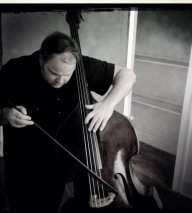
As a German bow player, when I have a fast change to pizz, I "drop" the bow with all but my ring finger, and let the bow hang from it. My German bow hold has the third finger inside the throat of the frog so I do not need to reposition anything to make that happen, and you can actually turn your wrist a bit and slightly "throw" it in that direction if gravity isn't getting it out of the way fast enough. To switch back to arco, I swing the bow back to horizontal on that finger. The advantage being that all of your fingers are in a position where they don't have to move much to get from a pizz position to an arco position. This likely looks pretty similar to your first photo, but I can't really tell what's happening with the bow in that position.
The second horizontal option seems like the least efficient option. While it may work on French bow, with the length of the German button I don't see how you could get your thumb back to an arco playing position quickly, which is the issue we are trying to address. The same holds true for the bow facing upwards, your thumb has a lot of distance to travel in order to get back to where it needs to be. You are also working against gravity to get the bow up there in the first place, which doesn't seem like a quick thing to do.
I will occasionally catch the first pizz in a fast change with my thumb on an "up" stroke when I am switching to the position I was describing earlier. The bow still goes to to the same place in your hand, but as it is getting there you can stick your thumb out to grab a note before you plant it and pizz with your preferred finger(s). Other less desirable solutions involve a left hand pizz which is most successful on open strings but can be achieved with the 3rd and/or 4th finger(s) while stopping a note with your 1st finger, shortening an arco whole note enough to facilitate the down beat pizz happening on time, or omitting the 4th pizz quarter note to get to an arco.