• TalkBass has been independent since 1998. Add your voice.
    Create a free account to reply to discussions, view embedded media, and browse with fewer display ads.
    Join freeLog in
    Want zero display ads or expanded classifieds tools? Compare plans.

Are 5 strings on the way out?

I bought a Dan Electro doubleneck bass a long time ago. It was a 4/6 string. I used it a few times. It looked cool, sounded great, and it weighed a lot and was unwieldy to play. I sold it after a few months. I wish I still had it for those special occasions, and just because.

Usually the audience gets impressed a lot by double necks because they think that you can play "two times the quantity"
 
  • Like
Reactions: Auspuff and Bobo
4,5, and 6. not in that order. What difference does it really make as long as you're happy?
3peat.jpg
 
While that's true, the only notes you're losing are the 5 highest you'd have on the G string, since most of what is on the G string can be found out the D string, albeit just in different positions. I'd be willing to bed that 95% of bassists won't miss those 5 highest notes. I'd much rather lose them than lose B to Eb by not having a B string.

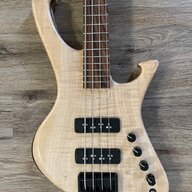
To the point, I don't see 5ers declining. In the cover band scene, I see more 5s than 4s.

I have two five string basses. A Rob Allen tuned g-d-a-e-b, and a Carvin tuned c-g-d-a-e. Both work quite well.

S
 
Seems largely genre dependent. I still see a lot of them in Metal, and in genres where you are adapting to the singer (Modern Country and R&B) so you might end up in funny keys. They seem less prevalent in general rock right now, which seems to be having sort of a throwback period and is a little more vintagey. Personally, I gig a 4 and a 6 (the 6 where I need flexibility, the 4 for most of the set because it's more comfortable)
 
I grew up in a time when 4 string was the only option (the vintage Fender Bass V and Bass VI weren't exactly true basses). It's awesome that bassists have so many options these days: 4, 5, and 6 strings are all easy to find at reasonable prices. Basses with more than 6 strings (non-paired) are also available from multiple manufacturers.

Certain string counts will increase or decrease in popularity, but bass guitar hasn't been a "four stringed instrument" for decades now. Again, that's a good thing.
 
P.S. A bandmate recently asked me "Oh, I see you're playing a 5 string. When did you start doing that?" (Answer: Y2K). This is a trombone player I've been gigging with a few times a year for 14 years, and he plays multiple instruments including guitar and bass. Our band is a 60's/70's classic rock/R&B band, so I took his question as a great compliment. I frequently play the low B string in that band, but usually above the 5th fret... I try to be careful with notes below low D in that band. So, in this case it was good that he was unaware that I was a 5-string guy.


In the 'bone player's defense, the horn section of this band takes the front of the stage, while guitar, bass, and drums are behind. Also, I play Fender-style/Precision-style fivers as opposed to fancy boutiques: even musicians see the P-bass shape and automatically assume 4 strings.
 
Last edited: