

Enjoy the benefits of a premium membership!
Upgrade Account
-
TalkBass has been independent since 1998. Add your voice.
Create a free account to reply to discussions, view embedded media, and browse with fewer display ads.
Join free Log in
Want zero display ads or expanded classifieds tools? Compare plans.
You are using an out of date browser. It may not display this or other websites correctly.
You should upgrade or use an alternative browser.
You should upgrade or use an alternative browser.
Are there any "timeless" basses?
- Thread starter Just Wrong
- Start date
More options
Who Replied?

Where did you get your data about this domianance you speak of? IAlso there is a whole wild /wide world

It's funny, Guy Pratt mentioned in an SBL video that he thought the Spector NS-2 was "of a time" (dated) in comparison to, say, his Betsy Jazz bass.
For me, Spector still makes my favorite basses, but it's true that the Jazz was en vogue before that era and after that era... a Jazz and a Precision will be timeless as long as electric bass matters.
So I agree that the Jazz and P-Bass are timeless, and I can't think of a ton of others. Maybe a Ric??
For me, Spector still makes my favorite basses, but it's true that the Jazz was en vogue before that era and after that era... a Jazz and a Precision will be timeless as long as electric bass matters.
So I agree that the Jazz and P-Bass are timeless, and I can't think of a ton of others. Maybe a Ric??

Sabres are magic. That’s a solid fact.I consider my fretless '79 Sabre to be timeless, but that's more about my playing than anything else. Kidding aside, while it's very much of its time, its tone is timeless for me.
But yeah, Fender Ps and Js would seem to define timelessness for basses to me. They're ubiquitous and while they've fallen into and out of fashion, from an industry standpoint, they're simply bedrock first-principles instruments.
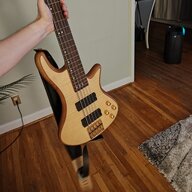
I think it's partially a generational thing. I think the test is this: if you ask someone to name the most iconic non-fender bass you will get different answers based on age and musical taste. I see a lot of TBers say Ric or Hofner. I would say a Spector, other people my age might say EBMM, Warwick or even Ken Smith or MTD. Some younger players might even say Ibanez.It's funny, Guy Pratt mentioned in an SBL video that he thought the Spector NS-2 was "of a time" (dated) in comparison to, say, his Betsy Jazz bass.
For me, Spector still makes my favorite basses, but it's true that the Jazz was en vogue before that era and after that era... a Jazz and a Precision will be timeless as long as electric bass matters.
So I agree that the Jazz and P-Bass are timeless, and I can't think of a ton of others. Maybe a Ric??
But if you ask anyone of any age to name the most iconic bass without the "non-fender" qualifier you're going to get one of two answers...
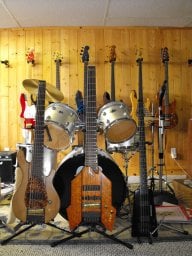
I think Rics have to be on the timeless list, probably even number 2 after the Precision, especially in the rock bassist's world. Many companies would make a Ric clone if they weren't afraid of being sued into oblivion.

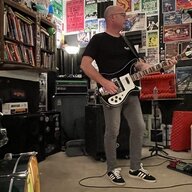
To me timeless means you can look at random footage of any random live performance from just about any decade since electric guitars and basses became a thing, and the instrument wouldn’t look out of place. So, what’s that, Fenders, Ricks, Gibsons, Martins?

“Timeless” implies that it didn’t look (or sound) out of place in any decade since the electric bass gained poularity.
Basses that satisfy this condition must have been around since the early 60s, and still be popular in a wide range of musical styles.
By this logic, your friend is right about the Fender Jazz and Precision Bass.
Basses that satisfy this condition must have been around since the early 60s, and still be popular in a wide range of musical styles.
By this logic, your friend is right about the Fender Jazz and Precision Bass.

I will answer in a dfferent key, giving you friends a "side example", ok? So, I definitely am a bassplayer, I love playing the bass with my fellow bandmates more than any other hobby. Now, after my divorce I decided to buy THE guitar (six strings), for a pure personal satisfaction. Ok: I already have other guitars that fit my need on occasion (I am a real donky on guitar, mind you!) So, from Ishibashi I ordered myself THE guitar: a used but basically new (mint, I would say) Usa cream white Performer Stratocaster (large headstock, Hendrix style!). THIS is a classic timeless for me. Or maybe a mint original Les Paul, a Tele, a 335. I could have bought any other guitar, even more expensive, but THE go-to guitar, the holy graal for me is that one. Something that will be desired, used, revered also in 50 years from now. So, a good solid Jazz, a Precision, a Stingray will be the bass reference. My 2c.

Very few designs in any field have endured like the P and the J. Even with digital tech, internet and AI, people won’t be trading in their Fenders.
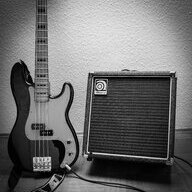
 ...Timeless...
 ...........


I agree.I think this is the first thread where everyone agreed?
T$
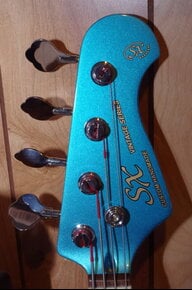
You are right, I i exaggerated its transformation... a little. But, the Les Paul's dropping sales was the reason for Gibson's decision and if it weren't for a new musical style created by a few masterful players it would never have returned in its original form.Not sure the Les Paul transformed into the SG, more they decided to make a totally different guitar and re-used the name. A classic case of misreading the market. But as it never really went away I think timeless with a brief interval
Another example of people's preferences negating the existence of any real "timeless" instruments.


To me, "timeless" suggests consistent dominance,
I'd like to say your username is just right for your definition of timeless.
When you talk about timeless car designs, people will think of things like the Porsche 911 of the 80s, the Ferrari Testarossa, the Mercedes Benz 300SL, the Jaguar E-Type, the Corvette Stingray or the Shelby Cobra (among many others).
None of these cars have ever dominated the streets and many of them are actually quite bad as a car. Just try to daily drive the Testarossa or the E-Type . . .
When you look at furniture, the Throw Away couch or the Eames office chairs are timeless designs, even though none of them are dominating anything.
Timeless means that even while people gravitated towards Steinbergers in the 80s, there were still P basses in use, and after the 80s ended and the fashion switched to Warwicks, there were still P basses in use. Even today, P basses are played around the world, while other trends come and go.
And despite small changes, a modern P bass largely looks the same as a '59 model. A bass expert that has a vast knowledge of Fender would make a case that they are not the same, but anyone else looks at a '59 and then looks at a 2024 model and will say "They're the same bass".
Because they never made a real "icon" bass model, despite the excellent quality of most of their models (no question about this). Same of Ibanez, Yamaha, Ken Smith, Alembic or Sadowsky, just disregarding the price factor, My opinion...Here’s a question- why hasn’t anyone mentioned G&L?

I first saw a Fender bass in 1971, (it was Gorgeous) at stage band practice, for every other musical group before that for 6 years, all acoustic, there were no fender basses including the local civic symphony, church with full Baroque organ, concert hall. Without the fragile power grid that thing is firewood. There are few instruments as associated with a specific and very finite time than bass guitar...There has never been a time when showing up with a Fender was a problem or lost you a gig. That seems pretty timeless to me
Timelessness is such a squirrely* concept that arguing about it seems to be the most foolhardy enterprise possible. A timeless ridiculous argument.
* meaning, too subjective, a semantic exercise only, meaning whatever you want it to mean. I find it's used the most in advertising copy, a way to magically elevate the opinion of something, make exciting or noteworthy. So it's usually used for bull-ticki, and is a red flag.

While I agree with what you posted, a little more context may be useful. As a long time player of PBs with thousands of gigs, countless rehearsals, hundreds of recording sessions under my belt, dealing with hundreds of sound engineers or soundmen over the years. and exclusively using round wound strings since 1977, I have never had a complaint, or even a suggestion to change my tone and or bass. Pretty much I’ve covered every genre with the exception of death metal, zip, zero negative comments as it was always spot on the money.I've been debating with a friend about whether any basses can truly be considered "timeless." He argues that the Fender Precision and Jazz fit the bill, but I disagree for several reasons.
To me, "timeless" suggests consistent dominance, but while the Precision and Jazz have always been in use, they haven’t always been the go-to choices. In the '80s, bassists gravitated toward StingRays, Steinbergers and Spectors. The '90s saw Warwicks take centre stage. These shifts suggest that bass trends come and go. The Precision with flatwound strings defined the '60s, but by the '70s and '80s, it had largely faded. It has made a resurgence, but will it still be everywhere in 2035? I have my doubts.
Another factor is how much the Precision and Jazz have evolved over the years. Yes, the core designs remain similar, but countless changes have been made—pickups, neck profiles, fretboard radius, tuners, bridges, preamps and more. My friend noted that David Gilmour primarily played Strats throughout his career, but even he made significant modifications—like switching to EMG pickups in the '80s—which drastically changed the instrument's character. A heavily modified Strat is hardly the same as a '60s model with single-coil pickups.
In that sense, I struggle to call anything physical "timeless." Stories, art, and music? Maybe. But basses? I’m not so sure.
What do you think?
I can’t explain timeless any other way.


