• TalkBass has been independent since 1998. Add your voice.
    Create a free account to reply to discussions, view embedded media, and browse with fewer display ads.
    Join freeLog in
    Want zero display ads or expanded classifieds tools? Compare plans.

Are there any "timeless" basses?

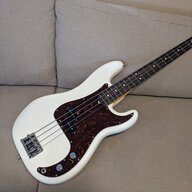
I've been debating with a friend about whether any basses can truly be considered "timeless." He argues that the Fender Precision and Jazz fit the bill, but I disagree for several reasons.

To me, "timeless" suggests consistent dominance, but while the Precision and Jazz have always been in use, they haven’t always been the go-to choices. In the '80s, bassists gravitated toward StingRays, Steinbergers and Spectors. The '90s saw Warwicks take centre stage. These shifts suggest that bass trends come and go. The Precision with flatwound strings defined the '60s, but by the '70s and '80s, it had largely faded. It has made a resurgence, but will it still be everywhere in 2035? I have my doubts.

Another factor is how much the Precision and Jazz have evolved over the years. Yes, the core designs remain similar, but countless changes have been made—pickups, neck profiles, fretboard radius, tuners, bridges, preamps and more. My friend noted that David Gilmour primarily played Strats throughout his career, but even he made significant modifications—like switching to EMG pickups in the '80s—which drastically changed the instrument's character. A heavily modified Strat is hardly the same as a '60s model with single-coil pickups.

In that sense, I struggle to call anything physical "timeless." Stories, art, and music? Maybe. But basses? I’m not so sure.

What do you think?
Your friend is right.
 
Yep !

1739405155520.jpeg
 
But see, this is my second point. If the 1962 Precision was "timeless," why would it have needed a badass bridge, a Dimarzio pickup and a brass nut?
It doesn’t. TalkBass is a very skewed view of the bass world. In the real world, most people don’t modify their basses.

The answer to your question is that basses DON’T need a badass bridge, Dimarzio pickups or brass nuts.
 
Blue Jeans are timeless. Yet they have changed. Button fly, zip fly, high rise, low rise, holes in the knees. Yet they are all still Blue Jeans.

Same with the Fender P and J basses. There have been variations but none of them caused them to cease to be a P or a J in their basic essence.

Music Man, Alembic, Warwick, Kubicki, Ibanez, Smith and many others have made basses but none have become as dominant for as long as the good ole P or J.
 
  • Like
Reactions: FRoss6788
+1 on the overall sentiment that when people think bass guitar, they think Fender or Fender style bass akin to the P or J. Musicians in all styles of music and in all generations/age groups use or have Fenders. Yes, there are plenty of exceptions to the rule, but by and large, the majority of musicians out there use a P/P-style or J/J-style bass.

Of course, at least in my own experience gigging, touring, attending shows, etc., I've found that Ibanez Soundgear basses are just as ubiquitous as Fenders or FSOs (Fender Shaped Objects) but they don't capture that same reverence that the iconic Fenders do (even if other companies "do Fender better than Fender.") No one covets a Soundgear they way they covet a Fender. Rib13 said in a video that because Soundgear is more of a platform than a model, it lends itself to the way Ibanez' designers experiment and push bass design forward. It's almost future-proof to an extent.

Perhaps Fender P and J basses along with Ibanez Soundgears are "timeless" in different ways.
 
  • Like
Reactions: Bassdirty
Not only are the Precision and Jazz timeless, you can add the other instruments that came out of Fender - and Gibson - in the 50s to the timeless list. Tele, Strat, Les Paul, 335, all still here and with loads of clones.
I would ALMOST agree with you, but the fact that the Les Paul was discontinued for a time, not to mention its transformation into the SG, makes me not count that one. It is Classic, but not Timeless.
 
  • Like
Reactions: Pdaddy1978
I think your friend is right about the Fenders.
This.

OP can find a very cheap fender knockoff or a very expensive fender knockoff, or any number of Fender's lines past and present in pawn shops and music stores darn near anywhere. Any place they go to that's had live music has similarly had some dude in it with one of those Ps or Js, genuine or knockoff. It's been like that for decades now, and I've seen it in places that aren't NA too.

I think OP either needs to eat his words on this or they and their buddy need to operationalize the meaning of the word timeless - because if that kind of proliferation doesn't help l qualify I'm not sure how to help them.
 
  • Like
Reactions: FRoss6788
I would ALMOST agree with you, but the fact that the Les Paul was discontinued for a time, not to mention its transformation into the SG, makes me not count that one. It is Classic, but not Timeless.

Not sure the Les Paul transformed into the SG, more they decided to make a totally different guitar and re-used the name. A classic case of misreading the market. But as it never really went away I think timeless with a brief interval :)
 
I've been debating with a friend about whether any basses can truly be considered "timeless." He argues that the Fender Precision and Jazz fit the bill, but I disagree for several reasons.

To me, "timeless" suggests consistent dominance, but while the Precision and Jazz have always been in use, they haven’t always been the go-to choices. In the '80s, bassists gravitated toward StingRays, Steinbergers and Spectors. The '90s saw Warwicks take centre stage. These shifts suggest that bass trends come and go. The Precision with flatwound strings defined the '60s, but by the '70s and '80s, it had largely faded. It has made a resurgence, but will it still be everywhere in 2035? I have my doubts.

Another factor is how much the Precision and Jazz have evolved over the years. Yes, the core designs remain similar, but countless changes have been made—pickups, neck profiles, fretboard radius, tuners, bridges, preamps and more. My friend noted that David Gilmour primarily played Strats throughout his career, but even he made significant modifications—like switching to EMG pickups in the '80s—which drastically changed the instrument's character. A heavily modified Strat is hardly the same as a '60s model with single-coil pickups.

In that sense, I struggle to call anything physical "timeless." Stories, art, and music? Maybe. But basses? I’m not so sure.

What do you think?
Just as an FYI for you about your go-to basses for the '80's - I worked at Apple Music in Portland, OR, which was a very large privately owned music store in 1985 while I went back to college for computer sci. We had about 75 Jazz and P-basses in the shop at any one time. Had no Stingrays. We did have a couple of Steinbergers, but no Spectors. We also had an Alembic bass there as well as the Aria line. Also had Peavey basses and amps. A lot of folks loved the Alembic but bought the Aria Pro II because Alembic was way beyond their price range, and the Aria Pro II was a "active" bass. Active basses were becoming "the thing" in 1985. Fender was still king of the hill in 1985 even though that was a very confusing time for them as CBS divested themselves of Fender in March of 1985.

Also, I'd say despite the various changes that have been made with the Jazz and the P-bass over the years, both designs are timeless they are both instantly recognizable. I say that even though it took me almost 10-years to find a Jazz bass with the same shape, profile, and radius neck that had been on my '65 Jazz Bass. I bought my 1965 Jazz in 1966; played it throughout high school, some college, toured with it for 3 years playing approx. 750 performances; and then played weekend gigs after that until all my touring gear was stolen in 1976. I had checked out hundreds of Jazz Basses by 1985 when I bought my current Jazz.

Also, I think the design is timeless because so many other manufacturers such as Lakland, Sadowsky. Sire and even Dingwall, to name a few, make versions of them. Just my opinion of course and I am definitely Jazz Bass biased, having played Jazz Basses since 1966.
 
@M-Mittlesteadt quoted a definition of "timeless" from Google: "not affected by the passage of time or changes in fashion."

I should've started with the definition. And if we do start there, I can't agree that the Fender Precision and Jazz weren't "affected by the passage of time or changes in fashion": Preamps, slimmer necks, straighter fretboards, different neck sizes, the new heels, lighter tuners, higher output pickups, different pickup voicing, etc.
You're really grasping now. The early P basses are so coveted that people pay crazy amounts of money for them. Those who can't afford the real thing can buy what is essentially the same brand new. Aside from all of the variants that fit the needs of many, the original specs are still made and sold in large numbers.
 

Latest posts