
Enjoy the benefits of a premium membership!
Upgrade Account
-
TalkBass has been independent since 1998. Add your voice.
Create a free account to reply to discussions, view embedded media, and browse with fewer display ads.
Join free Log in
Want zero display ads or expanded classifieds tools? Compare plans.
You are using an out of date browser. It may not display this or other websites correctly.
You should upgrade or use an alternative browser.
You should upgrade or use an alternative browser.
Are two 12 as loud as four 10's?
- Thread starter HMZ
- Start date
More options
Who Replied?I love pi. Apple or Peach oh my.
Hijacked thread alert. Okay I can play through two QSC 1000 watt amps and 2x12 and a 4x10 after eating blueberry pie. I love the tone.
Will that do?
Hijacked thread alert. Okay I can play through two QSC 1000 watt amps and 2x12 and a 4x10 after eating blueberry pie. I love the tone.
Will that do?
Wouldn't frequency response come into play? If a 2X12 cab has better low end, wouldn't that cut through better in a band setting? If a 4X10 is more focused in the midrange, wouldn't there be some competing with guitars?

- Dec 18, 2000
- 13,201
- 340
- Disclosures
- greenboy designs: fEARful, bassic, dually, crazy88 etc
Wouldn't frequency response come into play? If a 2X12 cab has better low end, wouldn't that cut through better in a band setting? If a 4X10 is more focused in the midrange, wouldn't there be some competing with guitars?
Depends on the mix, depends on the guitars' amps and tone/settings.
But if you compare say Avatar 410 and 212, with their OEM Deltalite drivers, you'll find that though the 212 reaches a little lower, as volumes rise its drivers run out of xmax fairly early and limit how much low SPL it can produce anyway. The Deltalite 10" drivers also run out at about the same place, but since there are four of them and with similar sensitivity, if it's broadband SPL you are after, the 410 may be a better choice, tonal considerations withstanding.
billfitzmaurice
Commercial User
- Sep 15, 2004
- 16,860
- 278
- 76
- Disclosures
- Owner, Bill Fitzmaurice Loudspeaker Design
The answer to the question is that there is no answer. Reason: insufficient data. It's like asking which will go faster, a motorcycle with two twenty inch tires or an automobile with four fifteen inch tires. Where output is concerned the size and quantity of drivers being used is one of the least significant factors.

alexclaber
Commercial User
Really useful graph this, A9X:
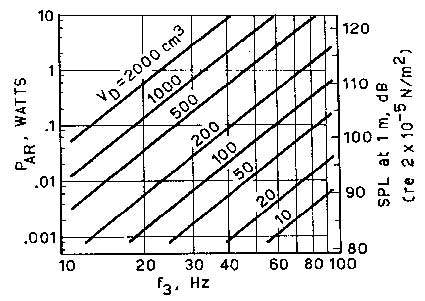
Ignoring the port contribution (which could typically add about another 3dB) an Acme 4x10" has a Vd of ~1100cc, an Ampeg 8x10" has a Vd of ~800cc, an Epifani UL 4x10" has a Vd of about ~600cc.
Alex
Ignoring the port contribution (which could typically add about another 3dB) an Acme 4x10" has a Vd of ~1100cc, an Ampeg 8x10" has a Vd of ~800cc, an Epifani UL 4x10" has a Vd of about ~600cc.
Alex
- Dec 18, 2000
- 13,201
- 340
- Disclosures
- greenboy designs: fEARful, bassic, dually, crazy88 etc

The short answer is, the winner is determined entirely by which driver is more sensitive.
Let's use the 2510 and 2512 Deltalite drivers for examples.
Reading the data sheets, the 2512 is 1dB more sensitive in the 100 ~ 200 Hz range.
1x10=94 SPL at 100 Hz
1x12=95 SPL at 100 Hz
For example, we will select 100 Hz at 2.83v and do the math:
2x12 in parallel=101 SPL
+3 for doubled cone area, +3 for parallel wiring = +6dB more than 1 driver
95+6=101
4x10 in series/parallel=100 SPL
Group of Two in parallel = +3 for doubled cone area, +3 for parallel wiring = = +6dB more than 1 driver
Two Groups in series = +3 for doubled cone area, -3 for series wiring = 0 change
94+6+0=100
At the same input voltage (volume control setting), a parallel 2x has no loudness advantage or disadvantage over a series-parallel 4x using the same drivers. Both are +6dB louder than the single driver. The 4x will handle a higher input voltage (more power) than the 2x, and produces more noise as a consequence.
Let's use the 2510 and 2512 Deltalite drivers for examples.
Reading the data sheets, the 2512 is 1dB more sensitive in the 100 ~ 200 Hz range.
1x10=94 SPL at 100 Hz
1x12=95 SPL at 100 Hz
For example, we will select 100 Hz at 2.83v and do the math:
2x12 in parallel=101 SPL
+3 for doubled cone area, +3 for parallel wiring = +6dB more than 1 driver
95+6=101
4x10 in series/parallel=100 SPL
Group of Two in parallel = +3 for doubled cone area, +3 for parallel wiring = = +6dB more than 1 driver
Two Groups in series = +3 for doubled cone area, -3 for series wiring = 0 change
94+6+0=100
At the same input voltage (volume control setting), a parallel 2x has no loudness advantage or disadvantage over a series-parallel 4x using the same drivers. Both are +6dB louder than the single driver. The 4x will handle a higher input voltage (more power) than the 2x, and produces more noise as a consequence.

The size given for drivers, is for the hole speaker, not the cone. I don't have any tens handy but squinting through the grill; my Eden 12 looks to have a 10" cone. Assuming tens loose the same two inches: 4X10=201 square inches, 2X12=157 square inches. So, the 12s give up ~30 percent in area. Then there's the previously mentioned X-max.
Greater surface area means lower frequency ability. Speakers placed close together, act like one big speaker. So, possibly another thing in favor of 4X10.
Forget theory. Try them in a real word situation, and listen.
Ugh, I'm keeping my 2X15.
Greater surface area means lower frequency ability. Speakers placed close together, act like one big speaker. So, possibly another thing in favor of 4X10.
Forget theory. Try them in a real word situation, and listen.
Ugh, I'm keeping my 2X15.
- Dec 18, 2000
- 13,201
- 340
- Disclosures
- greenboy designs: fEARful, bassic, dually, crazy88 etc
The size given for drivers, is for the hole speaker, not the cone.
Not so. Sd is the figure for the actual speaking cone - and you might also note that it is not flat, it's roughly conical.
Greater surface area means lower frequency ability
Not so; not a given.
Forget theory. Try them in a real word situation, and listen.
Every time someone says theory in this context it's almost as if they don't think it's tested out in gazillions of cases, and so far hasn't had holes punched in it. Driver designers don't disparage theory - it's how they work toward audible results.

Jazzdogg
Less barking, more wagging!
Not so. Sd is the figure for the actual speaking cone - and you might also note that it is not flat, it's roughly conical.
Not so; not a given.
Every time someone says theory in this context it's almost as if they don't think it's tested out in gazillions of cases, and so far hasn't had holes punched in it. Driver designers don't disparage theory - it's how they work toward audible results.
Gee, I always thought "Forget theory," really meant "I have a strong emotional need to win this argument, but I'm not qualified to discuss these issues rationally."


In like designs, 4x10 is very slightly louder, but the tone difference would be the bigger issue. The 2x12 will weigh much less.



In the real world, out there in the gigging trenches a pair of 2x10's is a great flexible setup. In my experience a pair of 12's won't keep up from a volume stand point. This assumes you power at hand to drive them of course.
Stack 'em vertiaclly and you get really good stage monitoring. Split 'em to each side of the drummer and keep the over all volume down on large stages works as well.
Small gig - leave one in the truck.
Stack 'em vertiaclly and you get really good stage monitoring. Split 'em to each side of the drummer and keep the over all volume down on large stages works as well.
Small gig - leave one in the truck.
Der. It's just a factor, which can be over-riden by other factors, such as the ones I mentioned.Not so; not a given.
Every time someone says theory in this context it's almost as if they don't think it's tested out in gazillions of cases, and so far hasn't had holes punched in it. Driver designers don't disparage theory - it's how they work toward audible results.
And then test them in the real world. Anyways I'm not saying cab engineers should forget theory. But that bass players shouldn't worry so much about theory, and just listen with their ears. Not the marketing hype, not the driver size/number...
alexclaber
Commercial User
But that bass players shouldn't worry so much about theory, and just listen with their ears. Not the marketing hype, not the driver size/number...
Marketing hype and driver size/number are not theory. T/S parameters, cab volume and tuning, and correctly measured response plots are the combination of theory and measurement that actually mean something. From my knowledge of theory I can instantly discount ~95% of cabs as not worth me listening to if I were considering an upgrade. Then the ~5% whose real specs (not bs marketing specs) pass muster can be auditioned.
Alex

alexclaber
Commercial User
And a single Kappalite 3015LF has a displacement of ~846 cm³.
With the 50Hz tuning and large cab volume when loaded in a Omni 15TB the 3015LF has to be near unbeatable when it comes to high SPL lows.
Alex

Very good.i don't care for ether. i'm a codiene kinda guy.

I just did a A/B side by side comparison and they are both silent. Its a tie folks. Without anything pushing them, they are both pretty quiet.


